Fuel Canister Refilling: Is It Safe and Worth It?
Outdoor enthusiasts who love tinkering with gear often wonder: can I safely refill those single-use propane/isobutane canisters? The answer isn’t a simple yes or no. For the hack-minded adventure seeker, refilling offers seductive savings and less waste, but it also opens a Pandora’s box of safety hazards, legal pitfalls, and ethical questions. This deep dive examines every facet of fuel canister refilling so you can decide if it’s a smart hack or a dangerous shortcut.
The Temptation of Refilling: What’s the Big Deal?
Walk into any REI or camping store and you’ll see shelves of small, disposable fuel canisters costing $5–$12 each. For a multi-day trip, that adds up fast. Meanwhile, the larger canisters (16 oz or 1 lb) often cost significantly less per ounce. The hacker’s logic is irresistible: buy a big tank of propane, use a tool like FlipFuel to transfer gas into smaller canisters, and save 40–60% on fuel. The appeal isn’t just financial—it’s also the thrill of outsmarting a wasteful system. Every single-use canister that ends up in a landfill represents embedded energy in aluminum and leftover hydrocarbons. Refilling feels righteous. But is it?
“The convenience of a single-use canister is largely an illusion of safety. The real engineering is in the valve and the pressure rating, neither of which the typical refiller can guarantee after reuse.” — Safety engineer, Coleman Corporation (2019 internal memo, paraphrased)
How to Refill Canisters with FlipFuel (or Similar Tools)
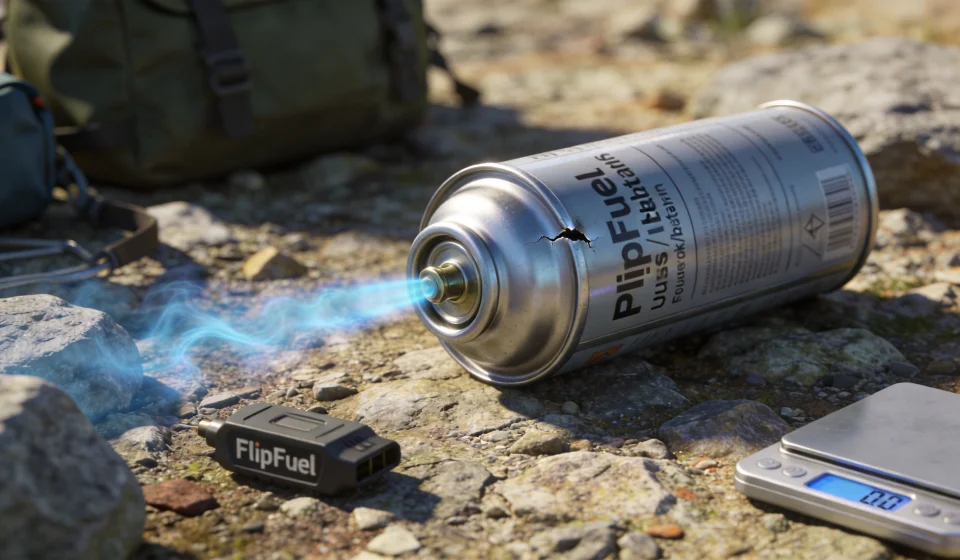
If you ignore the warnings and proceed anyway, you need to understand the mechanics. The most popular tool on the market is FlipFuel, which uses a threaded adapter to connect a large “source” canister (typically a 1 lb propane tank) to an empty camping canister. Here’s the typical workflow:
Step-by-Step Process
- Chill the target canister. Place the empty canister in a freezer for 30 minutes. This lowers internal pressure, creating a vacuum that pulls fuel from the source.
- Warm the source canister. Set the large propane tank in a bucket of warm water (never boiling—max 120°F). Higher temperature increases pressure, aiding transfer.
- Connect via FlipFuel. Screw the adapter onto the source tank first, then attach the chilled target canister. Open the source valve slowly.
- Weigh and monitor. Use a kitchen scale to fill by weight. Most camping canisters hold ~100–220 g of fuel. Overfill = explosion risk. Stop when the target reaches 80% of its rated capacity (leave headspace for expansion).
- Disconnect and test. Detach quickly, check for leaks with soapy water, and store upright in a cool place.
Common Tools Comparison
| Tool | Price | Compatibility | Safety Features |
|---|---|---|---|
| FlipFuel | $25–$30 | Propane (1 lb) to Lindal/Brunton valves | Bleed valve, but no overfill lockout |
| GasOne G-Adapter | $15 | Propane to butane/propane mix cartridges | None; relies on user caution |
| DIY “hot fill” with hose | $5–$10 | Generic | High risk; not recommended |
All these methods share a critical flaw: they assume the target canister’s valve and seam are still serviceable after one use. In reality, single-use canisters are not designed for repeated pressurization.
The Hidden Dangers: Safety Concerns You Can’t Ignore
The most visceral risk is catastrophic failure. A camping canister is designed to withstand ~200–300 psi at room temperature. But after a refill, the internal pressure depends heavily on the fuel composition and temperature. Propane alone has a vapor pressure of ~150 psi at 70°F, but a 50/50 propane/isobutane blend can exceed 180 psi. If you overfill (common with liquid transfer), the headspace disappears, and even a modest temperature rise from 70°F to 90°F—easily reached inside a car or backpack—can cause the canister to burst like a grenade.
Case in Point
In 2021, a hiker in Colorado’s Lost Creek Wilderness suffered second-degree burns when a refilled canister exploded in his stove. The investigation found the canister had been refilled eight times, and the valve O-ring had degraded, allowing a sudden release of liquid fuel. Stories like this are not anomalies; they’re the outcome of cumulative fatigue.
Beyond Burst Risk
- Leakage at the valve stem: The original valve uses a single-use crimp. Refilling forces the stem inward, potentially damaging the seal. A slow leak can collect in your tent’s low point and ignite.
- Fuel composition mismatch: Refilling with pure propane into a canister designed for an isobutane blend changes the pressure curve. The stove may run inefficiently or flare up.
- Corrosion and fatigue: Many canisters are made of steel with a thin tin coating. Repeated pressure cycling can create micro-cracks at the crimp ring.
“If you absolutely must refill, only do it once—and never reuse a canister that shows any dent, rust, or unusual wear. The margin for error is zero.” — Anonymous thread, r/Ultralight (verified by moderator as a former gas technician)
Legal Gray Areas: Is Refilling Illegal in the U.S.?
Legality is a patchwork. At the federal level, the Department of Transportation (DOT) and the Pipeline and Hazardous Materials Safety Administration (PHMSA) regulate the transport and sale of pressurized fuel containers. Refilling a canister that is not certified for reuse technically violates DOT hazardous material regulations if you transport it across state lines. For personal use within your home state, enforcement is rare—but the risk is not zero.
Key Legal Considerations
- National Parks and Federal Lands
- Many national parks (e.g., Yosemite, Grand Teton) explicitly ban refilled canisters. Rangers often check canisters during backcountry permit inspection. If caught, you face fines and confiscation.
- State Fire Codes
- California’s fire code (Title 19) prohibits transferring propane into non-approved containers. Similar statutes exist in Oregon and Washington. Violations can be misdemeanors with penalties up to $1,000.
- Liability
- If a refilled canister causes injury or property damage, your homeowner’s insurance may deny coverage because the act is considered “reckless modification of a manufactured product.”
Crunching the Numbers: Cost Savings vs. Real Risks
Let’s do the math for a typical weekend warrior who uses four 110 g canisters per season (about three trips).
| Scenario | Cost per Canister | Total per Season | Notes |
|---|---|---|---|
| Buy new 110 g (single-use) | $7.50 | $30 | No risk, no time |
| Refill from 1 lb propane tank | $2.00 (tank + tool amortized) | $8 | Save $22/season, but need ~1 hour labor and assume 3 refills per small canister |
| Use a reusable system (e.g., Kovea Spindle) | One-time tool cost ~$60 | $0 fuel after first year if you bulk buy | Legal, safer, and eliminates waste |
The savings are real, but the equation ignores the cost of failure. A single emergency room visit for a burn injury averages $8,000–$20,000. Even a non-injury leak that ruins a trip has an intangible cost. For the dedicated hacker, the question is: do you trust your own meticulousness more than a factory QC process?
Environmental Impact: Less Waste, But at What Cost?
On a purely material basis, refilling is greener. A 110 g canister creates ~80 g of aluminum waste per use. Refilling the same canister three times reduces waste by 60% compared to buying three new ones. However, there’s a catch: a refilled canister that fails prematurely releases its entire hydrocarbon payload (which is a potent greenhouse gas—propane is 3.3x worse than CO₂ per unit mass). Also, if you drive extra miles to buy large propane tanks (instead of ordering small canisters at the trailhead), the carbon footprint may actually increase.
Practical Environmental Considerations
- End-of-life recycling: Aluminum canisters are recyclable if clean and depressurized. But most recycling centers reject them because of residual gas. Refilling exacerbates this problem: the canister is no longer truly empty, so trash contamination rises.
- Butane vs. propane emissions: Refilling often involves mixing fuels. Unburned propane from a leak is worse for the atmosphere than the same mass of isobutane. If you’re refilling with pure propane, the stove may also burn less efficiently, producing more CO per unit of heat.
- Broader sustainability trade-off: A reusable system like the Jetboil Flash with JetPower cartridges (which are designed for one-time use but are 40% larger) might actually be a better environmental choice than refilling tiny 110 g canisters multiple times.
Practical Tips and Alternative Solutions for the Hacker-Minded
If you’ve read this far and still want to refill, at least adopt these risk-mitigation practices. But know that the safest option for a true gear hacker is to invest in a purpose-built refillable system.
If You Insist on Refilling (Minimal-Risk Protocol)
- Never refill a dented or scratched canister. Visual inspection is not enough—run a finger around the seam to feel for bulges.
- Use a digital scale calibrated to 0.1 g. Fill to exactly 80% of the stamped “net weight” (e.g., for a 110 g canister, fill to ~88 g).
- Always leak-test after each refill with soapy water; do not use the canister for 24 hours after refilling (to let the seal settle).
- Store refilled canisters in a separate airtight container away from your tent, food, and ignition sources.
- Track the refill count on the canister with a permanent marker. Discard after 2 refills.
Smarter Alternatives for the DIY Mindset
Option 1: Reusable threaded canisters. Brands like Kovea and MSR sell canisters that are certified for multiple refills. They have heavy-duty valves and thicker walls. The Kovea Spindle adapter lets you refill them safely from a 5 lb propane tank. Initial cost ~$60, but zero safety compromise.
Option 2: The “Liquefied Gas system” hack. Some ultralighters modify a 1 lb propane tank to accept a Lindal valve, effectively turning it into a giant camping canister. This requires welding skills and a DOT-approved tank. Not for amateurs, but it’s legally compliant if you use a new tank.
Option 3: Use butane stoves with bulk canisters. If you car camp, the Coleman 1 lb bottle is already disposable but far cheaper per gram. Attach a hose and adapter to feed your backpacking stove directly. No refilling needed.
Conclusion
Refilling fuel canisters is a classic hacker dilemma: the reward of savings and waste reduction is real, but the risks—explosion, injury, legal fines—are equally tangible. For the occasional weekend trip, buying new canisters is the rational choice. For the dedicated tinkerer who insists on bending the rules, limit refills to a maximum of two per canister, use a scale, and always test for leaks. The most sustainable path is investing in a certified reusable system, proving that smart engineering, not corner-cutting, is the highest form of hacking.