The 140 Cal/Oz Backpacking Menu: How Calorie Density Changes What You Pack
A backpacker can pack 3,500 calories for a day and still end up carrying dramatically more food weight than another hiker eating exactly the same number of calories. The difference is calorie density, usually expressed as calories per ounce, and it is one of the simplest numbers for understanding how food choices affect backpack weight. 🎒 Once you begin comparing a 100-calorie-per-ounce menu with a 140-calorie-per-ounce menu, food planning starts looking less like grocery shopping and more like pack engineering.
That does not mean every food in your bag needs to hit 140 calories per ounce, nor does it mean the highest-calorie food automatically makes the best backpacking food. A useful target is usually an average across the entire menu, because some foods may be selected for protein, fiber, convenience, flavor, texture, or simply because you actually enjoy eating them. The real question is therefore not, “What is the most calorie-dense food?” but “How does changing my average calorie density change the amount of food I must carry?”
What Does 140 Calories Per Ounce Actually Mean?
A food averaging 140 kcal/oz supplies 140 food calories for every ounce of weight you carry, so a 10-ounce collection of foods at that average would contain approximately 1,400 calories. Backpackers pay attention to this because food can become a substantial part of pack weight on trips lasting several days, especially when thousands of calories must be carried for each day between resupply points. ⚖️ Increasing calorie density allows the same energy target to fit into fewer ounces.
The important word, however, is average, because an entire backpacking menu does not need to consist of foods that individually provide exactly 140 calories per ounce. You might have a less-dense breakfast, a very calorie-dense snack, a moderate-density dinner, and a high-fat addition that pushes the day’s overall average upward. This flexibility makes calorie-density planning far more practical than rejecting every food that fails to meet an arbitrary threshold.
Same Calories, Very Different Food Weight
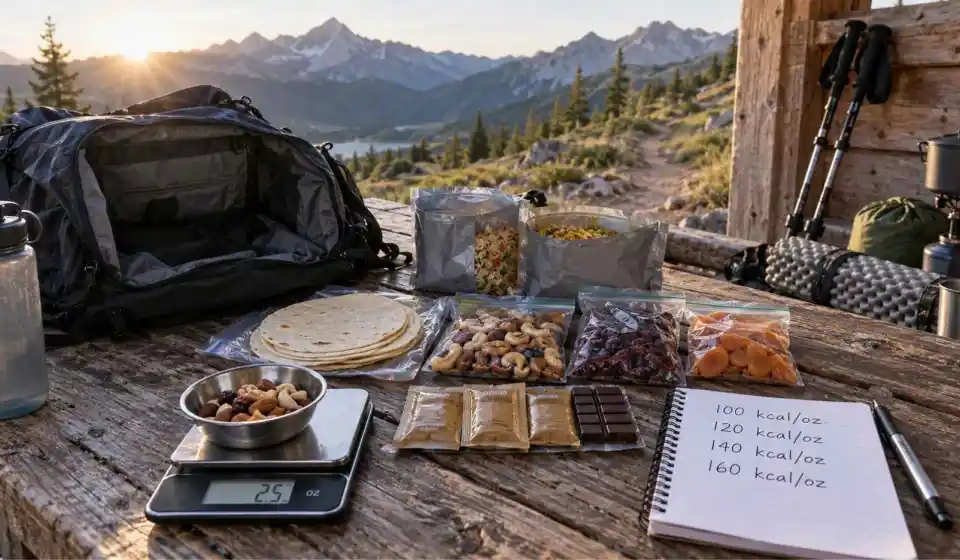
Consider a backpacker planning around 3,500 calories per day, a hypothetical target that makes the effect of calorie density easy to see. Divide 3,500 by the average calories per ounce, and you get the approximate ounces of food required to supply those calories. 📊 Nothing about the calorie target changes in the following comparison; only the density of the menu changes.
| Average calorie density | Food for 3,500 calories | Approximate pounds |
|---|---|---|
| 100 kcal/oz | 35 oz | 2.19 lb |
| 120 kcal/oz | 29.2 oz | 1.82 lb |
| 140 kcal/oz | 25 oz | 1.56 lb |
| 160 kcal/oz | 21.9 oz | 1.37 lb |
At 100 kcal/oz, reaching 3,500 calories requires roughly 35 ounces of food, while a 140 kcal/oz menu requires only 25 ounces. That is a difference of about 10 ounces per day, which becomes approximately 50 ounces—or more than three pounds—across five days if every day follows the same assumptions. 🥾 This is why apparently small differences in average food density can become meaningful on longer carries.
Why Fat Changes The Calorie-Density Equation
The mathematics behind high-calorie backpacking food begins with the three macronutrients: fat provides about 9 calories per gram, while carbohydrate and protein each provide about 4 calories per gram. Because fat contains more than twice as much energy per gram, foods containing substantial amounts of fat can often raise the calorie density of a trail menu. 🥜 Oils, nuts, nut butters, chocolate, seeds, and other fat-containing foods therefore appear frequently in calorie-dense backpacking menus.
This does not mean backpackers should build their entire diet around pure fat, because food planning involves more than maximizing one mathematical ratio. Carbohydrates, protein, fiber, meal satisfaction, and personal tolerance still matter, and different foods serve different purposes throughout the day. Calorie density simply explains why adding a relatively small amount of a high-fat food can noticeably increase the average kcal/oz of the complete food bag.
Water Weight Matters More Than Many Beginners Realize
Another important factor is water because water contributes weight without providing calories, which is why foods containing large amounts of moisture usually have lower calorie density than dry foods. Fresh fruit, many ready-to-eat meals, and other moisture-rich foods may taste excellent but can require carrying significantly more weight for the same calorie total. 💧 Backpackers often favor dehydrated, dried, powdered, or naturally low-moisture foods partly because trail water can frequently be added later when preparing the meal.
That does not make wet food “bad,” particularly on short trips where the weight penalty may be insignificant compared with convenience or enjoyment. A fresh first-day sandwich, fruit, or another heavier food may be completely reasonable when you only need to carry it for a few hours. The calorie-per-ounce calculation is a planning tool rather than a rule, allowing you to see what a food choice costs in pack weight before deciding whether that cost matters.
Why You Shouldn’t Optimize Only One Number
Imagine creating an extremely calorie-dense menu that looks perfect in a spreadsheet but consists mostly of foods you become tired of eating after two days. The mathematical efficiency would be impressive, yet the practical menu might fail because appetite, variety, texture, preparation, and personal food preferences matter on the trail. 🍫 Backpacking food therefore works better when calorie density is treated as one variable alongside the other characteristics that make food useful.
Protein and fiber can also change the average because foods selected specifically for those characteristics may not always be the most calorie-dense foods available. Convenience matters too, since a food requiring lengthy cooking may consume extra fuel and time even if its nutritional numbers appear attractive. A useful menu balances weight, calories, protein, fiber, preparation, cost, and enjoyment rather than allowing kcal/oz to dominate every decision.
How To Raise Your Average Without Rebuilding The Menu
You do not necessarily need to redesign breakfast, lunch, dinner, and every snack just because your current menu averages below 140 calories per ounce. One easier strategy is to identify several heavier, lower-density items and replace or complement them with compact foods such as nuts, nut butter, chocolate, tortillas, dried foods, or appropriately packaged oils. 🔄 A few substitutions can raise the overall average while allowing most of your familiar menu to remain unchanged.
For example, suppose several foods you enjoy sit around the middle of the calorie-density spectrum rather than at the high end. Pairing those foods with calorie-dense snacks or adding fat to suitable meals can increase the day’s average without forcing every individual item to meet the same threshold. This approach is often more realistic because 140 kcal/oz becomes a menu-building target instead of a food-by-food admission test.
What A 140 Cal/Oz Day Could Look Like
Think of the menu as a portfolio rather than a collection of identical numbers, with some foods pulling the calorie-density average upward while others contribute something else you want. Breakfast might emphasize easy preparation, daytime snacks might lean toward nuts or chocolate, lunch could use tortillas with a calorie-dense filling, and dinner might combine dehydrated ingredients with an added source of fat. 🌯 The precise nutrition depends on the actual products and portions chosen, so package labels remain the best source for calculating a real menu.
You can calculate your own daily average by adding the total calories of everything packed for the day and dividing that number by the total food weight in ounces. If your day’s food contains 3,500 calories and weighs 25 ounces, the average is exactly 140 calories per ounce; if those same calories weigh 28 ounces, the average drops to 125 calories per ounce. This method is more useful than guessing whether your food bag “looks ultralight.”
How Much Difference Does It Make On A Longer Trip?
The effect becomes especially visible when food must be carried for several days before the next resupply. At 3,500 calories daily, a 100 kcal/oz menu requires about 2.19 pounds per day, while the theoretical 140 kcal/oz version requires about 1.56 pounds per day. 🏕️ Across four days, that difference is approximately 2.5 pounds of starting food weight before considering packaging.
Moving from 140 to 160 kcal/oz produces a smaller additional reduction because the menu is already relatively dense, dropping the theoretical food requirement from 25 ounces to about 21.9 ounces per day. That illustrates an important principle: pushing calorie density higher continues saving weight, but doing so may increasingly restrict food choices or require more reliance on high-fat foods. The “best” target is therefore the density that fits the trip, appetite, food preferences, nutrition goals, and acceptable pack weight.
When 140 Cal/Oz Isn’t Necessary
A 140-calorie-per-ounce target can be useful, but backpackers should not treat it as a universal requirement for every trip. On an overnight hike, short weekend route, low-mileage itinerary, or trip with frequent resupply, saving several ounces of food may matter less than bringing meals you strongly prefer. 🙂 Someone comfortable carrying slightly more weight may reasonably choose a lower-density menu if it provides better variety, lower cost, or easier eating.
Food availability matters as well because building an extremely calorie-dense menu from specialty products can become unnecessary when ordinary supermarket foods already meet your practical needs. Beginners especially may gain more from learning how to calculate total calories and food weight before worrying about maximizing every ounce. A sensible progression is calculate first, identify obvious heavy items second, and optimize only as far as the trip actually requires.
Build Around An Average, Not Perfection
The biggest lesson from the 140 kcal/oz approach is that calorie density gives backpackers a clear way to connect nutrition planning with pack weight. At 3,500 calories, moving from a 100 kcal/oz average to 140 kcal/oz theoretically reduces daily food weight from 35 ounces to 25 ounces, while pushing the average to 160 kcal/oz lowers it further to roughly 21.9 ounces. 🎯 Those numbers make the consequences of food selection visible before you ever step onto the trail.
But an efficient food bag is not necessarily the one with the highest possible kcal/oz number. It is the one that supplies enough planned energy while balancing weight, protein, fiber, taste, convenience, preparation requirements, cost, and foods you will realistically want to eat. Calorie density is powerful because it helps you make those tradeoffs deliberately rather than discovering several days into a hike that your food bag is heavier—or less enjoyable—than expected.