🥾 How to Plan a 5-Day Backpacking Menu Without a Resupply
A five-day backpacking trip without a resupply can turn food planning into a small logistics project. You’re not just deciding what sounds good for dinner. You’re figuring out how much food to carry, how to keep it organized, what will survive five days in your pack, and how to avoid bringing unnecessary weight.
The good news is that a no-resupply trip doesn’t require five completely different menus. A better strategy is to create a repeatable food system built around versatile ingredients, simple meals, compact snacks, and a realistic amount of backup food. 🎒🌲
Here’s how to build a five-day menu that is practical without making your food bag unnecessarily complicated.
🗺️ Start With Your Itinerary
Before shopping for food, understand what the five days actually involve.
Ask yourself:
- When does the trip start?
- When does it end?
- How many hours will you hike each day?
- Are there particularly strenuous sections?
- Will temperatures be hot, cold, or variable?
- Are reliable water sources available?
- Will you use a stove?
- Are there food-storage requirements because of wildlife?
- Can you leave the route early if necessary?
A “five-day trip” doesn’t always require 15 full meals.
For example, if you eat breakfast at home before starting, Day 1 may only require lunch and dinner. If you finish near a trailhead around lunchtime on Day 5, you may not need a full fifth-day dinner.
Build your menu around actual eating occasions, not simply the number of days on the calendar.
🍽️ Create the Food Framework First
Before choosing individual foods, establish the daily structure.
A simple five-day framework could be:
🌅 Breakfast
A quick meal that doesn’t require much preparation.
🥙 Lunch
Something easy to eat during the hiking day.
🥜 Trail snacks
Small portions that can be eaten between meals.
🍲 Dinner
A filling meal that can be cooked or prepared with hot water.
🍫 Evening snack
Optional, depending on your appetite and overall plan.
This gives you a predictable structure while still allowing different flavors.
⚖️ Estimate Your Food Needs
There is no universal number of calories that every backpacker needs.
Your energy requirements can vary according to:
- Body size
- Age
- Sex
- Hiking distance
- Elevation gain
- Terrain
- Weather
- Hiking pace
- Individual appetite
Instead of copying someone else’s exact calorie target, use your previous hiking experience as a starting point.
If you know that a particular hiking day leaves you extremely hungry, plan accordingly.
If you frequently return with large quantities of untouched food, adjust future portions.
For a five-day trip, small planning errors can become significant because they are multiplied across several days.
🥜 Choose Foods That Work Hard
When you have to carry five days of food, versatility matters.
Choose ingredients that can appear in several meals.
Useful categories include:
- Nuts and seeds
- Nut or seed butter
- Tortillas
- Instant oats
- Instant rice
- Couscous
- Dehydrated vegetables
- Dried fruit
- Granola
- Crackers
- Shelf-stable tuna or chicken
- Powdered milk
- Chocolate
- Snack or energy bars
- Small amounts of oil
- Seasonings
You don’t need everything.
A compact selection of foods you genuinely enjoy is often easier to manage than a huge collection of specialized backpacking products.
🍚 Build Meals With a Simple Formula
A useful way to create backpacking meals is:
Carbohydrate + protein + fat + flavor
For example:
Dinner
Instant rice + tuna + oil + seasoning
Breakfast
Oatmeal + powdered milk + nuts + dried fruit
Lunch
Tortilla + nut butter + dried fruit
This formula is flexible.
You can change the seasoning or protein while keeping the same basic structure.
That makes it possible to create variety without carrying dozens of ingredients.
🥣 Make Breakfast Easy
Five mornings of complicated breakfasts can become tedious.
Instead, choose one or two breakfast bases.
Option 1: Instant oatmeal
Combine:
- Instant oats
- Powdered milk
- Nuts
- Dried fruit
You can portion each day’s ingredients into a separate bag before the trip.
Option 2: Granola-style breakfast
Granola, powdered milk, nuts, and dried fruit can provide another simple combination.
The exact foods should match your dietary needs and what you know you tolerate well during physical activity.
The important thing is to test unfamiliar foods before committing them to a five-day trip.
🌯 Make Lunch Mostly No-Cook
Lunch is often the easiest meal to simplify.
You may not want to stop, unpack your stove, boil water, and wash a pot in the middle of a long hiking day.
Tortillas are useful because they can serve as a compact base.
Try combinations such as:
Tortilla + nut butter + dried fruit
or
Tortilla + shelf-stable tuna/chicken + seasoning
You can alternate sweet and savory versions throughout the trip.
Other no-cook possibilities include:
- Crackers + shelf-stable protein
- Trail mix
- Nuts + dried fruit
- Bars
- Ready-to-eat foods appropriate for the conditions
🍲 Make Dinner the Main Hot Meal
If you’re carrying a stove, dinner can be the meal where you use it.
A simple five-day dinner rotation might look like:
Day 1: Instant rice + tuna + seasoning
Day 2: Couscous + chicken + dried vegetables
Day 3: Instant mashed potatoes + protein + seasoning
Day 4: Instant rice + protein + curry seasoning
Day 5: Couscous + protein + oil + spices
Notice that the basic ingredients overlap.
That’s intentional.
You can create different flavors without carrying five completely different recipes.
🧂 Use Small Flavor Boosters
After several days on the trail, flavor becomes important.
You don’t need to carry full-size bottles or jars.
Small portions of:
- Salt
- Pepper
- Chili flakes
- Garlic powder
- Curry seasoning
- Soy sauce
- Hot sauce
- Parmesan
- Other dry seasonings
can make simple meals more enjoyable.
Choose ingredients that work with multiple meals.
A tiny seasoning packet that improves four dinners is more useful than a specialty ingredient that only works once.
🥜 Plan Snacks Separately
Snacks are not an afterthought.
For a five-day trip, they can make up a substantial portion of your food system.
Good portable categories include:
Nuts and seeds
Compact and easy to portion.
Dried fruit
Convenient and doesn’t require preparation.
Bars
Useful when you want something that can be eaten quickly.
Trail mix
Easy to customize.
Chocolate
A compact treat that can add variety, although melting may be an issue in hot conditions.
Nut or seed butter
Useful with tortillas or crackers.
Rather than carrying one enormous bag, portion snacks by day.
For example:
Day 1 snack bag
Trail mix + bar
Day 2 snack bag
Nuts + dried fruit
Day 3 snack bag
Trail mix + chocolate
This makes it easier to control how much you eat and how much food remains.
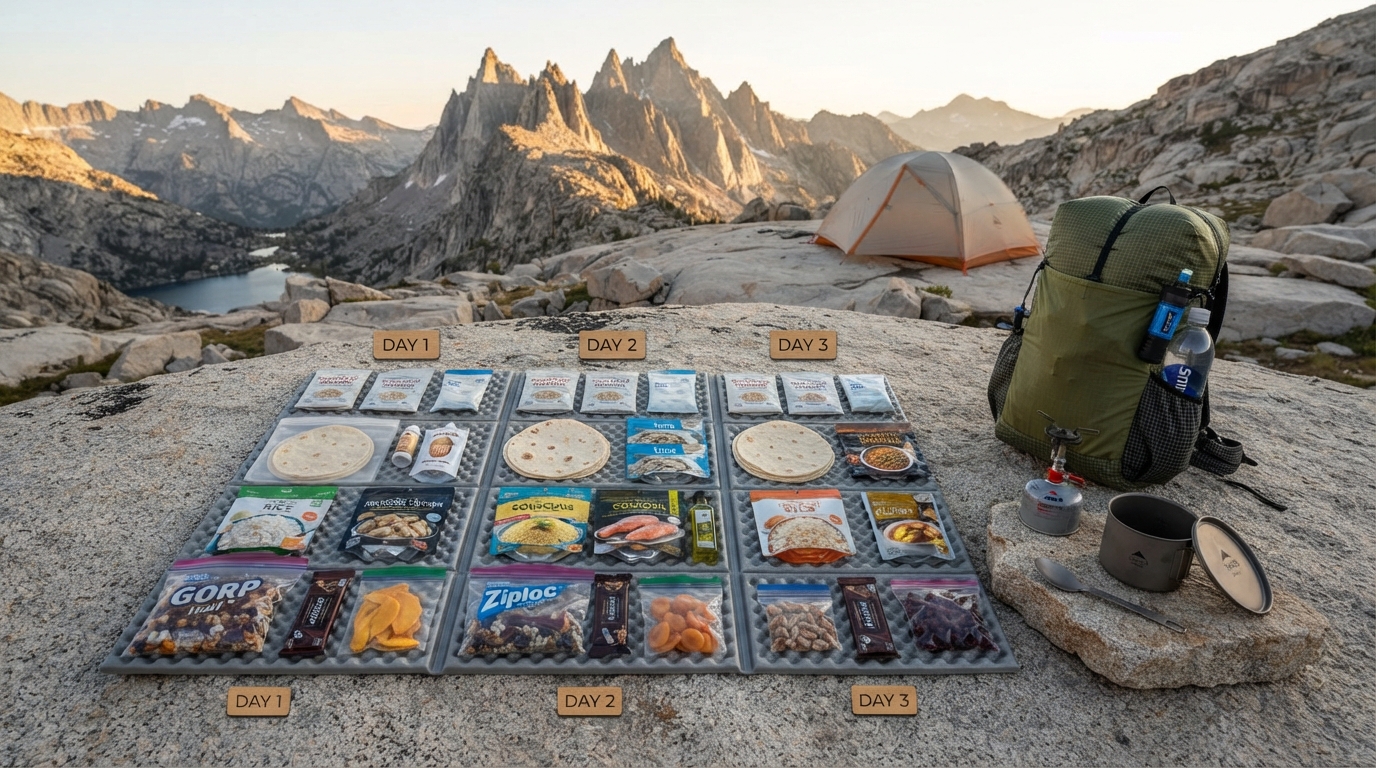
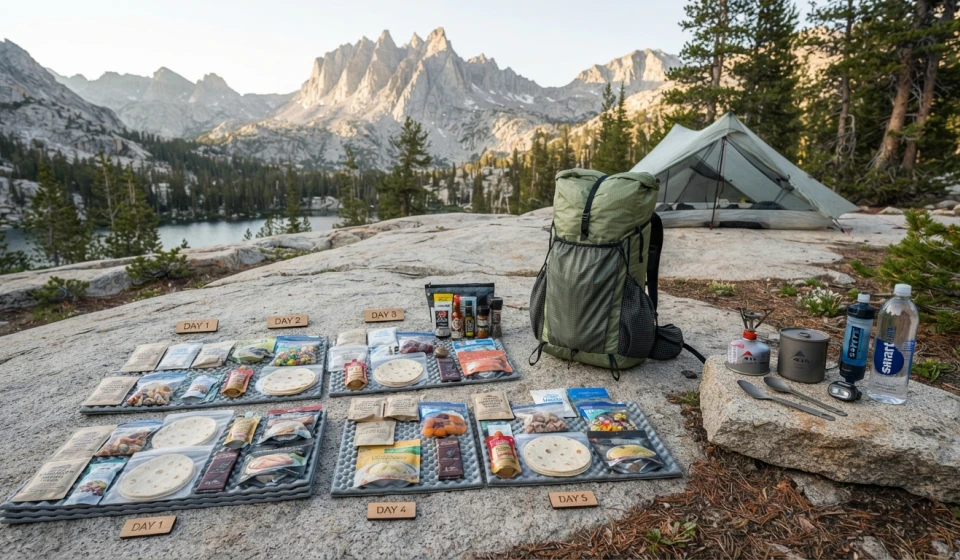
📦 Think in Five Daily Food Bags
One useful organization method is to divide the food into five daily groups.
Day 1
Breakfast
Lunch
Dinner
Snacks
Day 2
Breakfast
Lunch
Dinner
Snacks
Continue through Day 5.
You can either physically separate each day or simply label individual meals.
This approach gives you a visual inventory.
If the Day 3 food bag is still full halfway through Day 4, you’ll immediately know that your consumption hasn’t matched the original plan.
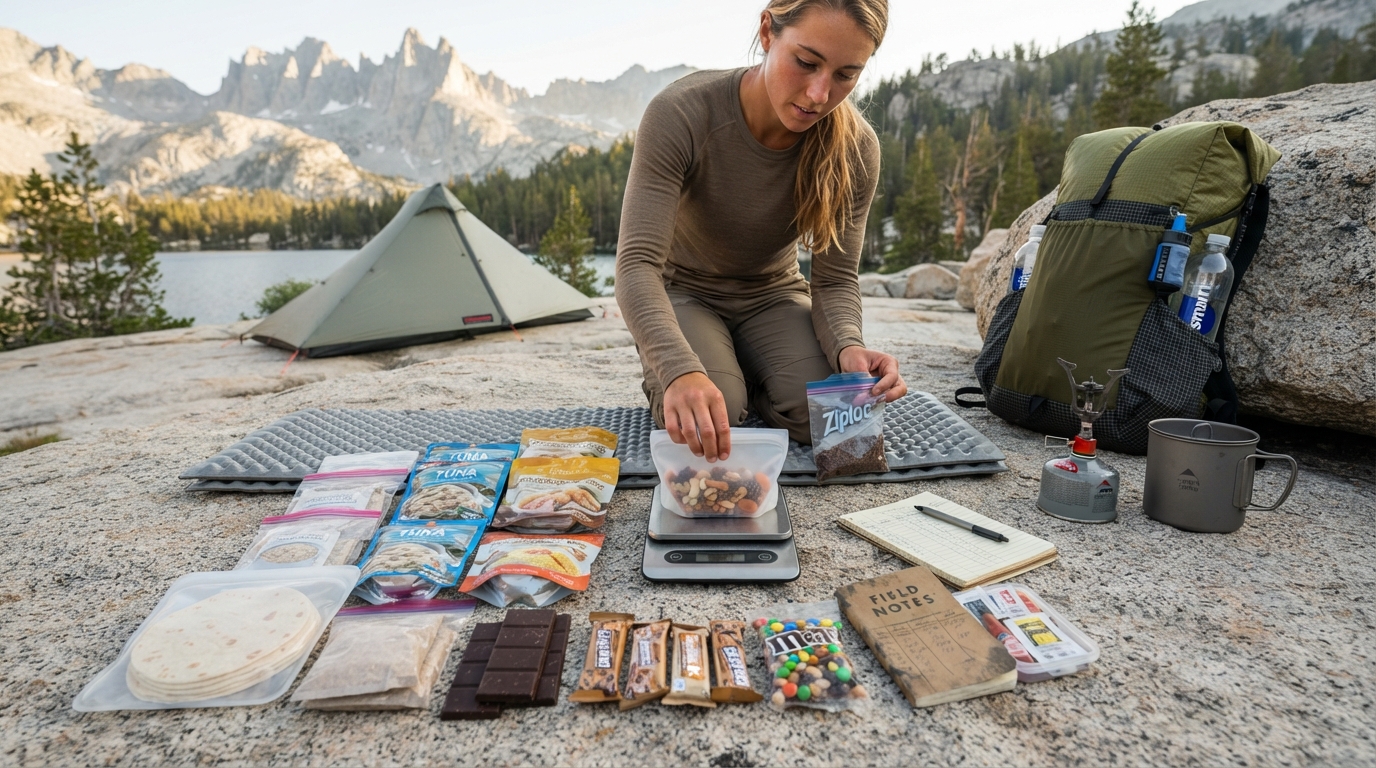
⚖️ Weigh the Complete Food Load
A kitchen scale can help you identify where the weight is going.
Weigh:
- Breakfast ingredients
- Lunch ingredients
- Dinner ingredients
- Snacks
- Condiments
- Drink mixes
- Backup food
Then add everything together.
Don’t forget that food packaging contributes to carried weight.
Where appropriate, remove unnecessary outer packaging and portion foods into lightweight bags or containers.
However, retain important product information such as preparation instructions, ingredients, allergen information, and storage guidance when needed.
🔥 Plan Your Fuel Alongside Your Menu
A five-day menu can require considerably more cooking than a one-night trip.
Count your planned cooking sessions.
If you only need hot water for breakfast and dinner, you can estimate fuel based on those sessions rather than imagining that you’ll cook three times every day.
Follow the manufacturer’s guidance for your stove and fuel system, and allow for conditions that can increase fuel consumption.
Cold temperatures, wind, altitude, and inefficient cooking can all affect how quickly fuel is used.
Never make the food plan so dependent on a precise fuel estimate that you have no margin for changing conditions.
💧 Water Becomes Even More Important
A five-day no-resupply trip requires serious attention to water.
Identify:
- Expected water sources
- Their reliability
- Treatment requirements
- Distances between sources
- Water needed for cooking
- Water needed for drinking
A lightweight dehydrated meal may reduce food weight but still require water at camp.
And natural water should not be assumed safe simply because it looks clean.
Your water strategy should be planned alongside your food strategy.
🐻 Think About Food Storage
Five days of food can attract animals, particularly if you’re carrying strong-smelling foods.
Follow the rules and recommendations for the area you’re visiting.
Depending on the destination, appropriate food storage might involve:
- A bear-resistant food container
- A designated food locker
- A hanging system where permitted
- Keeping food away from sleeping areas
Don’t improvise wildlife-storage methods without checking the requirements for your destination.
🧮 Example 5-Day Menu
Here’s an example framework for one person.
| Day | Breakfast | Lunch | Dinner | Snacks |
|---|---|---|---|---|
| 1 | Oatmeal + milk + nuts | Tortilla + nut butter | Instant rice + tuna | Trail mix + bar |
| 2 | Oatmeal + dried fruit | Tortilla + protein | Couscous + chicken | Nuts + chocolate |
| 3 | Oatmeal + nuts + fruit | Crackers + protein | Mashed potatoes + protein | Trail mix + bar |
| 4 | Oatmeal + milk + fruit | Tortilla + nut butter | Instant rice + protein + curry seasoning | Nuts + dried fruit |
| 5 | Oatmeal + nuts | Tortilla + remaining filling | — | Bar + trail mix |
This is a planning example, not a universal meal prescription.
Adjust portions based on your energy requirements, dietary restrictions, hiking intensity, weather, and expected trip duration.
If you know you’ll need a full dinner on Day 5, add one. If you expect to reach the trailhead early, you may not need one.
🎒 Keep a Small Backup
A no-resupply trip deserves some margin.
A compact backup food can be useful if:
- You hike farther than expected
- Weather slows you down
- You become hungrier than expected
- Your itinerary changes
- A meal gets damaged or becomes unusable
Good backup foods are compact, familiar, shelf-stable, and easy to eat.
Examples include a bar, nuts, or nut butter.
The appropriate amount depends on the remoteness and difficulty of your route. A remote trip may justify a larger safety margin than a short route close to roads.
🚫 Avoid These Five-Day Packing Mistakes
1. Bringing too much variety
Five different breakfasts and five completely different dinners can create unnecessary weight and complexity.
2. Packing full-size packages
You probably don’t need the entire container of anything.
3. Forgetting packaging weight
A food’s listed nutritional weight isn’t necessarily the same as what you’re carrying.
4. Choosing foods you haven’t tested
A long trip is not the ideal time to discover that you dislike a particular meal.
5. Treating the food target as more important than adequate nutrition
A lighter backpack is useful, but insufficient food can make a demanding trip much harder.
📝 Final Pre-Trip Checklist
Before closing your backpack, check:
☐ Five-day itinerary reviewed
☐ Breakfasts planned
☐ Lunches planned
☐ Dinners planned
☐ Snacks portioned
☐ Backup food included
☐ Water sources checked
☐ Water treatment packed
☐ Stove and fuel checked
☐ Cooking utensils packed
☐ Food-storage system prepared
☐ Important food labels/instructions retained
☐ Packaging protected from moisture
☐ All waste can be packed out
☐ Complete food load weighed
🌲 Final Thoughts
Planning five days of backpacking food without a resupply is much easier when you stop thinking about individual recipes and start thinking about systems.
Choose a few versatile ingredients. Repeat useful meal components. Keep breakfasts simple, make lunches easy to eat, use straightforward dinners, and divide snacks into manageable portions.
Then weigh everything, check your water and cooking requirements, and include a sensible food buffer.
You don’t need a gourmet kitchen in the wilderness. You need food that is nutritious enough for your needs, enjoyable, practical, and easy to manage for five days. 🥾🎒🌲
A well-planned food bag should give you confidence without making your backpack feel like you’re carrying a grocery store.