The 5-Day Backpacking Resupply Formula: How Much Food Should You Carry Between Grocery Stops?
A five-day resupply interval changes backpacking food planning because you are not solving for an entire trip at once. 🎒 You are solving for the largest block of calories you must carry between reliable grocery stops, which makes starting pack weight easier to estimate. Instead of asking how many meals fit in your bag, ask how many calories the next section requires and how many ounces are needed to carry them.
Every figure below is an example planning scenario, not a universal calorie target, because energy needs vary with body size, mileage, elevation, pace, weather, terrain, pack weight, appetite, and experience. A hiker planning 2,500 calories per day will carry less food than someone planning 3,500, even if both resupply every five days. The formula lets you insert your own planning estimate rather than copy someone else’s menu.
Start With The Resupply Interval
For food-weight planning, a ten-day hike with a grocery stop around day five is very different from ten days without resupply. If you can replace food halfway through, your maximum carry is based mainly on reaching the next dependable stop instead of covering the entire trip from the trailhead. ⛰️ The total eaten may be similar, but the maximum amount sitting in your pack at one time can be much lower.
Resupply also lets you adjust after seeing what happened during the first section. You may learn that one snack was unappealing, lunch portions were too large, or your estimated food intake did not match your appetite. Thinking in five-day blocks turns one large ten-day guess into two smaller decisions, with useful feedback available before the second carry.
Calculate Total Calories Before Counting Meals
The basic equation is simple: planned packed calories per day × number of food days = calories that must leave the resupply point with you. In an example scenario of 3,000 calories per day for five full days, the required carry equals 15,000 calories. 🔢 That number tells you more about food weight than saying you packed five breakfasts, five lunches, and five dinners.
The same calculation works with other planning estimates, provided you treat them as examples rather than prescriptions. Five days at 2,500 calories equals 12,500 calories, while five days at 3,500 equals 17,500 calories. Once total calories are known, the next question is how efficiently those calories are packed into ounces.
Convert Calories Into Ounces
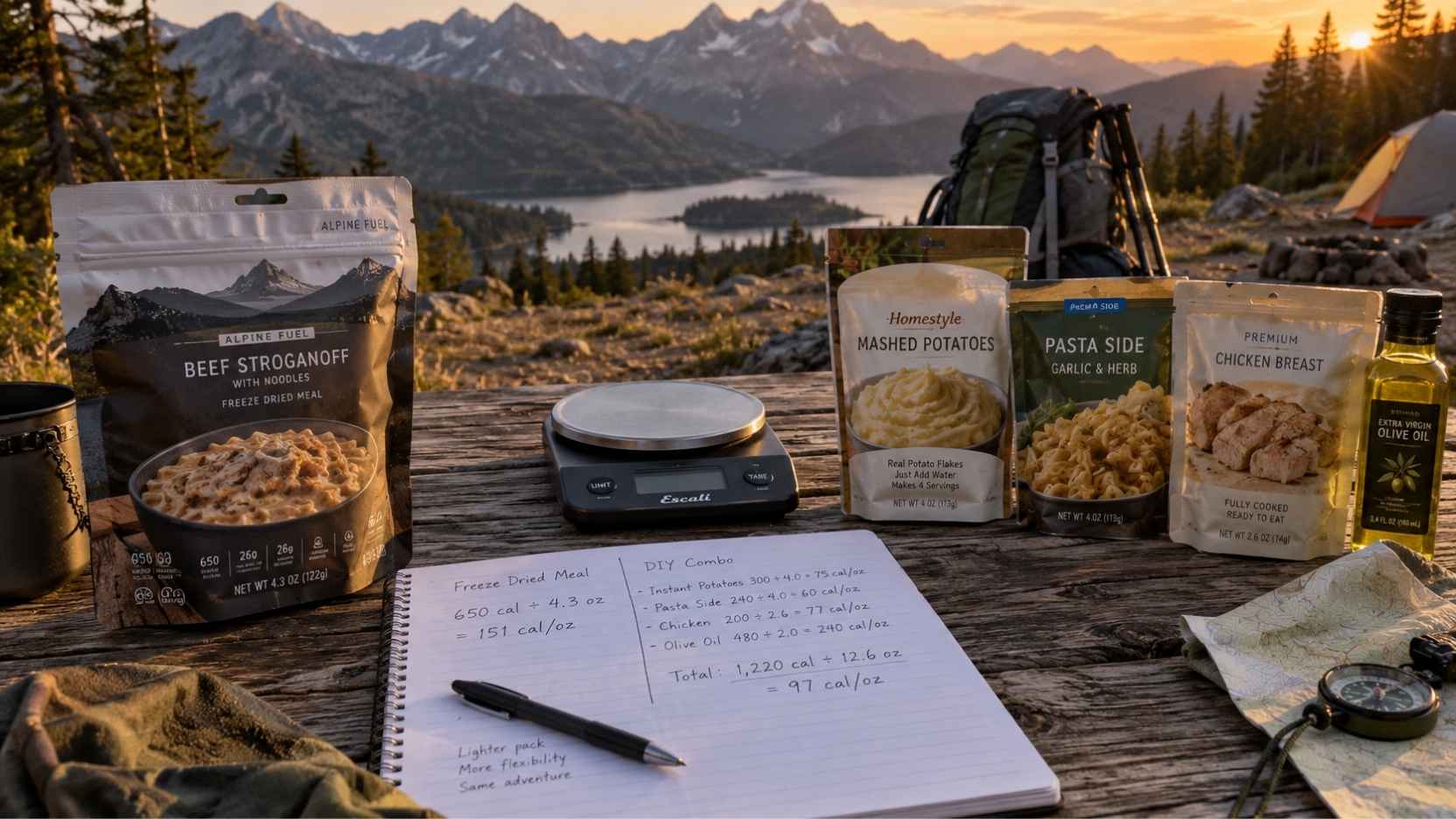
Caloric density describes how many calories a food provides per ounce, and menu-level average density is one of the most useful backpacking planning numbers. Foods containing more fat and less water often provide more calories per ounce, while moisture-heavy foods usually provide fewer calories for the same carried weight. 🥜 What matters is the average of the complete menu, not whether every item hits the same number.
Using the 15,000-calorie example, divide total calories by average calories per ounce to estimate food weight. At 100 calories per ounce, the carry needs 150 ounces, while at 150 calories per ounce it needs 100 ounces. That 50-ounce difference equals 3.125 pounds, showing why menu density can noticeably change starting pack weight.
| Example Menu Density | Ounces For 15,000 Calories | Approximate Weight |
|---|---|---|
| 100 cal/oz | 150 oz | 9.38 lb |
| 110 cal/oz | 136.4 oz | 8.52 lb |
| 125 cal/oz | 120 oz | 7.50 lb |
| 140 cal/oz | 107.1 oz | 6.70 lb |
| 150 cal/oz | 100 oz | 6.25 lb |
Use 125 Calories Per Ounce As A Planning Example
A 125-calorie-per-ounce menu is not a magic target, but it provides a useful middle-ground example. At that average density, 3,000 calories requires 24 ounces of food per day, or 1.5 pounds. Across five full days, the theoretical food load becomes 120 ounces, or 7.5 pounds before packaging.
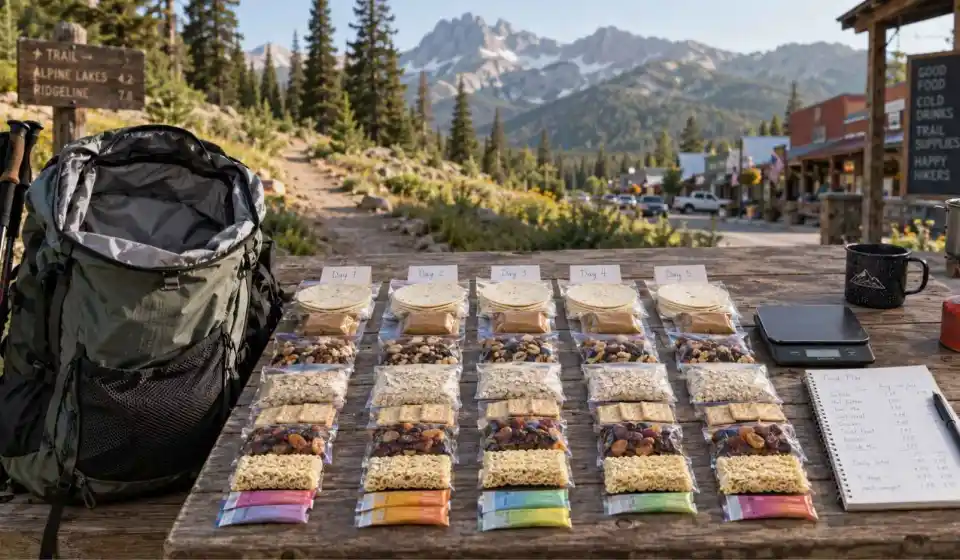
No individual item must equal exactly 125 calories per ounce because lower-density and higher-density foods can balance one another. Tortillas, nut butter, dried fruit, nuts, crackers, instant potatoes, candy, tuna packets, powdered drinks, and other grocery foods can all serve different purposes. 🧮 This keeps the menu focused on weight without ignoring taste, cost, protein, carbohydrates, fat, convenience, and whether you will actually eat the food.
Count First And Final Partial Days Separately
Many hikers overestimate food because they automatically count every calendar day as a full trail-food day. If breakfast is eaten before departure, or you reach the resupply store before dinner on the final day, those partial days may require fewer packed calories than your standard full day. 🍞 Counting those periods separately keeps your spreadsheet from adding food you never needed to carry.
For example, four full 3,000-calorie days plus a 2,000-calorie partial day totals 14,000 calories rather than 15,000. At 125 calories per ounce, that equals 112 ounces, or exactly 7 pounds, saving 8 ounces compared with the full five-day example. Keep a deliberate buffer when timing is uncertain, but track that buffer separately so you know exactly how much extra food you added and why.
Plan For Real Grocery-Store Availability
Your second carry may not look like your first because a small resupply store may not stock every specialty food you packed at home. Common options may include tortillas, peanut butter, nuts, cheese, crackers, candy, oatmeal, ramen, tuna packets, dried fruit, and powdered drinks, while a preferred dehydrated meal may be unavailable. 🏪 A practical resupply formula therefore needs to work with food categories and nutrition labels, not only one exact brand-by-brand shopping list.
Think in roles such as breakfast base, daytime snacks, lunch starch, calorie-dense spread, protein add-on, dinner base, and optional drink mix. If one product is missing, replace it with another item serving roughly the same role, then recalculate the total calories and weight. This makes the second five-day carry more resilient when package sizes, prices, brands, or inventory differ from what you expected.
Example Five-Day Food Allocation
An example 3,000-calorie day might allocate about 650 calories to breakfast, 1,000 to snacks and on-the-move food, 600 to lunch, and 750 to dinner. These are not prescribed meal sizes; they simply show one way to divide a daily calorie estimate into practical eating periods. 🥣 Some hikers prefer a larger dinner, while others find frequent daytime eating easier than one enormous evening meal.
Across five full days, that structure equals 3,250 breakfast calories, 5,000 snack calories, 3,000 lunch calories, and 3,750 dinner calories. The combined total is still 15,000 calories, so final pack weight depends on the average caloric density of all chosen foods together. Using categories also simplifies grocery resupply because a missing snack or dinner can be replaced without rebuilding the entire plan.
How Mid-Trip Resupply Changes Pack Weight
Without resupply, a ten-day example at 3,000 calories per day requires 30,000 packed calories at the start. At 125 calories per ounce, that equals 240 ounces, or 15 pounds of food before packaging and partial-day adjustments. With a day-five resupply, the theoretical five-day food load is about 7.5 pounds at a time instead of starting with all 15 pounds.
The hiker still eats roughly the same total calories across the ten-day scenario, but the entire trip’s food is never carried simultaneously. 🎒 Food weight falls after every meal, and the second block is collected only after most of the first block has been eaten. That is the mechanical advantage of resupply: it reduces maximum carried consumable weight rather than reducing the total amount of food needed over the trip.
Use The Formula, Then Check The Menu
The reusable equation is: calories for full days + calories for partial days + deliberate buffer = total section calories, then total section calories ÷ average calories per ounce = estimated food ounces. If one section totals 14,500 calories and your menu averages 125 calories per ounce, the estimated food weight is 116 ounces, or 7.25 pounds. ✅ Change the calorie estimate, number of days, buffer, or density and the answer changes immediately, which is why formulas are more useful than fixed claims such as “carry two pounds of food per day.”
Actual pack weight may be slightly higher because wrappers, bags, containers, and retail packaging also weigh something, while water used to prepare dry food should be planned separately. The goal is not to chase the lightest possible food bag, but to create a carry that is understandable, available at your resupply points, and realistic enough to eat. Calculate calories first, convert them to ounces second, then compare the result with your actual grocery list before stepping onto the trail.