How Many Days of Food Fit in a BV500? The Real Packing Math Explained
If you are planning a multi-day backpacking trip in bear country, one of the most practical questions is also one of the easiest to answer incorrectly: How many days of food actually fit inside a BV500?
The simple answer is about seven days for one person.
But real backpacking is rarely that simple.
A seven-day supply of lightweight freeze-dried meals can occupy dramatically less space than seven days of bulky snacks, tortillas, oatmeal packets, or foods still sitting inside their original packaging. Your calorie requirements also matter. So does whether you are carrying toiletries, trash, or other scented items in the same container.
The BearVault BV500 has an internal usable volume of approximately 11.5 liters, or 700 cubic inches, and BearVault currently describes it as holding about seven or more days of food for one person.
So what does that mean in real-world packing?
Let’s do the math.
Start With the 11.5-Liter Capacity
The BV500’s stated usable interior volume is 11.5 liters.
That sounds like a lot until you start dividing it by the number of days on your itinerary.
Using BearVault’s general planning guideline of approximately 1.6 liters, or 100 cubic inches, per person per day, the basic calculation looks like this:
11.5 L ÷ 1.6 L = approximately 7.2 person-days.
In cubic inches:
700 cubic inches ÷ 100 cubic inches = approximately 7 person-days.
That is where the familiar “seven days” figure comes from.
But this is a planning estimate rather than a guarantee.
Your actual food volume may be considerably higher or lower.
Why Seven Days Does Not Always Mean Seven Days
Imagine two backpackers carrying 3,000 calories per day.
Hiker A packs dehydrated meals, powdered drinks, tortillas, peanut butter, nuts, and energy bars. Most foods are repackaged into compact flexible bags.
Hiker B brings bulky commercial packaging, individually wrapped snacks, several large bags of chips, canned-style pouches, and food with lots of empty air.
Both may have exactly the same number of calories.
But they will not have the same amount of food volume.
This is why calories per liter can be more useful than simply counting meals.
For a BV500, packing efficiency can determine whether your food lasts five days, seven days, or potentially longer.
The 1.6-Liter Rule
A useful starting point is:
1 person × 1 day ≈ 1.6 L
That produces a rough planning table:
| Trip length | Approximate volume |
|---|---|
| 3 days | 4.8 L |
| 4 days | 6.4 L |
| 5 days | 8.0 L |
| 6 days | 9.6 L |
| 7 days | 11.2 L |
| 8 days | 12.8 L |
The BV500’s 11.5-liter interior therefore lines up closely with seven person-days.
However, the calculation assumes reasonably efficient packing and does not mean that every type of seven-day menu will physically fit.
Calories Matter Too
Suppose you need 2,500 calories per day.
For seven days:
2,500 × 7 = 17,500 calories.
Now suppose your backpacking menu averages 125 calories per ounce.
You would need approximately:
17,500 ÷ 125 = 140 ounces
of food, or about 8.75 pounds.
That is a useful weight estimate, but weight does not tell you whether the food will fit in the BV500.
Two foods can weigh the same while occupying very different volumes.
A dense block of nut butter has a different volume-to-calorie ratio from a large bag of puffed cereal. Freeze-dried meals can also vary significantly depending on packaging.
That is why successful canister packing requires thinking about both weight and volume.
Repackage Almost Everything
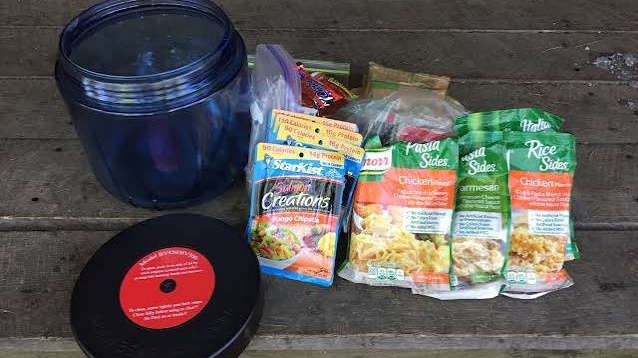
One of the easiest ways to waste BV500 space is to put food into the canister exactly as it came from the store.
Cardboard boxes, oversized plastic pouches, air-filled bags, and duplicate packaging consume valuable volume without providing additional calories.
BearVault recommends repackaging food into flexible freezer bags and prioritizing calorie-dense foods such as nuts, bars, jerky, and tortillas. It also recommends using small moldable foods to fill air gaps.
For example, instead of putting a boxed pasta meal into your canister, remove the cardboard and transfer the food into a labeled freezer bag.
The same principle applies to oatmeal, instant rice, dehydrated vegetables, powdered drink mixes, and many snacks.
Use the Walls First
A cylindrical canister creates a packing challenge.
The bottom and sides are easy to fill, but irregular gaps can appear between packages.
One useful strategy is to start with relatively flat items around the outside and place flexible bags toward the center.
Then use small items to fill remaining spaces.
Trail mix, powdered drink packets, jerky pieces, candy, and small snack portions can occupy spaces that a rigid package cannot.
Think of the BV500 like a three-dimensional puzzle rather than a grocery bag.
Your First Day’s Food Changes the Math
There is another important trick: you do not necessarily need to fit the entire first day’s food into the canister.
Depending on local regulations and your itinerary, food you will consume before reaching camp may be handled differently. However, never assume that an item can remain outside the required storage system simply because you intend to eat it soon. Follow the applicable park or land-management regulations.
The same principle applies to your last day.
Once food is consumed, empty space appears inside the canister. That can make the later days easier to manage.
Don’t Forget Scented Items
Food is not necessarily the only thing that needs space.
Depending on the regulations where you are hiking, your bear-resistant container may also need to hold:
- Toothpaste
- Sunscreen
- Lip balm
- Soap
- Deodorant
- Trash
- Menstrual products
- Cooking-related scented items
- Other toiletries
BearVault’s current FAQ specifically advises storing scented items such as food, toiletries, sunscreen, lip balm, menstrual products, utensils, and trash in the canister.
That means the entire 11.5 liters should not automatically be treated as available exclusively for meals.
If you reserve 0.5–1 liter for miscellaneous scented items, your food capacity falls accordingly.
Example: A Realistic Seven-Day Menu
Consider a hypothetical seven-day menu:
Breakfast
- Instant oatmeal
- Powdered milk
- Coffee
Lunch
- Tortillas
- Peanut butter
- Tuna or chicken packets
- Jerky
Snacks
- Nuts
- Energy bars
- Chocolate
- Trail mix
Dinner
- Dehydrated meals
- Instant rice or noodles
- Dried vegetables
Drinks
- Electrolyte powder
- Instant drink mix
If these foods are repackaged efficiently, a seven-day supply can be realistic for one person.
But if you add bulky packaging, large snack bags, fresh foods, or high-volume meals, the same seven-day trip can become difficult.
What About Eight or Nine Days?
BearVault describes the BV500 as capable of holding seven or more days, but the “more” depends heavily on your food choices.
Using the 1.6-L-per-day planning figure:
8 days = 12.8 L
That exceeds the nominal 11.5-liter capacity.
So an eight-day trip requires either unusually efficient packing, a lower-than-average food volume, resupply, or another food-storage solution.
Nine days would require approximately:
9 × 1.6 = 14.4 L
At that point, a single BV500 is generally not a realistic assumption for a typical solo menu.
What About Two People?
The math changes quickly.
Two people for three days equals:
2 × 3 × 1.6 = 9.6 L.
That fits within an 11.5-liter BV500 on paper.
Two people for four days:
2 × 4 × 1.6 = 12.8 L.
That exceeds the nominal capacity.
BearVault’s current guidance describes a BV500 as suitable for multiple-day trips for two or more people, but its more detailed size guide gives examples such as one BV500 for two people on a three-day trip with certain food choices and two BV500s for two people on five-plus-day trips.
That illustrates why packing style matters.
The Bottom Line
A BV500 has approximately 11.5 liters / 700 cubic inches of usable space. BearVault rates it at approximately seven days of food for one person, while its general planning rule is about 1.6 liters or 100 cubic inches per person per day.
The real answer, however, depends on your menu.
For a typical solo backpacker:
- 3–5 days: plenty of room
- 6 days: generally comfortable with efficient packing
- 7 days: realistic with good food choices and repackaging
- 8 days: possible only with unusually efficient volume management
- 9+ days: generally beyond a typical single-BV500 food plan
The best way to test your trip is to pack the entire food supply before departure.
If the lid closes easily and you still have room for required scented items, you have a workable system. If you have to crush packages, force the lid, or leave toiletries outside, your math needs another look.
The BV500 gives you approximately 11.5 liters. Your job is to turn those liters into as many useful trail calories as possible—without forgetting that bear-safety rules determine what must be stored inside.