Brain Fuel on the Trail: What Actually Powers Your Mind During a Long Hiking Day?
Introduction: The Problem With “Brain Food” on the Trail
When a hike lasts eight or ten hours, it is tempting to search for one snack that will supposedly keep your mind sharp. 🥾 A better trail question is whether you packed enough total energy, enough carbohydrate for harder sections, enough calorie-dense food to control pack weight, and enough fluid for the conditions. Long hiking days are mainly an energy-management problem, not a hunt for a magical “brain food.”
That matters because backpacking nutrition can easily drift into claims that nuts, berries, chocolate, or another ingredient directly improves concentration. In practice, a trail menu is better judged by calories, macronutrients, food weight, portability, hydration planning, and whether you will actually eat it. 🧭 The goal is not to promise better thinking from a snack; it is to avoid asking your body to work for hours on an inadequate plan.
Your Brain Doesn’t Have a Separate Food Bag
Your brain and body depend on the same overall food supply, so backpackers do not need a separate category of “brain fuel.” Carbohydrate, fat, and protein all have different jobs in the day’s menu, while water and electrolytes become practical considerations as duration, heat, sweat rate, and pace change. The useful question is therefore, “Does this food bag support the work required by this route?”
This becomes important because hikers often pack from habit rather than from the length and difficulty of the day. A lunch that feels generous on a three-hour walk may be too small when the same person is moving for eight hours with repeated climbs. ⛰️ Thinking in total calories, eating opportunities, and calories per ounce makes the plan easier to evaluate before leaving the trailhead.
Carbohydrates: The Easy-to-Use Trail Fuel
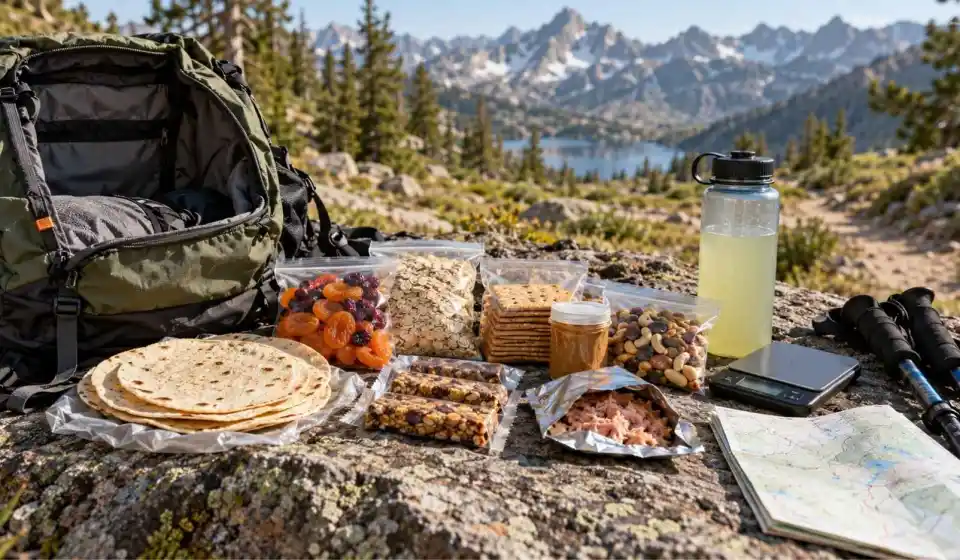
Carbohydrate-rich foods are practical during prolonged hiking because they provide a readily available source of energy and are often easy to eat while moving. Tortillas, dried fruit, crackers, oatmeal, pretzels, cereal, bars, chews, and candy can all fit, depending on taste, budget, digestion, and trip length. 🍌 Their value is not a special cognitive effect; it is that they can help supply energy during long climbs and repeated efforts.
A useful food bag combines meal-style carbohydrates with snacks that require almost no preparation. Breakfast might include oats or a bagel, lunch might use tortillas, and the miles between meals might be covered by dried fruit, crackers, or a bar. This creates several chances to eat instead of relying on two large meals after long periods of continuous walking.
Fat: Why Calorie Density Matters Once Food Goes on Your Back
Fat provides about 9 kilocalories per gram, while carbohydrate and protein provide about 4 kilocalories per gram, making higher-fat foods useful for calorie density. 🥜 Nut butter, nuts, seeds, olive oil packets, some cheeses, and certain bars can add substantial energy without making the food bag grow as quickly. For backpackers, that is mainly a weight-efficiency advantage, not proof that fat is always the best trail fuel.
The trade-off is that a menu built almost entirely around high-fat foods may provide fewer convenient carbohydrate options for harder sections. A practical backpacking menu often uses fat to raise calories per ounce while keeping carbohydrate-rich foods available for easy snacking. In other words, ultralight food planning works best as a balance between calorie density, usability, taste, and the demands of the route.
Protein: Important, but Not the Primary Hiking Fuel Calculation
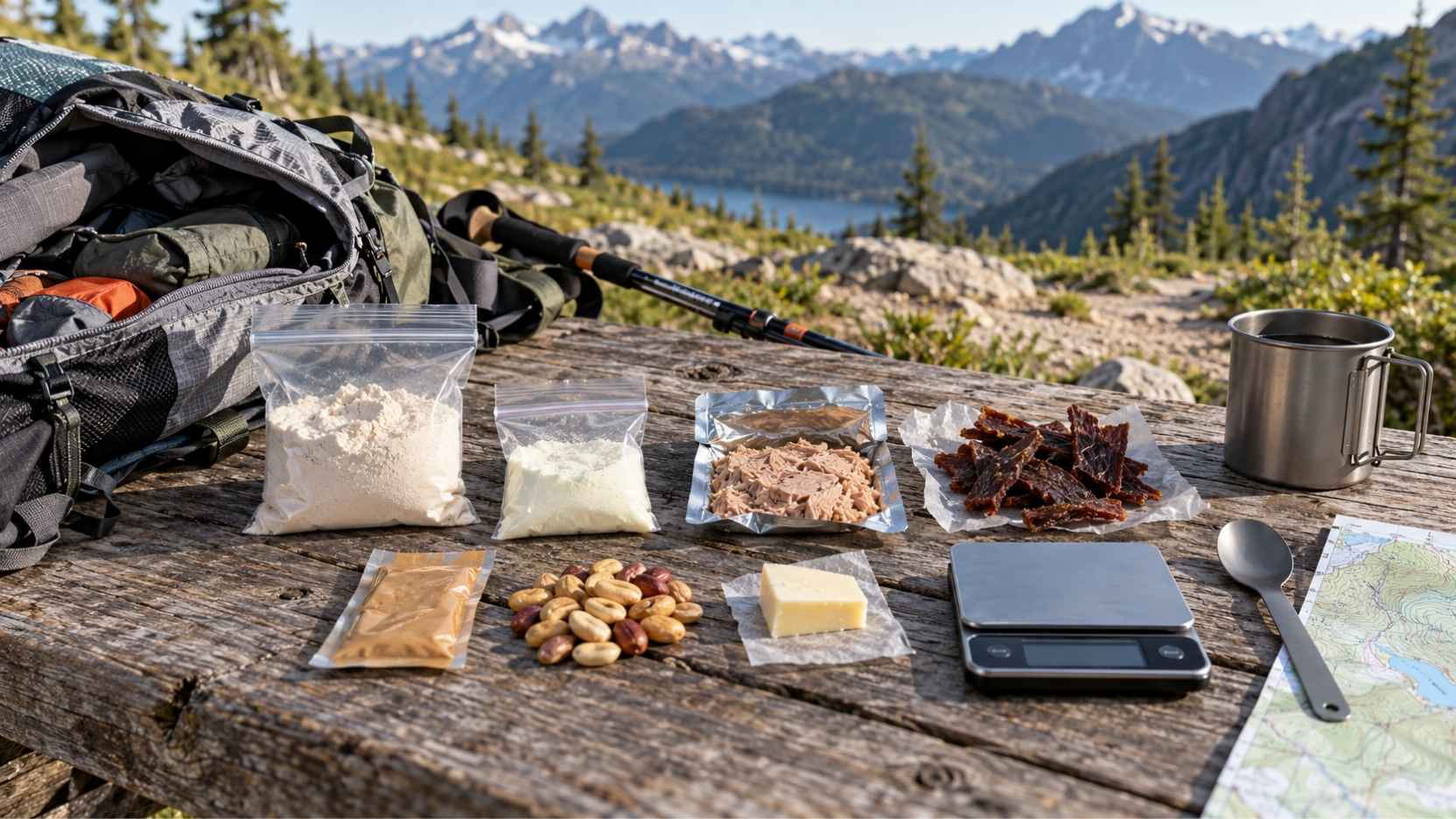
Protein belongs in a full-day trail menu, but it does not need to dominate simply because high-protein products are heavily marketed. Jerky, tuna packets, powdered milk, nuts, beans, cheese, and protein-containing bars can all contribute while also fitting other meal needs. 💪 The practical question is how protein fits inside the total calorie budget, food weight, cost, and preparation system.
It is usually easy to distribute protein across the day instead of saving nearly all of it for dinner. Nut butter at breakfast, nuts in a snack, tuna at lunch, or beans at dinner can each add to the daily total. Individual needs vary with body size, overall intake, training load, and other factors, so specific nutritional concerns belong with a qualified healthcare professional.
The Under-Fueling Problem
Under-fueling often happens because a food bag looks full even when its calorie total is lower than expected. Imagine a hiker planning for about 3,000 calories who packs a 500-calorie breakfast, two 250-calorie snacks, a 600-calorie lunch, a 300-calorie bar, and a 700-calorie dinner. That totals only 2,600 calories, leaving a 400-calorie gap before considering food that remains uneaten because it is inaccessible or unappealing.
The answer is not automatically to add a specialty “brain food”; it is to find where the plan is thin. Perhaps breakfast is too small, there are too few snacks for eight hours of movement, or lunch requires a long stop the route does not allow. 📦 Adding another tortilla, dried-fruit portion, nut-butter packet, or bar may solve the mathematical problem more directly than buying a product with impressive marketing.
A Sample 8-Hour Trail Fueling Calculation
Consider an illustrative hiker who chooses to pack about 3,200 calories for a long day based on route demands, body size, pace, experience, and the wider trip plan. They might allocate 700 calories to breakfast, 1,200 to trail snacks, 700 to lunch, and about 600 to later food or a post-hike meal. 🧮 This is an example for showing the math, not a universal target, because calorie needs can differ substantially between people and routes.
Calorie density then turns that energy target into approximate food weight. At an average of 120 calories per ounce, 3,200 calories weighs about 26.7 ounces, or roughly 1.7 pounds before packaging; at 90 calories per ounce, it weighs about 35.6 ounces, or around 2.2 pounds. That difference explains why backpackers care about calorie density, even though the lightest possible menu is not always the easiest or most enjoyable one to eat.
What This Means When Packing Tomorrow’s Food Bag
Start with the expected duration and difficulty of the hike, then use your own experience and trip plan to build a reasonable calorie budget rather than copying someone else’s number. Divide that total into meals and snack windows, keep accessible carbohydrate foods for periods of movement, use calorie-dense fats to manage food weight, and include protein across the day. 🎒 Finally, check whether the food is easy to reach, realistic for the weather, compatible with your water plan, and appealing enough that you will actually eat it.
The strongest “brain fuel” strategy for a long hiking day is therefore not a single ingredient but an adequate, portable, workable food system. If a hiker repeatedly experiences confusion, dizziness, severe weakness, or other concerning symptoms, food planning should not be treated as a diagnosis or treatment, and individualized advice should come from a qualified healthcare professional. For everyday backpacking preparation, the practical takeaway is simple: count the calories, watch calorie density, carry usable carbohydrates, include fat and protein, and create enough opportunities to eat.