Sardines vs Salmon vs Powdered Milk: Which Trail Food Packs the Most Calcium per Ounce?
Why serving-size comparisons can mislead backpackers
A nutrition label can tell you how much calcium is in a serving, but a backpacker has another question: how much calcium am I carrying for every ounce in my food bag? A food that looks impressive per cup may become much less attractive when that cup contains several ounces of water, while a dry powder can concentrate the same nutrient into a surprisingly small package. 🥾 For trail planning, that makes calcium per ounce a more useful comparison than calcium per conventional serving alone.
This does not mean hikers should choose food according to one mineral or attempt to optimize every ounce around calcium, because calories, protein, taste, cost, sodium, preparation, and overall diet still matter. Instead, think of calcium density as another column beside calories per ounce and protein per ounce, just as you might compare fuel efficiency rather than looking only at the size of a vehicle’s gas tank. The calculation is simple: calcium density = milligrams of calcium ÷ ounces of food carried.
The calcium-per-ounce calculation changes the ranking
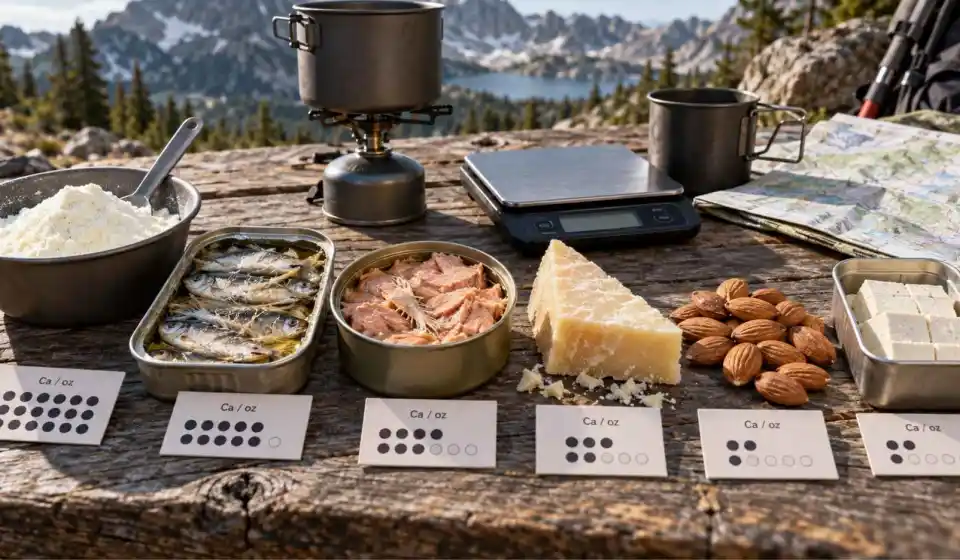
Representative USDA-derived data puts nonfat dry milk at about 1,257 mg of calcium per 100 grams, which works out to roughly 356 mg per ounce before adding water. Hard Parmesan is surprisingly close at about 1,184 mg per 100 grams, or approximately 336 mg per ounce, showing why relatively dry dairy foods perform so well when weight matters. 🥛 These foods contain much less water than canned fish or fresh tofu, so more of every carried ounce consists of actual food solids.
By comparison, canned Atlantic sardines with edible bones provide roughly 382 mg per 100 grams, or about 108 mg per ounce, while canned pink salmon containing edible bones is around 213 mg per 100 grams, or about 60 mg per ounce. The important words are with edible bones, because the bones contribute heavily to the calcium content and boneless salmon should not be treated as nutritionally equivalent for this calculation. NIH also identifies canned sardines and salmon with bones as meaningful nondairy calcium sources. 🐟
Sardines vs salmon vs powdered milk
Among the three foods in our headline comparison, nonfat powdered milk is the clear calcium-density leader by food weight, delivering around 356 mg per dry ounce using the reference values in this calculation. It also supplies roughly 103 calories and 10 grams of protein per ounce, making the powder unusually efficient at carrying calcium and protein together. Water is added at camp rather than transported from home, which is precisely the type of advantage emphasized in backpacking caloric-density and pack-out design.
Sardines come next for calcium, at approximately 108 mg per edible ounce, while providing about 59 calories and 7 grams of protein from the reference canned-in-oil product. Bone-in canned salmon supplies less calcium per carried ounce—around 60 mg—but still contributes roughly 39 calories and 5.6 grams of protein per ounce before considering the can or pouch itself. That does not make salmon “bad”; it simply demonstrates how a nutritionally valuable food can perform differently once carried weight becomes part of the equation.
Hard cheese, almonds, fortified foods, and tofu
Hard Parmesan deserves attention because its combination of low water content and naturally high calcium concentration places it near powdered milk, at approximately 336 mg calcium, 111 calories, and 10 grams protein per ounce. Almonds travel especially well from a calorie-density perspective, producing roughly 164 calories per ounce, but their calcium density is more modest at about 76 mg per ounce despite being considerably drier than fish. 🧀 This is an important reminder that calorie density and mineral density are different measurements, and a food can excel at one without leading the other.
Calcium-set firm tofu can contain substantial calcium nutritionally, yet ordinary tofu is mostly water, with representative data putting it at approximately 57 mg calcium and only 22 calories per ounce. Different tofu products can vary dramatically depending on the coagulant used, while fortified cereals, powdered plant beverages, and other fortified foods can also vary enough that the package nutrition label becomes more useful than a generic database value. 🌱 A calcium-fortified dry product can potentially work well for backpacking, whereas carrying an already-mixed beverage means carrying the water too.
Complete trail calcium comparison
Using representative food-composition values gives a useful planning snapshot rather than an exact promise for every product on a supermarket shelf. Brand formulations, draining methods, fish species, bone content, cheese type, fortification, and moisture levels can all move the numbers, so backpackers should treat the figures as comparison math and verify the label of the product they actually pack. The ranking nevertheless demonstrates how dramatically dehydration and water content influence nutrient density.
| Trail food | Approx. calcium/oz | Approx. calories/oz | Approx. protein/oz | Main trail consideration |
|---|---|---|---|---|
| Nonfat dry milk powder | 356 mg | 103 kcal | 10.3 g | Add water at camp |
| Hard Parmesan | 336 mg | 111 kcal | 10.1 g | Dense food; storage conditions matter |
| Sardines with bones | 108 mg | 59 kcal | 7.0 g | Water/oil and container add weight |
| Almonds | 76 mg | 164 kcal | 6.0 g | Excellent calorie density |
| Canned pink salmon with bones | 60 mg | 39 kcal | 5.6 g | High moisture and packaging weight |
| Calcium-set firm tofu | 57 mg | 22 kcal | 2.6 g | Very high water content |
The table also exposes something ordinary “high-calcium foods” lists rarely show: the highest-calcium trail food is not automatically the highest-calorie trail food. Almonds deliver far more calories per ounce than canned salmon despite having only moderate calcium density, while powdered milk and Parmesan combine strong calcium numbers with substantially better energy density than water-heavy foods. For a backpacker, each metric answers a different question rather than producing one universal winner.
The hidden weight penalty of canned food
Canned fish illustrates the difference between edible-food weight and total pack weight particularly well, because the nutrition database normally describes the food rather than the metal container sitting in your backpack. A can can also contain water, oil, or sauce, so the real “calcium per packed ounce” becomes lower once non-edible packaging and any liquid you carry but do not consume are included. 🎒 This is exactly why some foods that look lightweight in a grocery cart belong in a broader Foods That Look Light But Aren’t trail comparison.
Powdered milk reverses that situation because the water needed to prepare it can often come from the water supply you already planned to collect and treat along your route. Dry foods therefore frequently gain an enormous pack-efficiency advantage over ready-to-eat foods even when their ordinary serving sizes appear similar. That same logic explains why dehydrated meals, powders, couscous, instant potatoes, oats, and other low-moisture foods repeatedly appear in efficient backpacking menus.
When canned fish still makes sense on the trail
Weight efficiency is not the only goal of a trail menu, and canned sardines or salmon can still be practical when the trip is short, the first day’s food does not need to travel far, or the fish provides a meal you genuinely look forward to eating. Ready-to-eat fish also requires virtually no cooking and can turn tortillas, crackers, couscous, or another simple carbohydrate into a substantial lunch or dinner. 🍽️ For some hikers, that convenience and variety can outweigh several ounces of extra water and packaging.
Canned fish can also make more sense immediately after a resupply, at a campground, on a short overnight route, or anywhere the empty container will not remain in the backpack for several days. Powdered milk fits breakfast foods, hot drinks, oatmeal, mashed potatoes, and creamy trail meals, while Parmesan can be added in smaller quantities to pasta, couscous, or dehydrated dinners. Almonds work better as a snack and calorie booster, demonstrating why the “best” use depends on where the ingredient fits in the menu.
Calcium density and caloric density solve different problems
Backpacking nutrition often focuses on calories per ounce because food weight accumulates quickly across several days, but calcium-per-ounce analysis adds a different layer to menu design. Almonds illustrate the distinction perfectly: at around 164 calories per ounce they outperform every food in this comparison for energy density, yet powdered milk and Parmesan provide several times more calcium per ounce. 🔬 Sardines offer less energy and calcium per ounce than the dry dairy options, but they bring a completely different combination of protein, fat, flavor, and ready-to-eat convenience.
The practical lesson is not to build a backpack around whichever food wins a single column, but to understand what each ounce is accomplishing inside the entire menu. Powdered milk is the standout calcium-per-ounce option in this comparison, Parmesan is remarkably competitive, sardines outperform bone-in salmon for calcium density, and almonds remain stronger when calories per ounce become the priority. For individualized calcium requirements, dietary restrictions, allergies, or health concerns, consult a qualified healthcare professional rather than using trail-food calculations as personalized medical advice.