Can Fermented Foods Go Backpacking? Kimchi, Miso, Yogurt, Sauerkraut, and Trail-Safe Alternatives Compared
Fermented foods sound surprisingly compatible with backpacking because fermentation is historically connected with food preservation, yet the modern grocery-store versions of kimchi, yogurt, kefir, sauerkraut, miso, and kombucha do not all behave like traditional preserved trail foods. 🥾 A backpacker has to think beyond whether something is fermented and ask whether the exact product requires refrigeration, how much water it contains, how heavy its packaging is, whether it can leak, and how conveniently it fits into a trail meal. Those practical questions matter much more in a backpack than arguments about which fermented food supposedly offers the greatest digestive benefit.
This article therefore does not rank fermented foods by probiotic effectiveness, microbiome effects, or ability to treat digestive problems. Instead, it compares food formats through a backpacking lens: refrigeration, packaged weight, moisture, sodium, preparation, calorie contribution, shelf stability, and how easily a food can be incorporated into meals. The interesting question is not simply, “Can fermented foods go backpacking?” but “Which version of each fermented food earns space in a backpack?”
Fermented Does Not Automatically Mean Shelf-Stable
Fermentation can help preserve food, but “fermented” and “safe at room temperature indefinitely” are not interchangeable descriptions. Many modern fermented foods are sold from refrigerated cases specifically because manufacturers intend them to remain cold, and backpackers should follow the storage instructions printed on the individual package rather than assuming acidity or fermentation makes refrigeration unnecessary. USDA guidance recommends keeping foods that require refrigeration at 40°F (4.4°C) or below and generally limiting their time above refrigeration temperatures to two hours, or one hour when the temperature exceeds 90°F.
That immediately separates backpacking from ordinary car camping because a cooler filled with ice may be realistic beside a vehicle but usually makes little sense several miles down a trail. 🧊 A refrigerated product could potentially work for a very short outing when a proper cold source is maintained, but it becomes increasingly inconvenient as mileage, temperature, and trip duration increase. For multi-day trips, commercially shelf-stable, dried, dehydrated, freeze-dried, or otherwise appropriately packaged versions are usually much easier to manage.
Kimchi: Great Flavor, Awkward Backpacking Format
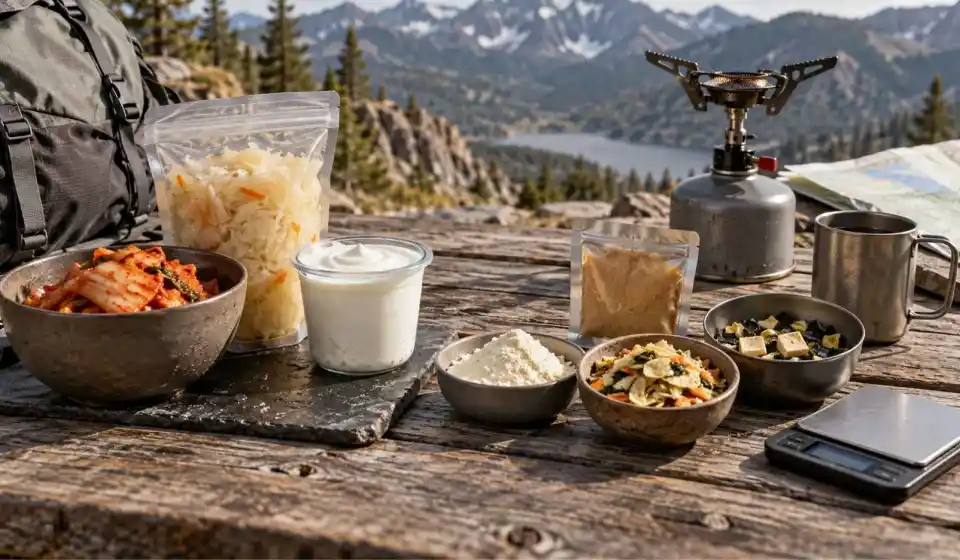
Traditional-looking refrigerated kimchi presents several practical problems in a backpack: it contains substantial water, usually comes packed with brine, can produce strong odors, and often needs refrigeration according to the manufacturer. A jar or pouch also adds packaging weight while delivering relatively few calories compared with calorie-dense trail staples such as nuts, nut butter, oil, tortillas, or dehydrated meals. 🌶️ Even if you love kimchi at home, carrying several hundred grams of vegetables and liquid becomes harder to justify when every ounce matters.
A better backpacking strategy is to preserve the flavor role of kimchi rather than insisting on carrying the refrigerator version. Dried kimchi pieces, commercially dehydrated kimchi ingredients, kimchi seasoning, or a properly dried homemade component can provide sour, spicy, savory character to noodles, rice, couscous, or soup without requiring you to haul the original food’s water. This is an important trail-food principle: sometimes the backpack-friendly version of a food is more useful than the food in its familiar form.
Sauerkraut: The Packaging Label Changes Everything
Sauerkraut creates a similar problem because products that look almost identical in the supermarket can have very different storage requirements. Refrigerated raw-style sauerkraut should not automatically be treated like a shelf-stable canned product, while commercially processed shelf-stable versions should be handled according to their individual packaging instructions. 🥬 The phrase “fermented cabbage” alone therefore tells a backpacker too little about whether a particular pouch or jar belongs on a warm multi-day hike.
Even genuinely shelf-stable sauerkraut has another disadvantage: water weight. Carrying 200 grams of sauerkraut means carrying cabbage plus much of the water surrounding it, whereas a dried vegetable ingredient may weigh only a fraction as much before being rehydrated at camp. For short hikes or base-camp meals, packaged sauerkraut may be perfectly enjoyable, but weight-conscious backpackers will usually get more flexibility from dried vegetables plus acidic or savory seasonings.
Miso May Be the Most Trail-Friendly Idea
Miso is particularly interesting because a very small quantity can add substantial savory flavor to a much larger meal. 🍜 A spoonful can transform plain noodles, instant rice, couscous, dehydrated vegetables, or soup, making it useful less as a major calorie source and more as a compact seasoning and meal-building ingredient. However, conventional tubs of miso are not automatically ideal trail products, and manufacturers commonly recommend refrigeration after opening to preserve quality.
The better backpacking options are products specifically labeled for room-temperature storage, individually portioned miso products where available, or dry instant miso-soup components. Commercial shelf-stable miso products do exist, demonstrating why backpackers should evaluate the package rather than making a blanket rule about miso itself. Because miso can also contain significant sodium, it makes sense to read the nutrition panel when combining it with other salty ingredients such as ramen seasoning, bouillon, dried meat, or packaged soups.
Yogurt And Kefir Become Difficult Without Refrigeration
Fresh yogurt and kefir are among the least convenient standard supermarket fermented foods for ordinary multi-day backpacking. They are dairy products normally intended to remain refrigerated, and USDA food-safety guidance specifically treats yogurt as a refrigerated perishable food. Add their high water content and bulky containers, and a breakfast that feels convenient at home suddenly becomes an inefficient item to carry through summer temperatures.
The interesting alternatives are commercially dried, powdered, or freeze-dried dairy products designed for shelf-stable storage, provided the exact package confirms that storage method. 🥣 Backpackers can also reproduce the function of a yogurt breakfast rather than the exact food by combining powdered milk or another shelf-stable base with oats, granola, dried fruit, nuts, chia, or powdered flavorings. Whether a dried yogurt product retains specific live cultures should be checked on the manufacturer’s label rather than assumed from the word “yogurt.”
Kombucha Is Usually More Beverage Than Backpacking Food
Kombucha demonstrates another backpacking problem: water is heavy. A standard bottle can weigh well over a pound once the beverage and container are counted, yet nearly all of that carried weight is liquid that must be transported from the trailhead rather than collected and treated along the route. 🥤 For recreational day hikes, picnics, or car camping, that may not matter, but it is difficult to justify on a weight-conscious multi-day itinerary.
Some kombucha products are also sold refrigerated, while packaging style, carbonation, ingredients, and storage directions vary between brands. Rather than treating kombucha as an essential backpacking fermented food, it makes more sense to think of it as an optional beverage whose weight-to-utility ratio is generally poor for long-distance carrying. Backpackers seeking variety can usually allocate that weight more efficiently to dry drink mixes, food, or an empty bottle that can be filled with treated water.
What Survives The Backpack Better Than The Original Food?
The pattern becomes clear when these foods are compared side by side: removing water often solves several trail problems simultaneously. Dehydration and freeze-drying reduce carried water weight, simplify packaging, and can make ingredients easier to portion into lightweight meals, although storage life depends on processing quality, moisture level, packaging, temperature, and the specific product. Commercial freeze-dried backpacking foods illustrate why moisture removal works so well for wilderness travel: dry ingredients can remain compact until the hiker adds water at camp.
This does not mean backpackers should casually dehydrate every refrigerated fermented food at home and assume it has become safely shelf-stable. ⚠️ Home preservation involves variables such as moisture level, sanitation, ingredients, drying temperature, packaging, oxygen exposure, and storage conditions, so tested preservation methods are preferable when food safety is involved. The broader lesson is simply that properly produced dried fermented-food ingredients can make far more logistical sense than carrying their wet refrigerated counterparts.
Compare Fermented Foods By Trail Logistics
For actual meal planning, a useful comparison starts with six questions: Does the label require refrigeration, how heavy is the food including water, how secure is the packaging, how much useful energy does it provide, how much preparation does it require, and what role does it play in the meal? A salty 15-gram miso portion that improves a bowl of noodles has a completely different backpacking role from a 450-gram bottle of kombucha or a large jar of refrigerated sauerkraut. 🎒 Evaluating foods this way prevents nutrition trends from overriding simple pack mathematics.
Calorie density matters especially when the fermented item is occupying space that could otherwise carry a substantial meal. Kimchi and sauerkraut can offer flavor and vegetable variety but are generally not concentrated calorie sources, while miso functions primarily as a seasoning rather than the main energy component of dinner. Yogurt-based dry products may fit breakfast construction more naturally, but backpackers should still build meals around the total calories, macronutrients, ingredient weight, and preparation requirements appropriate for their trip.
Build The Meal Around The Format, Not The Trend
A practical trail dinner might therefore use noodles or instant rice as the energy base, dehydrated vegetables for volume, nuts or oil for additional calories, and a small shelf-stable miso component for flavor. Another meal might recreate the character of kimchi fried rice using instant rice, properly dried vegetables, chili, garlic, and acidic seasoning rather than carrying a leaking container of fresh kimchi. 🌄 This approach gives hikers much of the culinary variety they want while respecting the central realities of backpacking: weight, water, storage, preparation, and reliability.
That also creates a natural bridge into Food Preservation Science, because the next question becomes how moisture removal changes weight, shelf life, texture, packaging needs, and rehydration. Once those principles are understood, backpackers can stop asking whether a particular fashionable food “belongs” on the trail and instead decide which preservation format performs the same job more efficiently. The result is a more flexible trail-food system rather than a list of foods hikers supposedly must eat.
The Bottom Line: Fermented Foods Can Go Backpacking, But Format Wins
Fermented foods absolutely can appear in backpacking meals, but their usefulness depends far more on product format and storage requirements than on fermentation itself. Miso-style dry or shelf-stable components, properly manufactured dried ingredients, and other lightweight formats often translate well to trail meals, while refrigerated yogurt, kefir, wet kimchi, fresh sauerkraut, and bottled kombucha become increasingly impractical as trip length and pack-weight sensitivity increase. 🏕️ Always follow the manufacturer’s storage instructions because two products from the same fermented-food category may require completely different handling.
Most importantly, backpackers do not need to chase claims that one fermented food is uniquely capable of changing the microbiome or solving digestive problems. This comparison is about food logistics, preservation, nutrition labels, weight, and meal construction, not probiotic efficacy or medical treatment. When refrigeration disappears and every ounce matters, the winning question is simple: what survives the backpack better than the original food?