Do Incline Treadmills Match Real Uphill Hiking Calories?
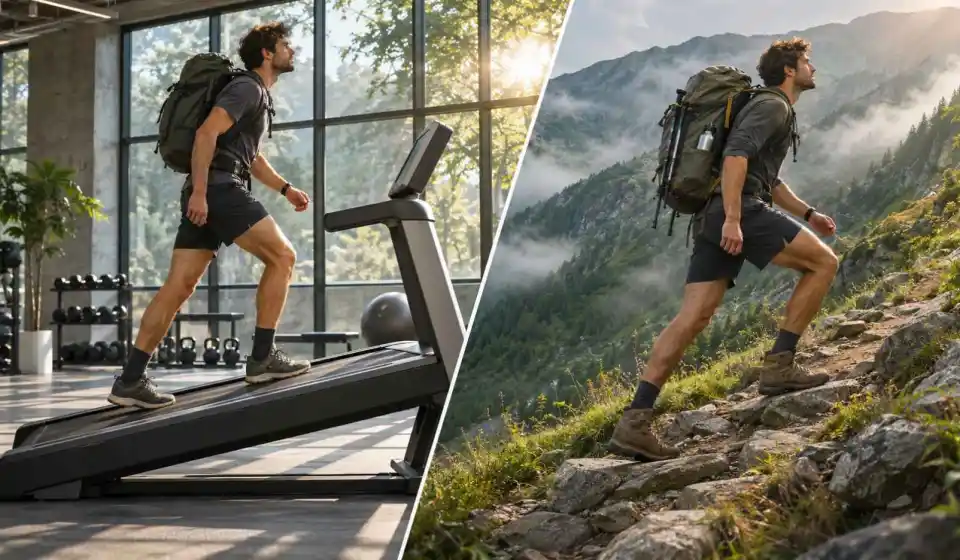
If you walk uphill on a treadmill for an hour without actually gaining elevation, are you burning the same calories as someone climbing a mountain? 🥾 This question makes treadmill incline vs outdoor hiking calories an interesting comparison for backpackers preparing for steep trails. Although both activities involve uphill walking, their calorie demands can differ because of terrain, pace, backpack weight, and environmental conditions.
A treadmill provides a controlled environment where speed and incline remain consistent, making it useful for estimating the energy required for uphill walking. Outdoor hiking introduces variables that are difficult to reproduce indoors, including rocks, changing gradients, uneven surfaces, and frequent adjustments in walking speed. Understanding these differences can help hikers interpret treadmill calorie estimates more realistically when planning their backpacking food and daily energy requirements.
Why Walking Uphill On A Treadmill Still Requires Energy 🏔️
A common misconception is that treadmill incline walking should require less energy because the person never travels to a higher physical location. However, each step requires the legs to move the body upward relative to the inclined walking surface while the motorized belt moves backward underneath. Your body remains approximately in one place, but your muscles repeatedly perform the movements required to walk uphill.
Think about climbing an escalator that continuously moves downward at approximately the same rate you climb upward. You may remain near the same physical position, but your legs must continue working to overcome the moving surface and maintain your position. ⚡ An inclined treadmill creates a comparable situation, which explains why uphill walking can increase energy expenditure even without a net gain in elevation.
Is A 15% Treadmill Incline Equal To A 15% Trail Grade?
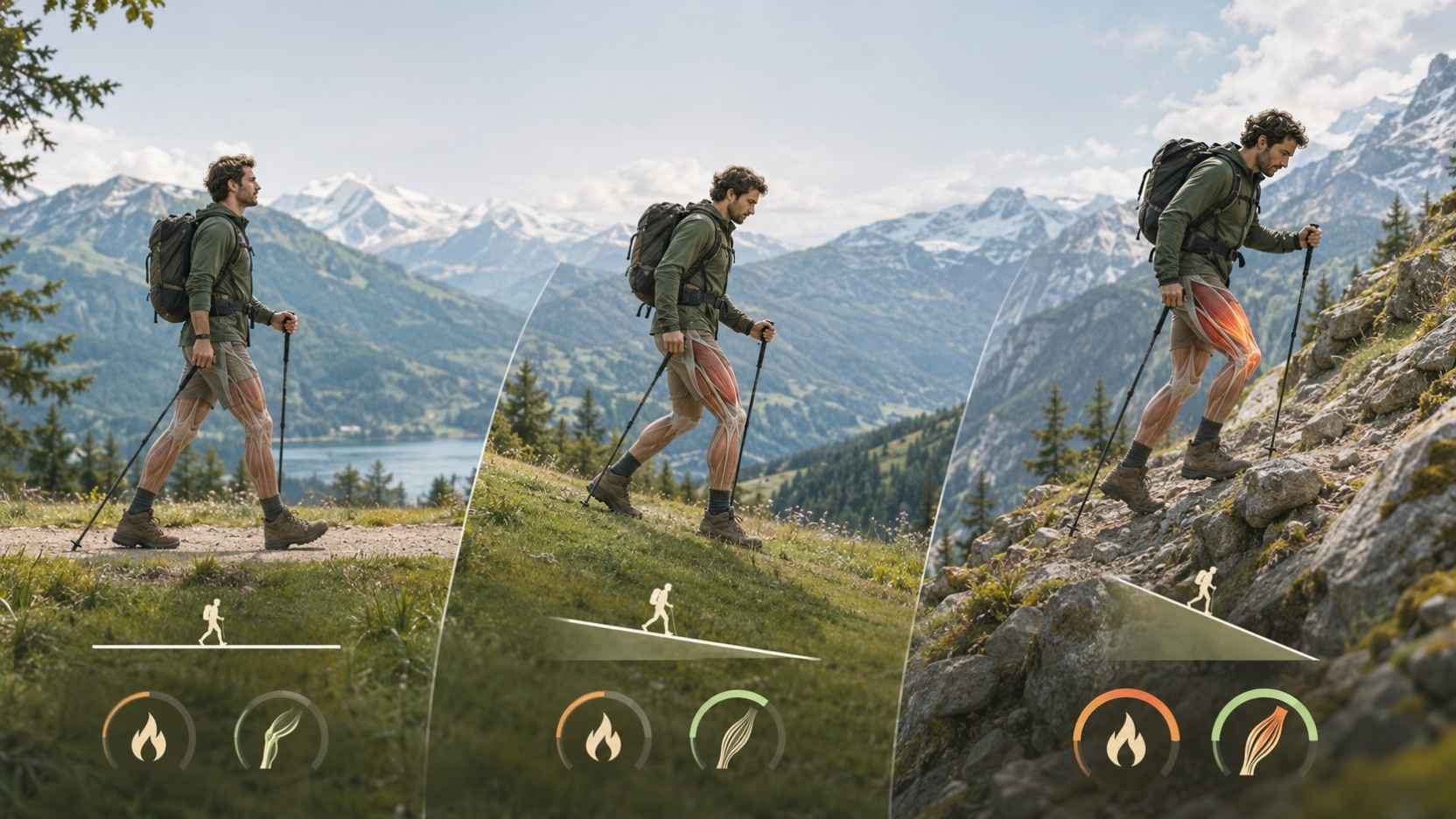
A treadmill displaying a 15% incline represents a grade of approximately 15 meters of vertical rise for every 100 meters of horizontal distance. A mountain trail with a consistent 15% grade has essentially the same geometric steepness, assuming the treadmill is properly calibrated. 📐 Importantly, 15% grade does not mean a 15-degree angle, because a 15% grade corresponds to approximately 8.5 degrees.
The important difference is that outdoor trails rarely maintain an identical grade across every section of a climb. A trail averaging 15% uphill might include short sections at 5%, steep stretches above 20%, switchbacks, and relatively level areas. Therefore, matching the average grade on a treadmill does not guarantee matching the actual walking effort of an outdoor route.
What Real Hiking Adds That Treadmills Cannot Fully Reproduce
Treadmills generally provide predictable footing, consistent traction, and a uniform surface that allows walkers to maintain a repetitive stride. Real hiking trails introduce loose gravel, mud, exposed roots, uneven rocks, and obstacles that require constant changes in foot placement and balance. 🌲 Research on walking across different outdoor surfaces has demonstrated that terrain characteristics can affect metabolic energy expenditure even when walking speed remains similar.
A mountain trail may also require stepping over fallen branches, taking unusually high steps, navigating switchbacks, and slowing down before difficult sections. These movements create demands that a standard treadmill calorie equation does not fully represent, although outdoor walking is not automatically more energy-intensive under every matched condition. The difference depends on the specific trail, movement patterns, walking speed, and environmental conditions, rather than simply whether the activity occurs indoors or outdoors.
How Backpack Weight Changes The Calorie Comparison 🎒
A backpack introduces another important difference because additional equipment, food, and water increase the mass carried during walking. Studies of loaded walking show that heavier loads generally increase metabolic energy requirements, although the relationship also depends on walking mechanics and load placement. Consequently, a hiker carrying a 12-kilogram backpack may experience different energy demands from an unloaded treadmill walker of the same body weight.
However, simply adding backpack weight to a standard treadmill equation does not automatically produce an accurate loaded-hiking calorie estimate. The original walking equation was developed for controlled exercise conditions, while backpacking changes posture, balance, movement efficiency, and the way forces are distributed through the body. For practical calculations, record backpack weight separately and consider using an appropriately validated load-carriage model when estimating backpacking energy expenditure.
Why Walking Pace Changes The Comparison
Comparing treadmill and outdoor hiking calories becomes more complicated when the two activities involve different walking speeds. Someone may comfortably maintain three miles per hour on a treadmill at a moderate incline but move considerably slower while climbing a rocky mountain trail. ⏱️ This distinction matters because energy expenditure depends on both how intensely someone walks and how long the activity continues.
An equal-speed comparison examines the energy needed to maintain the same walking pace, while an equal-duration comparison asks how much energy is expended during the same amount of time. An equal-distance comparison is different again because a slower uphill hike usually requires more time to finish the specified distance. Hikers should identify which comparison they are making before interpreting two calorie totals as equivalent.
How Many Calories Does Incline Treadmill Walking Burn?
The American College of Sports Medicine uses a standard walking equation that estimates oxygen consumption from walking speed and treadmill grade. For steady walking, the equation is VO₂ = 0.1 × speed + 1.8 × speed × grade + 3.5, where speed is measured in meters per minute and grade is expressed as a decimal. The resulting oxygen estimate can be converted into approximate calories using body weight and exercise duration.
For example, a 70-kilogram person walking at three miles per hour on a 10% incline for 60 minutes has an estimated expenditure of approximately 547 total calories using this equation. The same person walking at the same speed on a level treadmill would have an estimated expenditure of around 242 total calories, assuming steady walking without substantial handrail support. These values are mathematical estimates rather than individually measured calorie burns, and the equation is best suited to steady walking within its intended speed range of approximately 1.9–3.7 miles per hour.
Why Treadmill Calorie Displays Are Not Always Accurate
Most treadmills estimate calories using programmed calculations rather than directly measuring how much oxygen a person consumes. Their accuracy can depend on whether the machine knows the user’s correct body weight, recognizes walking speed and incline accurately, and applies an appropriate calculation. Some displays also report total calories while others emphasize exercise calories, creating confusion when two devices produce different numbers.
Handrail use introduces another complication because gripping the rails and supporting body weight can reduce the muscular effort required at a particular incline. Research examining treadmill walking has found that substantial handrail support, particularly when combined with leaning backward, can reduce measured energy expenditure. ⚠️ A treadmill may therefore overestimate calories relative to a formula assuming unsupported walking when someone heavily relies on the handrails.
Treadmill Vs Outdoor Hiking Comparison Worksheet 📊
A useful comparison worksheet should record body weight, walking speed, gradient, session duration, backpack load, and the conditions under which the activity occurs. Keeping these variables separate prevents readers from assuming that two activities with similar elevation profiles necessarily require identical amounts of energy. The following worksheet provides a starting point for comparing an indoor training session with a planned outdoor climb.
| Variable | Incline Treadmill | Outdoor Uphill Hiking |
|---|---|---|
| Body weight | ___ kg | ___ kg |
| Walking speed | ___ mph | ___ mph |
| Incline or ascent | ___ % grade | ___ m elevation gain |
| Moving duration | ___ minutes | ___ minutes |
| Backpack weight | ___ kg | ___ kg |
| Walking surface | Smooth moving belt | Actual trail conditions |
| Calories | Estimated from treadmill model | Requires a trail-specific estimate |
When completing the worksheet, begin by matching the planned climbing characteristics rather than forcing the calorie totals to agree. A treadmill session can simulate a similar grade and approximate climbing rate, but trail conditions and loaded walking may change the final energy requirement. The adjustable comparison tool below the article can help readers explore these differences before transferring the information into a hiking calorie calculator.
How To Use Treadmill Numbers For Backpacking Food Estimates 🍎
Treadmill calorie figures can be useful for planning because they illustrate how changes in grade, body weight, walking speed, and exercise duration influence estimated energy expenditure. However, an indoor workout estimate should not be treated as the guaranteed number of calories required for an entire backpacking day. A hiking day also includes variable terrain, downhill sections, rests, backpack loads, and energy needs outside the recorded walking session.
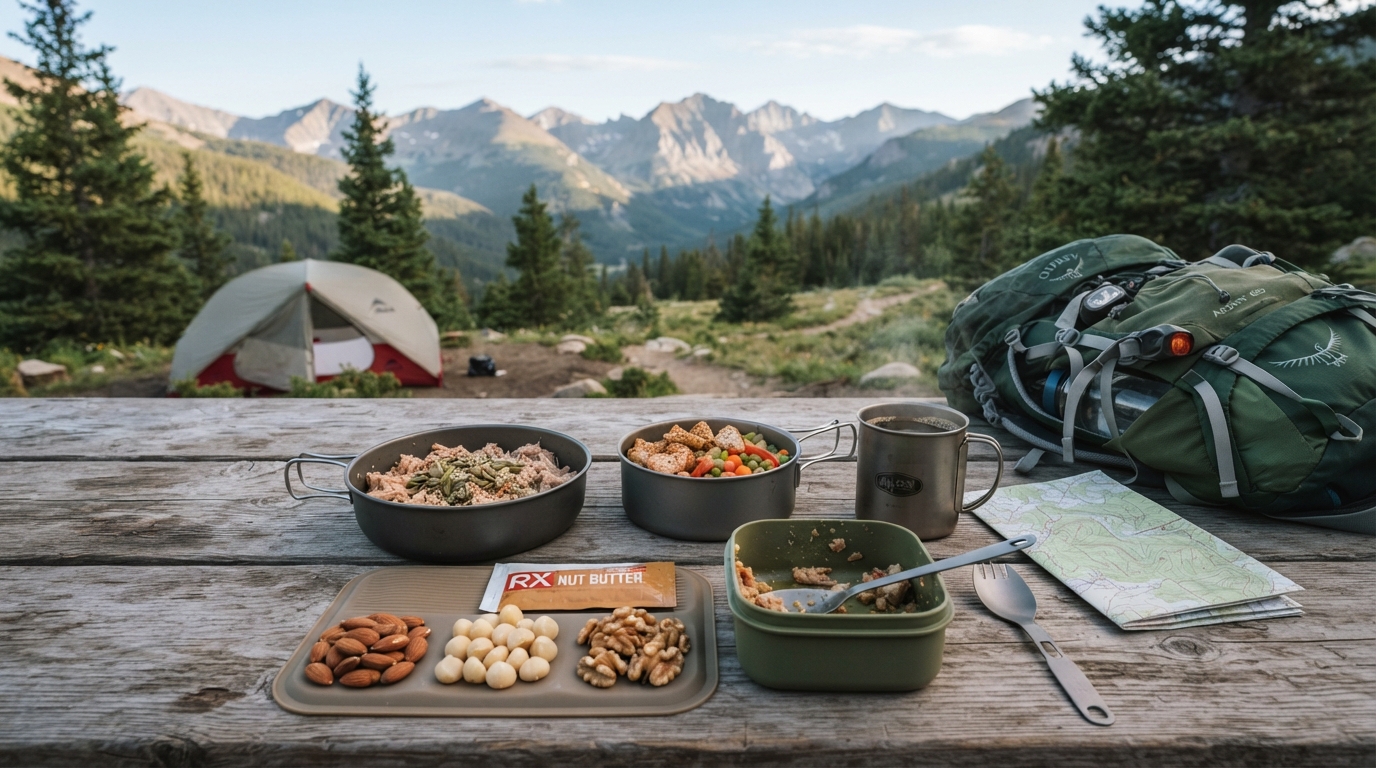
For food planning, start with a hiking calorie calculator that accounts for the intended route and the variables supported by its underlying calculation method. Then consider expected hiking duration, elevation gain, backpack weight, daily energy requirements, and the calorie density of the food you intend to carry. 🥜 The resulting estimate should serve as a planning reference rather than an exact prescription for how much an individual must eat.
A Practical Treadmill Strategy For Future Backpackers
An incline treadmill can help hikers practice sustained uphill walking without requiring access to a nearby mountain. One useful approach is to record speed, incline, moving duration, and perceived effort during repeatable sessions rather than focusing exclusively on the displayed calorie count. Comparing similar sessions over time creates a more consistent picture of training demands than comparing unrelated workouts with different settings.
As hiking preparation becomes more specific, outdoor practice remains important for learning how to manage irregular footing, equipment weight, changing terrain, and route navigation. Treadmill walking can complement those experiences by providing a controlled way to practice climbing movements and sustained walking effort. ⛰️ The goal is not to make the treadmill replicate every outdoor variable, but to combine repeatable indoor training with realistic outdoor preparation.
Final Verdict: Do Incline Treadmills Match Real Hiking Calories?
Incline treadmills can provide a reasonable starting point for estimating uphill walking energy expenditure when body weight, walking speed, grade, and duration are known. They also reproduce an important part of uphill movement, even though the walker remains physically stationary relative to the room. Nevertheless, outdoor hiking calorie requirements may be higher, lower, or similar depending on terrain, backpack weight, speed, walking mechanics, and other conditions.
For backpackers, the most useful approach is to treat treadmill data as one component of a broader trail nutrition calculation. Use indoor numbers to understand the energy demands of controlled climbing, then evaluate the actual route and equipment before planning food quantities. A treadmill can help estimate uphill effort, but the trail determines the final conditions of your hike. 🥾