Your Hiking Calculator Says 1,700 Calories: How Much Food Should You Actually Pack?
🥾 Your hiking calculator says you will burn 1,700 calories on a mountain hike, so should you immediately pack 1,700 calories of snacks? That number can look surprisingly high, especially when your planned outing lasts only five or six hours. However, how much food to pack for a mountain hike depends on more than the calories displayed by a fitness watch or online calculator.
🎒 The important distinction is that calories burned during hiking are not automatically the same as calories you must carry in your backpack. Your breakfast, meals after the hike, hiking intensity, expected duration, and emergency food all influence your packing decisions. Understanding those differences can help you avoid both unnecessary pack weight and inadequate food preparation.
Why A 1,700-Calorie Hiking Estimate Doesn’t Tell The Whole Story
⛰️ A hiking calculator estimates energy expenditure using information such as body weight, hiking duration, distance, speed, and sometimes elevation gain. Two people completing the same mountain route can expend different amounts of energy because their body sizes, walking efficiency, and effort levels differ. Consequently, 1,700 calories should be treated as an estimate rather than an exact measurement.
⌚ Fitness watches introduce additional uncertainty because they estimate energy expenditure indirectly from movement, heart rate, and other information rather than directly measuring metabolism. Scientific reviews of wearable devices have identified substantial variation in calorie-estimation accuracy across different models and activities. A calculator displaying 1,705 calories therefore does not mean your body used precisely 1,705 calories or that you need an identical amount of food in your pack.
Exercise Calories Vs Total Daily Energy Requirements
🔥 Your body uses energy even when you are sleeping, sitting, or reading a trail map, and this resting expenditure continues throughout the day. Total daily energy expenditure includes resting metabolism, physical activity, and energy involved in processing food. Hiking adds activity-related expenditure, but the way your device reports that expenditure determines how the numbers should be interpreted.
📊 Some fitness applications distinguish active calories from total workout calories, while others display a single estimated figure. Total workout calories generally include resting energy expenditure during the recorded activity, whereas active calories represent energy above that resting amount. Adding total workout calories to an entire day’s resting-energy estimate without accounting for the overlap can double-count some expenditure.
What Happens When Your Calorie Estimate Is Too High Or Too Low?
🎒 If a calculator overestimates your hiking expenditure, you might pack considerably more food than your outing requires, increasing backpack weight and potentially bringing home untouched snacks. Extra food is not automatically wasted, because a reasonable emergency reserve can be useful when weather, navigation problems, or slower travel extend your outing. The practical goal is to distinguish planned meals and snacks from emergency provisions rather than eliminating every spare calorie.
⚠️ Underestimating the outing can create the opposite planning problem, particularly when steep climbs, unexpected delays, and longer walking times increase food requirements. Your food plan should consider anticipated effort, how long you will be away from meals, and whether you have previously found certain portions adequate on comparable hikes. Calculator uncertainty is not a reason to ignore fueling; it is a reason to prepare a flexible food plan rather than a rigid calorie prescription.
How To Build A Food Budget For A Long Mountain Hike
🍳 Instead of immediately converting the 1,700-calorie estimate into snack portions, divide your hiking day into breakfast, food carried on the trail, and meals available afterward. For illustration, someone might plan a 450-calorie breakfast, 750 calories of intended trail food, and a 900-calorie combined post-hike meal and snack. These figures are examples of food allocation, not a recommended total daily intake or a promise that they meet every hiker’s energy needs.
🥪 The resulting 2,100 calories of planned food should not be directly compared with 1,700 exercise calories because the two figures measure different things. Other meals, resting expenditure, normal daily movement, and individual energy requirements still matter when evaluating the full day’s intake. Your trail-food budget should therefore reflect what you expect to eat before and after hiking, with adjustments for the duration, difficulty, and uncertainty of your route.
Five Trail Foods And Their Calories Per Ounce
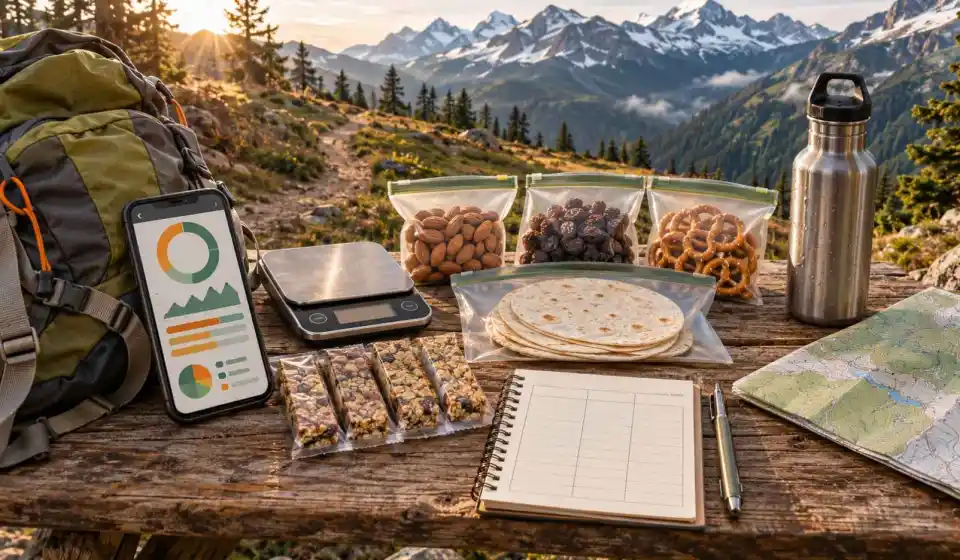
🥜 Calorie density measures how much food energy you obtain from a particular weight, making it useful when preparing a backpacking or mountain-hiking menu. A food containing 160 calories per ounce supplies twice as many calories per ounce as food containing 80, although that does not make it automatically better for every hiking situation. The following examples use rounded values calculated from listed nutrition servings for recognizable supermarket products.
| Trail food | Labeled serving | Calories per ounce |
|---|---|---|
| Sun-Maid raisins | 90 cal / 28 g | ≈91 |
| Rold Gold pretzels | 110 cal / 28 g | ≈111 |
| Mission soft taco flour tortilla | 140 cal / 50 g | ≈79 |
| Blue Diamond whole natural almonds | 160 cal / 28 g | ≈162 |
| CLIF Chocolate Chip Bar | 250 cal / 68 g | ≈104 |
📦 These examples come from published product nutrition information, and specific formulations or package labels may differ. Raisins, pretzels, and tortillas primarily contribute carbohydrates, while almonds contain considerably more fat and relatively less carbohydrate per ounce. A practical hiking food bag often combines several types rather than relying exclusively on the most calorie-dense option.
Calorie-To-Food-Weight Calculator: Three Sample Scenarios
⚖️ Once you have selected a trail-food calorie budget, you can estimate food weight using a simple equation: food weight in ounces = planned food calories ÷ average calories per ounce. A 900-calorie food allocation averaging 120 calories per ounce would weigh approximately 7.5 ounces before wrappers and containers. Changing the average calorie density changes the carrying weight without changing the total calorie allocation.
| Trail-food budget | 90 cal/oz | 120 cal/oz | 160 cal/oz |
|---|---|---|---|
| 600 calories | 6.7 oz | 5.0 oz | 3.8 oz |
| 900 calories | 10.0 oz | 7.5 oz | 5.6 oz |
| 1,200 calories | 13.3 oz | 10.0 oz | 7.5 oz |
🥾 These scenarios illustrate weight calculations, not suggested intake targets for specific hiking durations. Higher-calorie-density foods can reduce pack weight, but carbohydrate availability, personal preference, food texture, and ease of eating remain important practical considerations. Water, drinks, food packaging, and any emergency reserve must also be accounted for separately.
Sample Food Pack For A 5.5-Hour Mountain Outing
🏔️ Imagine a hiker planning a 5.5-hour mountain outing after eating breakfast at home, with a meal available after returning. Rather than automatically carrying the entire calculator estimate of 1,700 calories, the hiker chooses an illustrative trail-food allocation of 750 calories plus a separate emergency bar. The following pack combines sweet and savory foods without requiring trail cooking.
| Packed food | Quantity | Calories |
|---|---|---|
| Chocolate chip energy bar | 1 bar | 250 |
| Flour tortilla | 1 tortilla | 140 |
| Pretzels | 1 oz | 110 |
| Raisins | 1 oz | 90 |
| Almonds | 1 oz | 160 |
| Planned trail food | 750 | |
| Extra emergency energy bar | 1 bar | 250 |
| Total food carried | 1,000 |
🎒 Using the example serving weights, the intended 750-calorie food allocation weighs approximately 7.1 ounces, increasing to around 9.5 ounces with the reserve bar, excluding packaging. This is a packing illustration rather than a suitable amount for everyone, because a strenuous outing, larger individual requirements, or missed meals could justify substantially different quantities. A hiker should also plan drinking water, appropriate weather protection, and enough additional provisions for credible delays rather than judging preparedness from food calories alone.
Printable Hiking Food Calculator Worksheet
📝 A repeatable mountain hiking food planning worksheet helps you move beyond guessing from the workout-calorie number displayed on your phone. Complete the trip information first, then list meals available outside the trail and estimate your intended packed food using familiar portions. Finally, calculate the food weight from nutrition labels and confirm that your emergency reserve is included.
| Planning question | Your answer |
|---|---|
| Expected hiking duration | ______ hours |
| Elevation gain and trail difficulty | ______ |
| Calculator’s calorie estimate | ______ cal |
| Estimate type: active or total | ______ |
| Breakfast before departure | ______ cal |
| Intended food carried | ______ cal |
| Meals available after hiking | ______ |
| Average packed food density | ______ cal/oz |
| Packed food weight | ______ oz |
| Extra emergency food | ______ |
| Water and refill plan | ______ |
✅ For example, if your intended trail-food budget is 800 calories and your selected foods average 125 calories per ounce, the estimated weight is 800 ÷ 125 = 6.4 ounces. Check the actual serving weights and calorie labels because a mixed food bag will rarely match a perfectly round average density. After the hike, compare what you carried with what you ate and use that experience to improve future planning without treating any single outing as a universal standard.
The Better Rule: Pack For Your Whole Hiking Day
🥾 Hiking calories burned versus calories needed becomes easier to understand once you stop treating those phrases as interchangeable. A 1,700-calorie workout estimate provides context about the possible energy demands of the route, but it cannot determine your packed-food requirement by itself. The more useful approach combines your hike duration, estimated effort, meals before and afterward, food density, and reasonable emergency preparation.
🎒 For some hikers, a substantial packed lunch and several snacks may be appropriate, while others will plan their food differently depending on the same day’s schedule and expected conditions. Neither approach should be judged solely by whether the trail-food calories equal a fitness watch’s reported number. The best hiking food plan is one you can carry, eat comfortably, adjust to changing circumstances, and repeat with better information after each trip.