🛒 How to Find Cheap High-Calorie Backpacking Foods at Any Supermarket
You don’t need a specialty outdoor store to build a good backpacking food supply.
In fact, some of the most practical backpacking foods are sitting in ordinary supermarket aisles right now.
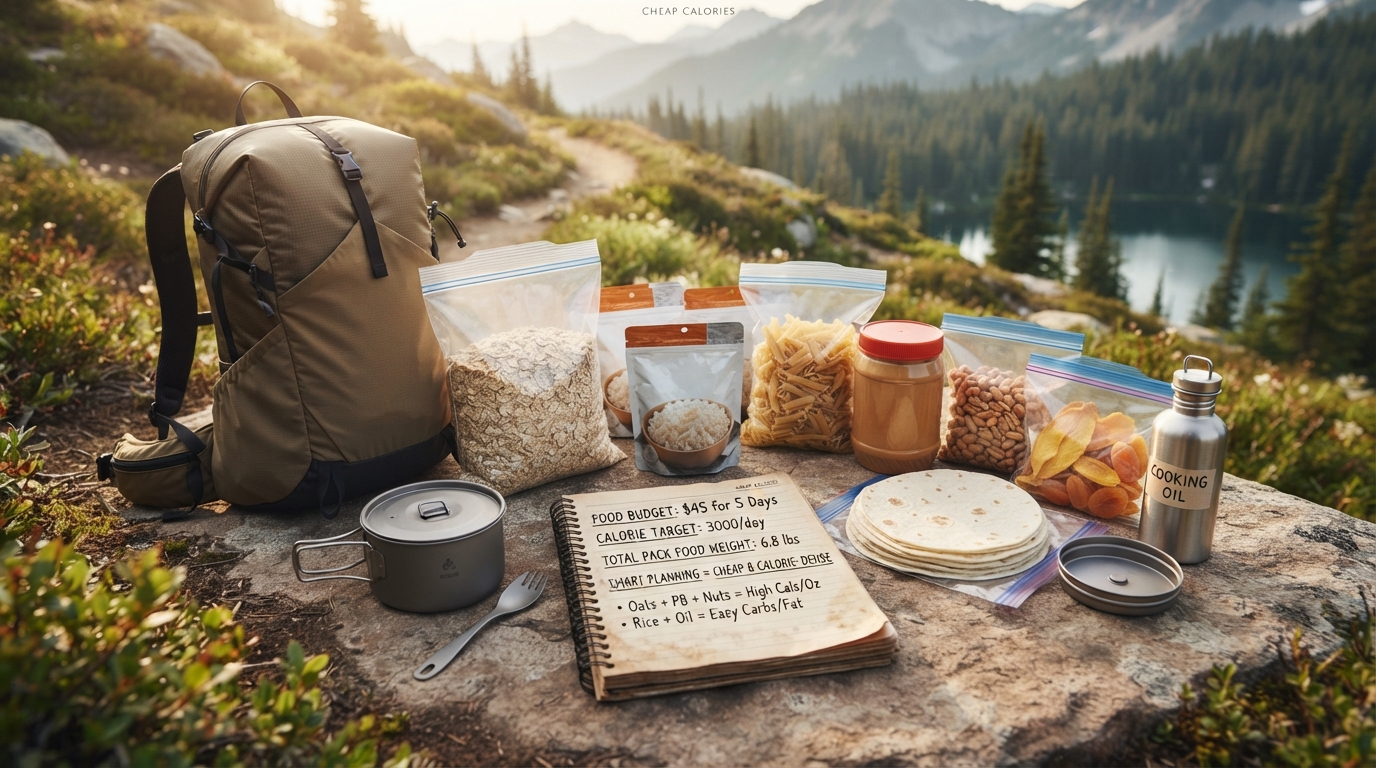
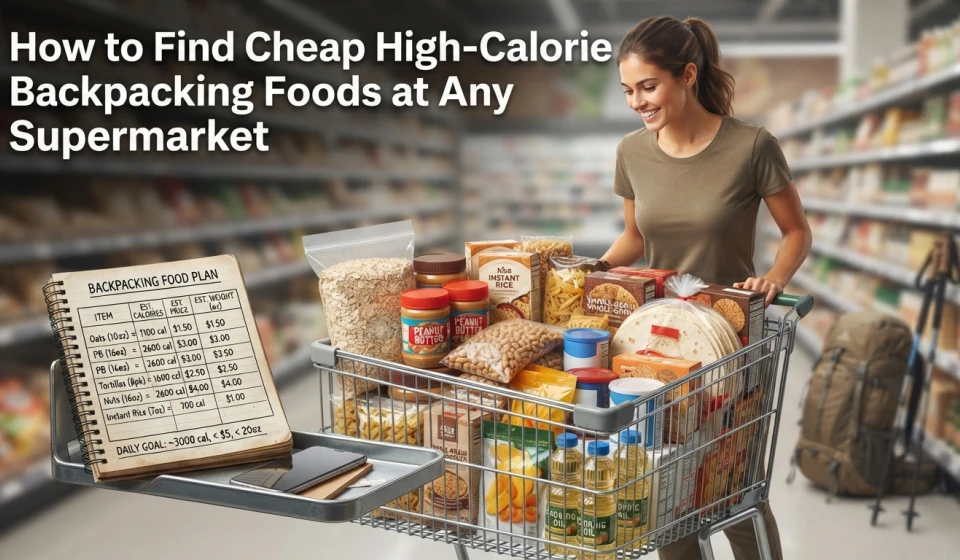
Oats, pasta, instant rice, peanut butter, crackers, nuts, powdered milk, tortillas, dried fruit, and other shelf-stable foods can become the foundation of inexpensive trail meals. The trick is knowing what to look for and how to compare products.
Instead of shopping by packaging or marketing claims, shop using five simple questions:
How many calories does it provide? How much does it cost? How much does it weigh? How easy is it to prepare? Will it hold up on the trail?
Once you start looking at food this way, a regular supermarket becomes your backpacking-food store. 🎒🥜
🔎 Start With the Nutrition Label
The nutrition label is one of your most useful backpacking-planning tools.
Don’t judge a food by the size of the package. Check the actual serving information.
Look for:
- Calories per serving
- Serving size in grams
- Protein
- Fat
- Carbohydrates
- Fiber
- Number of servings per package
A package might look small but contain several servings.
Likewise, a large package doesn’t automatically mean it provides more useful energy for its weight.
For backpacking, you want to know the total calories in the amount you actually plan to carry.
A simple calculation
If a food provides 200 calories per serving and the package contains five servings:
200 × 5 = 1,000 calories
You can then compare those 1,000 calories with the product’s price and weight.
This is much more useful than simply saying, “This package looks filling.”
💰 Compare Calories Per Dollar or Peso
Price alone doesn’t tell you whether a food is economical.
A better comparison is:
Calories per peso = total calories ÷ price
For example, imagine two products:
Food A:
1,000 calories for ₱100
= 10 calories per peso
Food B:
1,500 calories for ₱120
= 12.5 calories per peso
Food B costs more at checkout, but provides more calories for each peso spent.
This calculation is especially useful when comparing similar products.
You can use the same method with dollars or any other currency.
Don’t obsess over the exact number
You don’t need to calculate calories per peso for every item in the supermarket.
Focus on foods that will make up a large part of your backpacking menu.
These might include:
- Oats
- Rice
- Pasta
- Nut butter
- Nuts
- Crackers
- Tortillas
- Dried fruit
- Snack mixes
⚖️ Check Calories Per Gram Too
Cost isn’t the only thing that matters.
You’re also carrying the food on your back.
That makes calories per gram useful.
The formula is:
Calories per gram = total calories ÷ food weight in grams
For example, if a food contains 1,000 calories and weighs 500 grams:
1,000 ÷ 500 = 2 calories per gram
This lets you compare foods based on pack weight.
A food can be inexpensive but still inefficient if you need to carry a large amount to get enough calories.
For longer trips, this becomes particularly important.
Think beyond “cheap”
A good backpacking food often has a balance between:
Low cost + high calories + reasonable weight + easy preparation
You don’t necessarily need the absolute highest calorie density.
You need a combination that works for your trip and your body.
🥜 Search the Peanut Butter and Nut Aisle
The spreads and nut sections of a supermarket are worth checking early.
Nut butters can be useful backpacking ingredients because they provide concentrated energy and require no cooking.
Depending on your preferences and dietary needs, consider:
- Peanut butter
- Almond butter
- Other nut butters
- Peanuts
- Mixed nuts
- Seeds
For a budget-conscious menu, compare package prices and nutrition labels rather than automatically choosing the premium product.
Store-brand or larger packages may offer better value, although prices vary by supermarket.
Backpacking trick
Instead of carrying a large jar, portion the amount you need into a suitable leak-resistant container.
Always test your packaging before putting it inside your backpack.
A leaking container can turn an inexpensive meal into a very unpleasant packing problem. 😅
🥣 Don’t Skip Oats
The breakfast aisle is another excellent place to look.
Plain oats are inexpensive, easy to portion, and simple to customize.
You can combine them with:
- Powdered milk
- Peanut butter
- Dried fruit
- Sugar
- Honey
- Seeds
- Cinnamon
- Other shelf-stable ingredients
Oats also allow you to control the final calorie content.
If a basic bowl isn’t enough energy for your hiking day, adding an appropriate amount of nut butter, powdered milk, dried fruit, or another calorie source can increase the meal without completely changing the base.
🍝 Check the Pasta Aisle
Dry pasta can be an inexpensive backpacking staple.
It provides carbohydrates and can form the foundation of a simple dinner.
However, cooking time matters.
Traditional pasta may require more fuel and water than quick-cooking alternatives.
When shopping, look for products that fit your cooking system.
Possible options include:
- Quick-cooking pasta
- Small pasta shapes
- Instant noodles
- Instant rice
- Other quick-cooking grain products
The cheapest product isn’t necessarily the most efficient if it requires significantly more fuel or cooking time.
🍚 Look for Instant Rice and Quick-Cooking Grains
Instant rice can be especially convenient for backpacking because it can often be prepared with hot water rather than requiring prolonged cooking.
Depending on the product, it can be paired with:
- Shelf-stable protein
- Seasoning
- Oil
- Powdered sauces
- Dried vegetables
- Other dehydrated ingredients
Always follow the product’s preparation instructions and test your meal before taking it on a longer trip.
🫓 Explore the Bread and Tortilla Section
Tortillas can be useful for no-cook or low-cook meals.
They can be paired with foods such as:
- Peanut butter
- Shelf-stable spreads
- Cheese products suitable for your conditions
- Tuna or other packaged proteins when appropriate
- Dried fruit
Their usefulness depends on how well they fit your particular trip.
Check how easily they pack, whether they crush easily, and how long they remain acceptable in the expected conditions.
🍪 Don’t Ignore Crackers and Snack Foods
The snack aisle can contain several useful backpacking foods.
Look for products that are:
- Shelf-stable
- Compact
- Easy to portion
- Calorie-dense enough for your needs
- Easy to eat while hiking
Crackers, cookies, pretzels, snack mixes, and similar foods can sometimes become useful components of a trail menu.
However, don’t automatically assume that every snack food is a good backpacking choice.
Check the calories, weight, packaging, and how well it travels.
🍇 Search the Dried Fruit Section
Dried fruit is useful when you want a lightweight source of carbohydrates.
Options may include:
- Raisins
- Dried mango
- Dried banana
- Dates
- Other dried fruits
Dried fruit can work particularly well as part of a trail mix.
Because products vary considerably in added sugar, moisture content, and weight, check the nutrition label rather than assuming all dried fruit has the same calorie density.
🥛 Look for Powdered Milk and Shelf-Stable Ingredients
The baking, beverage, or dairy-related sections may contain powdered ingredients that can be useful in backpacking meals.
Powdered milk can add protein and calories to foods such as oatmeal or other rehydrated meals.
Other powdered ingredients may also work, depending on the recipe and your dietary preferences.
The important consideration is whether the product remains safe and practical once prepared.
Dry ingredients are generally easier to transport than foods that require refrigeration, but once mixed with water, different storage and food-safety considerations apply.
🥫 Be Careful With Canned Foods
Supermarkets are full of inexpensive canned foods, but not every cheap food belongs in your backpack.
Canned food can be heavy because you’re carrying both the food and the container.
For a short trip, you might deliberately choose a canned item if the convenience is worth the weight.
For longer trips, however, the weight can quickly add up.
Before putting a canned food in your backpack, ask:
How many calories am I carrying for the weight?
If the answer isn’t attractive, look for a shelf-stable alternative with a better weight-to-calorie ratio.
🧈 Use Oils Strategically
Cooking oils are extremely energy-dense, which makes them useful for increasing the calories of meals without adding a large amount of food volume.
A small amount can be added to appropriate meals such as:
- Pasta
- Rice
- Couscous
- Other savory dishes
But oil requires careful packaging.
Use a leak-resistant container and place it somewhere where a failure won’t contaminate your entire food bag.
Also remember that very fatty meals don’t work equally well for everyone. Test your meals before your trip.
🧾 Learn to Read the Supermarket Like a Backpacker
Instead of walking through the supermarket thinking:
“What food should I buy?”
Try asking:
“Which foods give me the calories, weight, price, and convenience I need?”
This changes how you shop.
Your supermarket checklist
When you pick up a product, check:
1. Calories
How many total calories will I actually carry?
2. Weight
How heavy is the food?
3. Price
What does it cost per package and per calorie?
4. Preparation
Does it require boiling, soaking, or cooking?
5. Water
How much water does it need?
6. Fuel
Will it require significant stove time?
7. Packaging
Can I repackage it efficiently?
8. Storage
Will it remain suitable for the expected trip conditions?
9. Taste
Will I actually want to eat it after several hours of hiking?
10. Nutrition
Does it contribute useful protein, carbohydrates, fats, or other nutrients to your overall menu?
🧮 Create a Supermarket Comparison Table
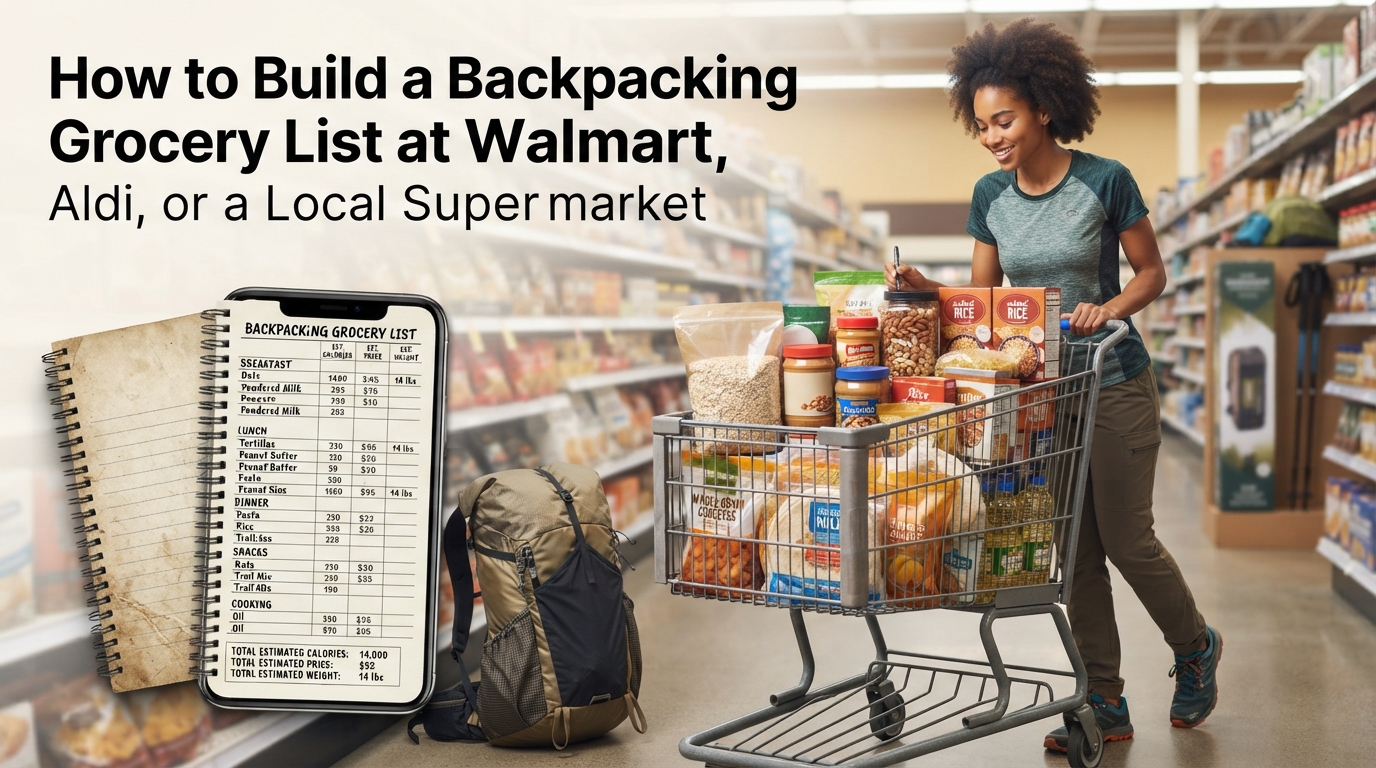
You can make shopping much easier by keeping a simple spreadsheet or note on your phone.
| Food | Price | Calories | Weight | Calories/g | Main Use |
|---|---|---|---|---|---|
| Oats | — | — | — | — | Breakfast |
| Peanut butter | — | — | — | — | Breakfast/snack |
| Instant rice | — | — | — | — | Dinner |
| Pasta | — | — | — | — | Dinner |
| Peanuts | — | — | — | — | Snack |
| Dried fruit | — | — | — | — | Snack |
| Crackers | — | — | — | — | Lunch/snack |
Fill in the numbers from the actual products available at your supermarket.
This is better than copying a universal “best backpacking foods” list because prices and product sizes vary by location and store.
🎒 Build a Meal, Not Just a Grocery Bag
Buying individual high-calorie foods is only the beginning.
You still need to combine them into meals.
For example:
Breakfast
Oats + powdered milk + peanut butter + dried fruit
Lunch
Tortilla + peanut butter + dried fruit + crackers
Dinner
Instant rice + shelf-stable protein + oil + seasoning
Snacks
Peanuts + dried fruit + crackers
The exact quantities should be calculated according to your personal calorie needs and trip conditions.
The goal is to make every item in your backpack have a purpose.
🚫 Avoid the “Cheap but Useless” Trap
Some foods look inexpensive but aren’t particularly helpful for backpacking.
Be cautious with foods that are:
- Extremely bulky
- Mostly packaging
- Very heavy because of water content
- Difficult to prepare
- Fragile or messy
- Highly perishable
- Low in calories for their weight
- Unpleasant to eat after a long day
This doesn’t mean you can never bring them.
A favorite comfort food can absolutely be worth carrying.
Backpacking food isn’t a mathematical competition.
Enjoyment matters too.
A slightly heavier food that you genuinely look forward to eating may be a better choice than an ultra-efficient food you hate.
💡 The “Five-Number” Supermarket Test
For a quick shopping system, write down these five numbers for promising foods:
Price
Total calories
Total weight
Calories per gram
Calories per peso/dollar
Then add one final question:
Would I actually eat this on Day 3?
If the answer is yes, you may have found a useful backpacking food.
🌲 Final Thoughts
Finding cheap, high-calorie backpacking food doesn’t require a special shopping list or an expensive outdoor store.
Start with your supermarket.
Read the nutrition label. Compare total calories. Check food weight. Calculate calories per gram when useful. Compare prices based on the amount of energy you’re actually getting. Then consider preparation time, water, fuel, storage, packaging, and taste.
The best bargain isn’t necessarily the food with the lowest price tag.
It’s the food that gives you the right combination of calories, cost, weight, convenience, and enjoyment for your particular trip. 🥾💰
Once you learn to shop this way, the supermarket becomes less like a place to buy random snacks and more like a toolkit for building an efficient backpacking menu.