BV500 Food Capacity Guide: How to Pack 3, 5, 7, or More Days
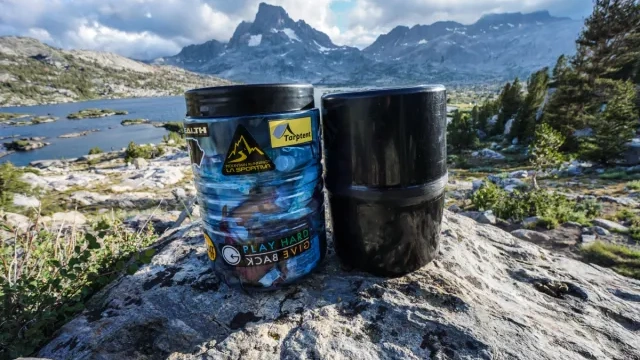
The BearVault BV500 is one of the most recognizable bear canisters used by backpackers, but its capacity is often misunderstood.
You may see the BV500 described as a “7-day bear canister,” which is a useful starting point. But seven days is not a universal limit, and it is not a guarantee that every seven-day food plan will fit.
The BV500 has approximately 700 cubic inches, or 11.5 liters, of usable interior volume. BearVault currently lists its capacity as about seven days for one person.
The real question is:
How much food volume does your particular menu require?
Once you understand that, you can calculate whether a BV500 will work for three, five, seven, or even longer trips.
BV500 Capacity in Plain Numbers
The easiest place to start is the manufacturer’s general rule of approximately 100 cubic inches, or 1.6 liters, of canister space per person per day.
That produces this basic calculation:
3 days × 1.6 L = 4.8 L
5 days × 1.6 L = 8.0 L
7 days × 1.6 L = 11.2 L
The final number is extremely close to the BV500’s 11.5-liter usable capacity.
That is why seven days is such a common estimate.
But these calculations describe volume, not calories.
Three Days: Easy Mode
A three-day trip gives you approximately:
4.8 liters of planned capacity.
Inside an 11.5-liter BV500, that leaves considerable room.
For a solo hiker, three days may allow a relatively flexible menu. You can bring different snacks, larger breakfast portions, or a few comfort foods without immediately fighting for space.
This is also useful if your trip has unusually high calorie demands.
For example, a strenuous mountain route can require more food than an easy weekend hike.
You may choose to carry foods that are less space-efficient because you have the room.
A three-day trip is therefore less about maximizing every cubic inch and more about learning how your food behaves inside the canister.
Five Days: The Sweet Spot for Many Menus
Five days requires roughly:
5 × 1.6 = 8 liters.
That leaves approximately:
11.5 − 8 = 3.5 liters
of theoretical remaining capacity.
That sounds generous, but some of that space may be consumed by packaging inefficiency and scented items.
Still, five days gives a solo backpacker plenty of opportunities to create a balanced menu.
You can combine:
- Freeze-dried dinners
- Instant oatmeal
- Tortillas
- Nut butter
- Nuts
- Jerky
- Energy bars
- Chocolate
- Dried fruit
- Drink mixes
The key is to remove unnecessary packaging.
Seven Days: Where Packing Skill Starts to Matter
Seven days requires approximately:
7 × 1.6 = 11.2 liters.
The BV500 provides about 11.5 liters.
That leaves only around 0.3 liters of theoretical space.
In practical terms, this means a seven-day food plan should be designed carefully.
You cannot expect to buy seven days of food from a grocery store, leave every item in its original packaging, and assume it will fit.
You need to think in terms of:
Calories + volume + packaging + scentables.
A food plan can be lightweight but bulky.
Another can be calorie-dense but difficult to compress.
The best BV500 menu combines high calorie density with efficient physical packaging.
Calculate Calories Before Packing
Let’s say you plan to eat 2,800 calories per day.
For seven days:
2,800 × 7 = 19,600 calories.
If your average food provides 125 calories per ounce:
19,600 ÷ 125 = 156.8 ounces
That equals approximately 9.8 pounds of food.
The weight may be acceptable, but now you need to determine whether that 9.8 pounds physically fits into 11.5 liters.
This is where calories-per-liter becomes useful.
A food that gives you 150 calories in a compact package is more useful for a limited-volume canister than a food providing the same calories in a large, airy package.
Why Freeze-Dried Food Can Help
Freeze-dried meals are popular among backpackers because they can provide substantial calories and nutrition without the water weight of a fully prepared meal.
But packaging matters.
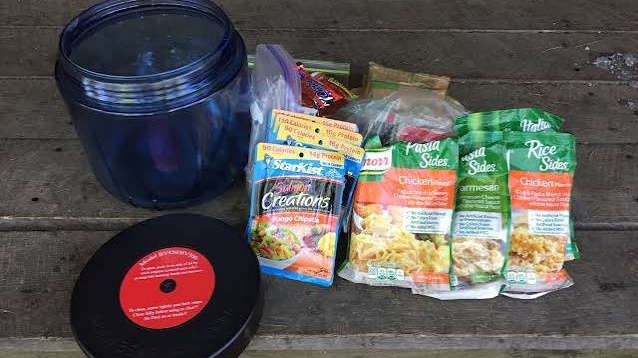
A freeze-dried meal inside a large commercial pouch may consume more canister space than the food itself requires.
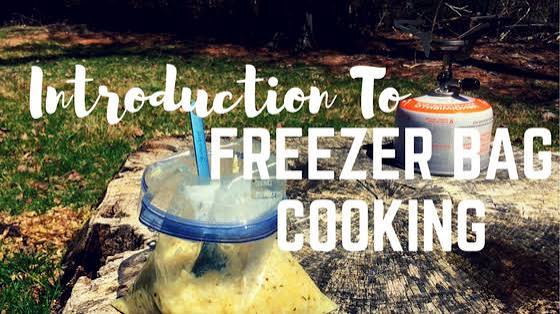
Repackaging meals into durable freezer bags can reduce wasted volume. BearVault specifically recommends repackaging foods into flexible freezer bags and filling air gaps with small, moldable foods.
Always label repackaged meals clearly with the meal name and preparation instructions.
Use Flexible Foods to Fill Gaps
Rigid packages create dead space.
Flexible bags can conform to the shape of the canister.
This makes foods such as these especially useful:
- Trail mix
- Nuts
- Powdered drink mixes
- Jerky
- Candy
- Granola
- Dehydrated fruit
- Powdered milk
- Instant potatoes
Instead of treating empty spaces as wasted space, use small flexible items to fill them.
Think of it as packing a suitcase.
Large items establish the structure. Small soft items fill the gaps.
The First Day Is Different
One of the most useful planning techniques is to separate food volume from food-storage requirements.
If you are leaving the trailhead after breakfast, some food may already be consumed before the main backcountry portion begins.
But do not assume that means you can ignore the applicable food-storage regulations while traveling.
Different parks define when and where food must be secured differently.
Always follow the rules for your exact trail.
The same applies to your last day. If you are hiking out early and will eat breakfast before leaving camp, your final storage volume may be lower.
Don’t Use Every Liter for Food
A common packing mistake is calculating:
11.5 L = food
That is not always correct.
Depending on local regulations, scented items may also need to go into the canister.
BearVault’s current guidance lists food, toiletries, sunscreen, lip balm, menstrual products, utensils, and trash among items that should be stored in the canister.
Therefore, a better calculation is:
Total canister volume − required non-food items = actual food volume.
If your toiletries and trash occupy 0.75 liters, you cannot realistically plan your menu around the entire 11.5 liters.
What Does 7+ Days Really Mean?
BearVault currently describes the BV500 as holding 7+ days of food for one person.
The “plus” is important.
Experienced ultralight backpackers who carefully select calorie-dense foods and eliminate unnecessary packaging may fit more than seven days.
But that does not mean every backpacker should plan an eight- or nine-day trip around one BV500.
The manufacturer’s detailed guide notes that capacity varies significantly depending on the type and amount of food. It gives the BV500 as suitable for seven or more days and notes that food choices can dramatically change the result.
So treat seven days as a realistic planning benchmark, not a hard physical maximum.
Two People Sharing One BV500
Sharing changes everything.
For two people on three days:
2 × 3 × 1.6 = 9.6 L.
That fits within 11.5 liters, although the actual menu still matters.
For two people on four days:
2 × 4 × 1.6 = 12.8 L.
That exceeds the nominal capacity.
This is why BearVault’s size guide gives examples of a single BV500 for two people on certain three-day trips but recommends additional capacity for longer trips.
The lesson is straightforward:
Calculate person-days, not just calendar days.
A seven-day solo trip is seven person-days.
A three-day trip for two people is six person-days.
Those are surprisingly close in terms of canister capacity.
A Simple BV500 Packing Formula
For quick planning, use:
Number of people × number of days × 1.6 L = approximate required volume
Then add a little margin for your specific menu and scented items.
Examples:
1 person × 5 days × 1.6 = 8 L
1 person × 7 days × 1.6 = 11.2 L
2 people × 3 days × 1.6 = 9.6 L
2 people × 4 days × 1.6 = 12.8 L
This is not an exact scientific measurement. It is a practical starting point based on BearVault’s published planning guidance.
How to Make Seven Days Fit Better
If your seven-day menu barely fits, try these strategies:
Remove retail packaging
Cardboard and unnecessary wrappers take up space.
Repackage meals
Use compact, flexible bags where appropriate.
Choose calorie-dense foods
Nuts, nut butter, bars, tortillas, and jerky can provide substantial calories without excessive volume.
Fill empty spaces
Use small foods to occupy gaps between larger bags.
Reduce duplicate containers
Do not carry separate bulky containers when one compact package can do the job safely.
Plan your trash
Remember that packaging you bring into the wilderness eventually becomes trash that may also need to go back into the canister.
Final Answer: How Many Days?
For a solo backpacker, the BV500 is realistically designed around about seven days of food, with the exact number depending heavily on the menu and packing method. Its usable volume is approximately 11.5 liters / 700 cubic inches.
A useful planning range is:
- 3 days: very comfortable
- 5 days: comfortable for most efficient menus
- 6 days: realistic with good packing
- 7 days: realistic target for one person
- 8 days: requires unusually efficient food packing
- 9+ days: generally requires another strategy or resupply
The most important thing is not to treat “seven days” as a magic number.
Your actual capacity depends on what you eat.
A compact 2,500-calorie menu can behave very differently from a bulky 3,500-calorie menu. Packaging, snacks, calorie density, and required scented items all change the result.
So before your trip, perform the real test: pack your complete food supply into the BV500 and close the lid.
If everything fits without forcing the container, and all required food and scented items can be stored according to local regulations, your packing math is probably working.
That is the real meaning of BV500 capacity: not simply how many days the label says, but how efficiently you can turn 11.5 liters of space into usable trail food.