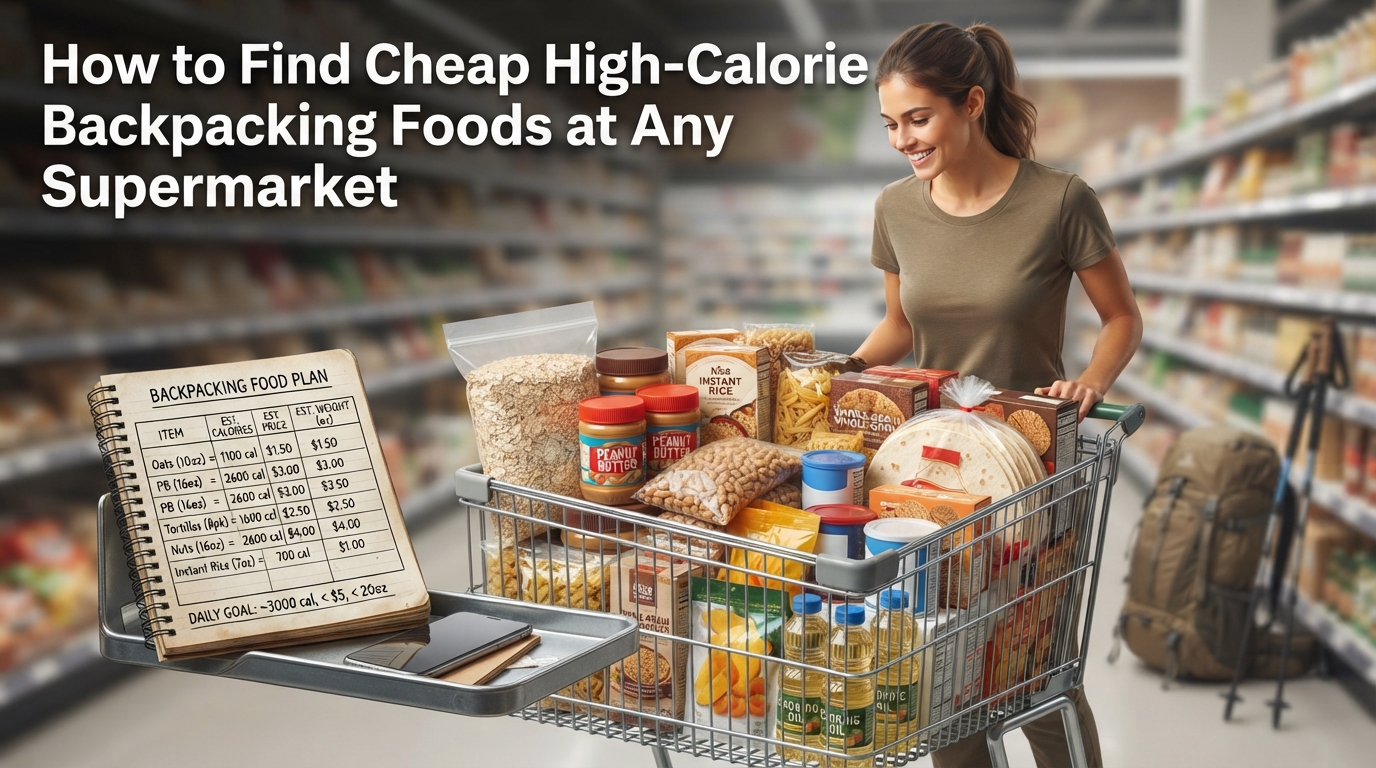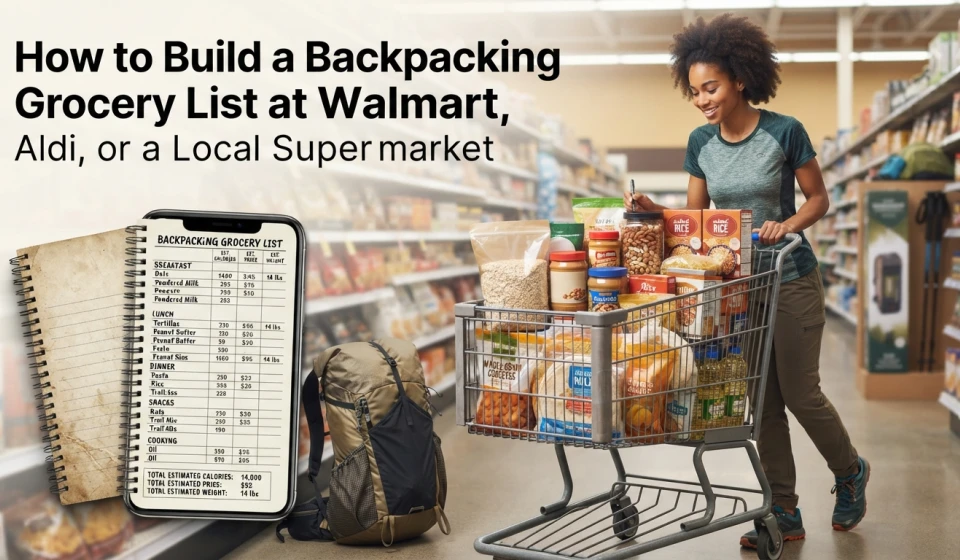
🛒 How to Build a Backpacking Grocery List at Walmart, Aldi, or a Local Supermarket
Building a backpacking grocery list doesn’t have to start with an outdoor store.
You can often find useful trail foods at Walmart, Aldi, or your local supermarket, sometimes for much less than specialty backpacking meals.
The challenge is knowing what to buy.
A normal grocery store is designed for everyday meals, not for carrying several days of food on your back. Some foods are inexpensive but heavy. Others are lightweight but expensive. Some have plenty of calories but don’t work well with your cooking system.
The solution is to build your grocery list around a few measurable factors:
Calories + cost + weight + preparation + shelf stability.
Once you understand that system, you can walk into almost any supermarket and build a backpacking food supply without depending on a specific brand or store. 🎒🥜
🥾 Start With Your Trip, Not the Store
Before entering Walmart, Aldi, or your local supermarket, figure out what you’re shopping for.
Write down:
- Number of hiking days
- Number of people
- Expected meals per day
- Approximate daily calorie target
- Cooking method
- Fuel limitations
- Water availability
- Dietary restrictions
- Foods you already know you tolerate well
Your calorie needs are individual and depend on factors such as body size, activity level, terrain, distance, weather, and hiking pace.
There isn’t one correct calorie target for every backpacker.
The important thing is to establish a reasonable daily food target before shopping.
Then you can work backward to create your grocery list.
🧮 Turn Your Daily Calories Into a Shopping Target
Suppose your trip requires approximately 2,800 calories per day.
For a 4-day trip:
2,800 × 4 = 11,200 calories
That’s your approximate trip target.
You can then divide those calories among:
- Breakfast
- Lunch
- Dinner
- Snacks
For example, you might decide that breakfast provides about 20–25% of your daily energy, lunch another 25–30%, dinner around 30%, and snacks fill the remainder.
These percentages are not rules. They’re simply a planning framework.
If you prefer to snack throughout the day instead of eating large meals, your grocery list should reflect that.
🛒 Use the Supermarket in Sections
One of the easiest ways to build a grocery list is to shop by supermarket section.
Instead of searching randomly for “backpacking food,” move through categories such as:
Breakfast aisle
Look for:
- Oats
- Instant oatmeal
- Powdered milk
- Breakfast grains
- Shelf-stable add-ins
Nut and spread section
Look for:
- Peanut butter
- Other nut butters
- Peanuts
- Mixed nuts
- Seeds
Pasta and grain aisle
Look for:
- Pasta
- Instant rice
- Couscous
- Quick-cooking grains
- Instant noodles
Snack aisle
Look for:
- Crackers
- Pretzels
- Snack mixes
- Granola
- Cookies
- Shelf-stable snack foods
Dried fruit section
Look for:
- Raisins
- Dates
- Dried mango
- Dried banana
- Other dried fruit
Protein section
Depending on your diet and trip conditions, consider:
- Tuna or other shelf-stable fish
- Meat products designed for shelf storage
- Powdered dairy products
- Nuts and seeds
- Other shelf-stable protein sources
Availability varies considerably between stores, so treat these as categories rather than guaranteed products.
💰 Don’t Shop by Sticker Price Alone
A ₱100 or $2 package isn’t automatically a good backpacking bargain.
You need to know what you’re getting for that money.
For each major food, check:
Total calories ÷ price = calories per peso or dollar
For example:
Food A costs $2 and provides 1,000 calories.
1,000 ÷ $2 = 500 calories per dollar
Food B costs $3 and provides 1,800 calories.
1,800 ÷ $3 = 600 calories per dollar
Food B costs more, but it provides more calories for the money.
You don’t need to perform this calculation for every snack in the store.
Focus on foods that will make up a large percentage of your backpacking menu.
⚖️ Add a Weight Check
Cost isn’t your only constraint.
You’re carrying everything.
Use:
Calories per gram = total calories ÷ food weight in grams
Or:
Calories per ounce = total calories ÷ food weight in ounces
This gives you a quick way to compare foods.
A food can be very inexpensive but still be inconvenient for backpacking if it contains lots of water or requires a large amount of food to provide enough energy.
This is one reason dry foods, nuts, spreads, and other concentrated foods are often useful in backpacking menus.
🥜 Build Around a Few Reliable Staples
You don’t need 30 different ingredients.
A simple grocery list can revolve around a small group of versatile foods.
For example:
Carbohydrate staples
- Oats
- Instant rice
- Pasta
- Couscous
- Tortillas
- Crackers
Calorie boosters
- Peanut butter
- Nuts
- Seeds
- Cooking oil
Protein sources
- Nuts and seeds
- Powdered milk
- Shelf-stable fish or meat
- Other shelf-stable protein products
Flavor
- Seasoning packets
- Salt
- Sugar
- Sauce mixes
- Spice blends
Snacks
- Dried fruit
- Granola
- Crackers
- Trail mix
This gives you enough flexibility to create multiple meals without buying a huge number of ingredients.
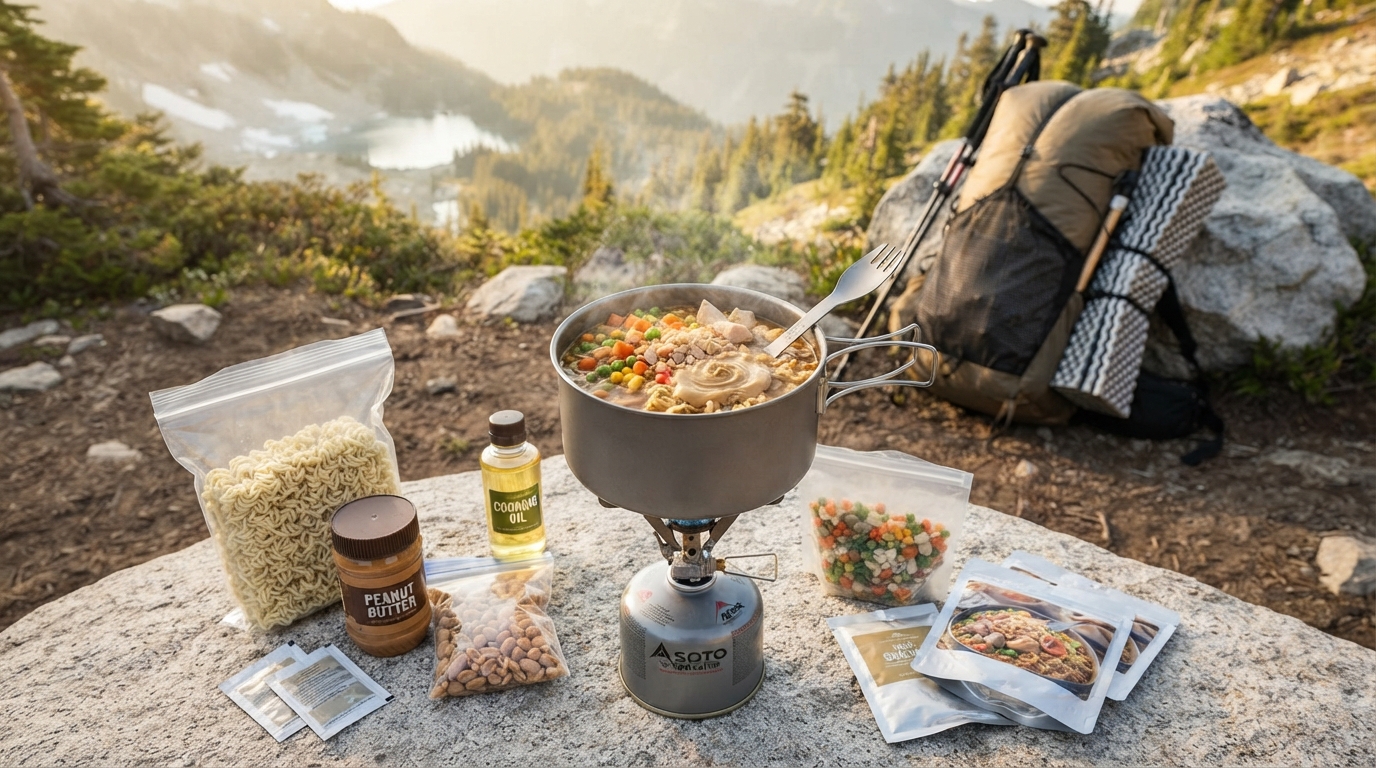
🍜 Create Meals Before You Create the Final List
Don’t fill your cart with individual foods and hope they become meals later.
Instead, create your menu first.
For example:
Breakfast
Peanut butter oatmeal
- Oats
- Powdered milk
- Peanut butter
- Dried fruit
Lunch
Tortilla snack wraps
- Tortillas
- Peanut butter
- Dried fruit
Dinner
Instant rice bowl
- Instant rice
- Shelf-stable protein
- Oil
- Seasoning
Trail snacks
- Peanuts
- Crackers
- Dried fruit
Now you can calculate how much of each ingredient you actually need.
This dramatically reduces random purchases.
📋 Make Your Grocery List by Quantity
Once your menu is finished, turn it into a shopping list.
For example:
| Ingredient | Daily Amount | Days | Total Needed |
|---|---|---|---|
| Oats | 80 g | 4 | 320 g |
| Peanut butter | 60 g | 4 | 240 g |
| Instant rice | 100 g | 4 | 400 g |
| Dried fruit | 50 g | 4 | 200 g |
| Nuts | 60 g | 4 | 240 g |
These numbers are examples, not universal serving recommendations.
Your actual quantities should come from the calorie requirements of your menu and the nutrition information on the products you purchase.
🧾 Then Compare Package Sizes
This is where supermarket shopping gets interesting.
Suppose your list requires 320 grams of oats.
The store might sell:
- 400 g
- 800 g
- 1 kg
The largest package may have the lowest unit price, but buying it isn’t automatically the best choice.
Ask:
Will I use the remainder?
If you’re building meals for multiple trips, buying larger packages can make sense.
If you’re preparing one short trip and won’t use the leftovers, a smaller package may reduce waste.
🏷️ Store Brands Can Be Worth Checking
At stores such as Walmart and Aldi, store-brand products can sometimes offer lower prices than comparable national-brand products.
Local supermarkets may have their own budget brands as well.
But don’t assume the store brand is always cheaper.
Compare:
- Price per package
- Price per gram
- Total calories
- Ingredients
- Package size
The cheapest-looking package isn’t necessarily the best value.
🔍 Learn to Read Unit Prices
Many supermarkets display a unit price near the main product price.
It may show a price per:
- Ounce
- Pound
- 100 grams
- Kilogram
- Other standardized unit
Unit pricing makes it easier to compare different package sizes.
For example, a large container may have a higher checkout price but a lower cost per gram.
This is particularly useful for foods you’re going to buy repeatedly.
🥫 Be Careful With Heavy Foods
A supermarket is full of foods that are convenient at home but inefficient to carry.
Some examples include:
- Canned foods
- Foods packed in large amounts of liquid
- Fresh produce with high water content
- Heavy glass containers
- Large bottles
That doesn’t mean these foods are forbidden.
A fresh apple might be completely reasonable on a short overnight trip.
A canned meal might be worth carrying if you strongly prefer it.
The point is to understand the trade-off.
Every extra gram goes into your backpack.
💧 Think About Water and Cooking
A food’s preparation method matters.
Compare:
Food A: requires several minutes of boiling.
Food B: rehydrates with hot water and a short soak.
Even if both provide similar calories, Food B may fit better with a lightweight cooking system.
Consider:
- Cooking time
- Fuel consumption
- Water required
- Pot size
- Cleanup
- Preparation complexity
For some backpackers, a no-cook menu may be the simplest solution.
For others, a hot dinner is worth carrying the stove and fuel.
🥜 Create a “Calorie Booster” Category
A useful grocery-list trick is to have a separate category for foods that can increase calories when your base meals aren’t enough.
Examples include:
- Peanut butter
- Nuts
- Seeds
- Cooking oil
- Powdered milk
- Other calorie-dense ingredients that fit your diet
This gives you flexibility.
If your dinner is only 500 calories but you need more energy, you don’t necessarily need to create an entirely new meal.
You may be able to add an appropriate calorie booster.
🍫 Plan Your Snacks Before You Shop
Don’t leave snacks until the end.
Trail snacks can make up a substantial portion of your daily food intake.
Think about foods you can eat while:
- Walking
- Taking a short break
- Waiting for water to boil
- Setting up camp
- Hiking during cold or wet weather
Possible choices include:
- Nuts
- Trail mix
- Dried fruit
- Crackers
- Granola
- Bars
- Peanut butter packets or portions
Choose foods that are practical for your conditions.
Chocolate, for example, can be enjoyable but may become messy in hot weather.
📦 Repackage After Shopping
Supermarket packaging is designed for retail shelves, not necessarily for backpacking.
Once you’re home:
- Weigh each ingredient.
- Divide it into meal portions.
- Put foods into appropriate bags or containers.
- Label each meal.
- Record calories.
- Record total food weight.
- Store everything according to the food’s requirements.
You can label meals like:
DAY 1 — BREAKFAST
DAY 1 — LUNCH
DAY 1 — DINNER
DAY 1 — SNACKS
This makes your food system much easier to manage on the trail. 🎒
🧮 Build the Final Grocery List
Your finished list might look something like this:
Breakfast
☐ Oats
☐ Powdered milk
☐ Peanut butter
☐ Dried fruit
Lunch
☐ Tortillas
☐ Peanut butter
☐ Crackers
☐ Shelf-stable protein
Dinner
☐ Instant rice
☐ Pasta or quick-cooking grain
☐ Protein
☐ Oil
☐ Seasoning
Snacks
☐ Peanuts
☐ Trail mix
☐ Dried fruit
☐ Granola
Packing supplies
☐ Small food bags
☐ Leak-resistant containers
☐ Labels
☐ Marker
Your actual list should reflect your chosen meals, dietary requirements, trip length, and cooking system.
📊 Do One Final Audit Before Paying
Before checking out, ask five questions:
1. Do I have enough calories?
Add the calories for every meal and snack.
2. Is the food weight reasonable?
Add the weight of the food you’ll actually carry.
3. Does the menu provide variety?
Eating the same food repeatedly can become difficult even when the numbers look good.
4. Can I actually prepare everything?
Check water, stove, fuel, soaking time, and cleanup.
5. Will I eat this?
This may be the most underrated question.
A perfectly calculated meal is useless if you can’t stand eating it.
💡 The Supermarket Backpacking Formula
When you’re standing in Walmart, Aldi, or your local supermarket, remember:
Choose → Calculate → Compare → Build → Repackage
Choose
Find inexpensive shelf-stable foods.
Calculate
Determine calories, weight, and quantity.
Compare
Look at cost per unit and calories per gram.
Build
Turn individual ingredients into actual meals.
Repackage
Create lightweight, clearly labeled trail portions.
This turns grocery shopping into a repeatable backpacking system.
🌲 Final Thoughts
A good backpacking grocery list doesn’t depend on finding a special outdoor-food aisle.
It starts with understanding your trip and then using ordinary supermarket products strategically.
Build your menu before shopping. Calculate your approximate calorie needs. Compare prices using unit costs and calories. Check food weight. Consider cooking time, water, fuel, storage, and taste. Then buy only what your menu actually requires.
Whether you’re shopping at Walmart, Aldi, or a small local supermarket, the same principle applies:
Don’t shop for “backpacking food.” Shop for ingredients that solve your backpacking problems. 🥾🛒
With practice, you can walk into almost any supermarket, build a complete trail menu, and know exactly why every item is going into your cart.