🍜 How to Turn Ramen Into a Higher-Calorie Backpacking Meal
Instant ramen is one of those supermarket foods that can be surprisingly useful on a backpacking trip.
It’s inexpensive, lightweight compared with many ready-to-eat meals, easy to find, quick to prepare, and familiar to almost everyone.
But a plain packet of ramen doesn’t necessarily make a complete backpacking dinner.
If you’re hiking for hours with a loaded pack, you may want a meal that provides more energy and better overall nutrition. Fortunately, you don’t need to turn ramen into an expensive gourmet dish.
With a few inexpensive supermarket ingredients, you can transform basic ramen into a higher-calorie, more satisfying backpacking meal. 🎒🍜
🧮 Start by Checking the Ramen Label
Before adding anything, find out what you’re actually starting with.
Check the package for:
- Calories
- Serving size
- Protein
- Fat
- Carbohydrates
- Sodium
- Package weight
- Number of servings
Don’t assume one packet equals one serving. Some products list nutritional information differently, so check the label carefully.
Once you know the calories in your ramen, you can determine how much additional food you need.
For example, if your ramen provides 400 calories, you can build the rest of the meal around that number.
The goal isn’t necessarily to make every ramen meal enormous.
The goal is to make it fit your overall daily calorie plan.
🥜 Add Peanut Butter for More Energy
Peanut butter is one of the simplest additions.
It contains fat and protein and can substantially increase the energy content of a meal with a relatively small amount of food.
A basic combination is:
Ramen + peanut butter + seasoning
It may sound unusual if you’ve never tried it, but peanut-based noodle dishes are common in many cuisines.
For backpacking, peanut butter can also serve multiple purposes.
You can use it in:
- Ramen
- Oatmeal
- Tortillas
- Snacks
That makes it useful when you’re trying to keep your ingredient list small.
How to use it
Cook or rehydrate the noodles according to the package directions.
Then stir in an appropriate portion of peanut butter.
If the mixture becomes too thick, add a small amount of hot water until you reach the consistency you prefer.
Test the combination at home before taking it on a multi-day trip.
🫒 Add Cooking Oil for a Calorie Boost
Oil is another efficient way to increase the energy content of ramen.
Fat provides a high amount of energy per gram, so a relatively small quantity can add substantial calories.
You can use:
- Olive oil
- Another suitable cooking oil
- Flavored oil, if appropriate for your menu
A small leak-resistant container is important.
Never assume a loose bottle cap will survive being squeezed inside a backpack.
Simple formula
Ramen + oil + protein + seasoning
This gives you a basic framework for building a more substantial meal without dramatically increasing food volume.
Remember that very fatty meals can cause digestive discomfort for some people, especially during strenuous activity.
Start with amounts you’ve already tolerated comfortably.
🥜 Add Peanuts or Other Nuts
If you don’t want to carry a bottle of oil, nuts can provide another calorie-dense addition.
Try:
- Peanuts
- Cashews
- Almonds
- Mixed nuts
Crushed peanuts can be stirred directly into ramen, or you can eat them alongside the meal.
This also adds texture.
For backpacking, the same ingredient can serve as both a meal component and a snack, which can simplify your food system.
🐟 Add a Shelf-Stable Protein
Ramen provides some protein, but you may want to add another protein source depending on your overall menu.
Possible options include shelf-stable products such as:
- Tuna
- Other packaged fish
- Shelf-stable meat products
- Powdered dairy ingredients
- Soy-based products
- Nuts or seeds
Choose products that fit your dietary preferences and your food-safety plan.
For example, a tuna-and-noodle combination can provide a simple savory dinner.
Think beyond calories
Adding protein isn’t simply about making the calorie number larger.
A backpacking menu works better when you consider the overall balance of carbohydrates, protein, and fat across the day.
🍜 Add a Second Noodle Portion
Sometimes the simplest answer is more noodles.
If one packet doesn’t provide enough calories for your dinner, you can combine two portions.
This is particularly straightforward if you’re cooking for a high-energy day.
However, doubling the noodles also means:
- More weight
- More volume
- More water
- Potentially more cooking time
- More sodium depending on the products and seasoning used
So compare this approach with adding a calorie-dense ingredient.
You may prefer a smaller noodle portion plus peanut butter, nuts, oil, or another addition.
🥛 Try Powdered Milk in Creamy Ramen
Powdered milk can work surprisingly well in certain ramen combinations.
You can create a creamy-style noodle meal using:
- Ramen
- Powdered milk
- Peanut butter
- Seasoning
The result can be richer and more substantial than plain noodles.
If you’re using powdered milk, mix it according to the product’s instructions and test the recipe before your trip.
Once dairy powder is reconstituted, normal food-safety considerations apply.
🥚 What About Eggs?
Eggs can be delicious with ramen at home, but fresh eggs aren’t always practical for backpacking.
They are fragile and require appropriate food handling.
For a backpacking meal, consider shelf-stable or dehydrated egg products if they are appropriate for your food system and preparation method.
Don’t assume that a food becomes backpacking-safe simply because it works well in your kitchen.
🌽 Add Dehydrated Vegetables
If you want more variety, dehydrated vegetables can add flavor, texture, and some micronutrients without carrying the same amount of water found in fresh vegetables.
Options can include:
- Dehydrated peas
- Carrots
- Corn
- Mushrooms
- Mixed vegetables
You can add them while preparing the noodles so they rehydrate with the meal.
They won’t necessarily make the meal dramatically higher in calories, but they can make repetitive trail food more enjoyable.
And that matters.
A meal you actually want to eat is more useful than one that looks perfect on a spreadsheet.
🧂 Don’t Forget Seasoning
Ramen already comes with seasoning, so you may not need much extra.
But small additions can completely change the flavor.
Consider:
- Chili flakes
- Garlic powder
- Curry powder
- Soy sauce powder
- Sesame seasoning
- Dried herbs
- Peanut sauce powder
- Spice blends
Keep the amount appropriate for the trip.
A tiny seasoning packet weighs very little but can prevent several days of identical-tasting meals.
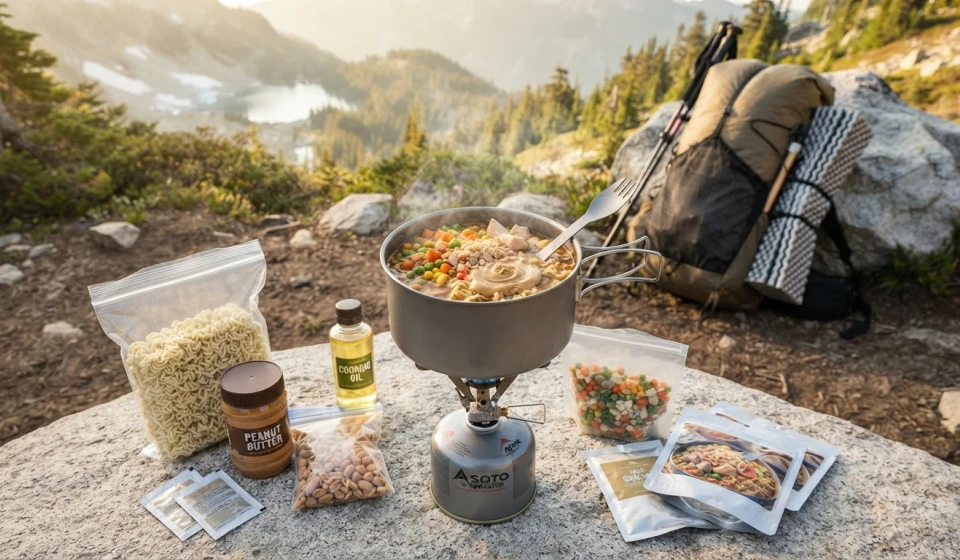
🧮 Build Your Ramen Meal Using a Formula
A useful way to plan your meal is:
Base + calorie booster + protein + flavor
For example:
Option 1: Peanut Ramen
- Instant ramen
- Peanut butter
- Peanuts
- Chili seasoning
Option 2: Tuna Ramen
- Instant ramen
- Shelf-stable tuna
- Oil
- Dried vegetables
Option 3: Creamy Peanut Ramen
- Instant ramen
- Powdered milk
- Peanut butter
- Chili or curry seasoning
Option 4: Double Noodle Ramen
- Two ramen portions
- Shelf-stable protein
- Dried vegetables
- Seasoning
These are frameworks rather than fixed recipes.
The exact quantities should be calculated using the nutrition information on the products you actually purchase.
⚖️ Compare Calories With Food Weight
When you’re backpacking, calories aren’t the only number.
You also have to carry everything.
Suppose you have two ways to add 400 calories to your dinner.
One option requires 200 grams of additional food.
Another requires 80 grams.
If both fit your diet and you tolerate them equally well, the lighter option may be more attractive for a longer trip.
This is why calories per gram can be useful.
Calculate:
Total calories ÷ total food weight
This gives you an approximate calorie density.
Don’t treat the highest number as automatically the best.
Taste, nutrition, digestion, preparation, and variety still matter.
💧 Think About Water Requirements
Ramen needs water.
That’s important when you’re planning a lightweight cooking system.
Before adding ingredients, consider:
- How much water the noodles require
- Whether the added ingredients need rehydration
- Whether you’re boiling or soaking
- How much water remains after cooking
- Whether water is readily available along your route
If water is scarce, a meal requiring substantial cooking water may not be ideal.
If water is plentiful, ramen can be a very convenient dinner.
🔥 Consider Stove Fuel
Cooking time also affects your backpacking system.
Traditional ramen generally cooks quickly, which is one reason it works well for simple trail meals.
But every additional cooking step can affect fuel consumption.
If you’re using a small canister stove or another limited-fuel system, test your meals before the trip.
You want to know how long your actual meal takes to prepare.
🎒 Package Everything Before You Leave
Don’t simply throw several ramen packets into your backpack.
Build individual meal kits.
For example:
DAY 2 — DINNER
- 1 ramen packet
- Measured peanut butter
- Measured peanuts
- Dehydrated vegetables
- Seasoning
Put the ingredients together in one labeled package when practical.
This makes camp cooking faster and helps prevent accidentally eating tomorrow’s dinner today.
It also allows you to calculate the exact calories and weight of each meal before leaving.
🧾 Example Ramen Meal Calculation
Suppose your meal contains:
- Ramen: 400 calories
- Peanut butter: 200 calories
- Peanuts: 170 calories
- Oil: 120 calories
Your total would be:
400 + 200 + 170 + 120 = 890 calories
Those numbers are only an example.
Always use the actual nutrition information from the products you’re carrying.
This calculation method lets you increase or decrease the meal depending on your daily target.
⚠️ Watch the Sodium
Instant ramen can be high in sodium, depending on the product and seasoning packet.
That doesn’t automatically make it unsuitable for backpacking.
But it is worth considering the ramen as part of your whole day’s diet, particularly if you’re eating multiple packets over several days.
You can adjust the amount of seasoning used if you prefer.
If you’re managing a medical condition or have been advised to restrict sodium, follow your healthcare professional’s guidance rather than using a generic backpacking recommendation.
🤢 Test Your Recipe Before the Trail
This is one of the most important steps.
Don’t invent a complicated ramen recipe on the first night of a five-day trip.
Try it at home first.
Then test it on a shorter hike.
Ask yourself:
- Did I like the taste?
- Was the portion large enough?
- Did it feel too greasy?
- Did I have enough water?
- Was it easy to prepare?
- Did the ingredients mix well?
- Did I feel comfortable afterward?
A recipe that looks fantastic on paper can behave differently after a long day of hiking.
💡 The “Ramen Upgrade” Checklist
Before packing your meal, check:
☐ Base ramen provides enough carbohydrates
☐ Added ingredient increases calories if needed
☐ Protein is included somewhere in the meal or daily menu
☐ Food weight is reasonable
☐ Ingredients are shelf-stable for the trip
☐ Water requirements are manageable
☐ Cooking time fits your stove system
☐ Packaging won’t leak
☐ You’ve tested the recipe
☐ You actually enjoy eating it
If most of these boxes are checked, you have a practical trail meal.
🌲 Final Thoughts
Instant ramen doesn’t have to remain a plain packet of noodles.
With inexpensive additions such as peanut butter, nuts, oil, shelf-stable protein, powdered milk, and dehydrated vegetables, you can turn it into a more substantial backpacking dinner without relying on expensive specialty meals. 🍜🎒
The key is to build the meal around your actual needs.
Calculate the calories. Check the weight. Consider protein and overall nutrition. Think about water and fuel. Test the recipe before your trip.
Most importantly, don’t confuse more calories with better food.
A successful backpacking meal needs to provide enough energy while remaining practical, enjoyable, and compatible with the rest of your food system.
Sometimes, the cheapest supermarket ramen can become one of the most useful ingredients in your backpacking kitchen.