The First-Day and Last-Day Food Calculation: Stop Packing Seven Full Days for a Seven-Day Trip
A seven-day backpacking trip does not automatically require seven complete days of breakfast, lunch, dinner, and snacks. 🎒 If you eat breakfast before reaching the trailhead on Day 1 and finish hiking before dinner on Day 7, part of those calories will come from food outside your backpack. Treating every calendar day as a full trail-food day can therefore make a carefully planned food bag heavier than the itinerary actually requires.
The better approach is to separate calendar days from food days, then calculate exactly which meals and snacks must be carried between entering and leaving the trail. This is not about stripping your menu down to the smallest possible amount or eliminating sensible backup food. It is simply more accurate accounting, much like calculating how many hotel nights you need rather than counting every date printed on a vacation itinerary.
Calendar Days Vs Food Days
A calendar day tells you that you will be somewhere on the trip during that date, while a food day represents the amount of food you actually need to carry for that period. 🍽️ A full food day might include breakfast, morning snacks, lunch, afternoon snacks, dinner, and any planned evening food. A partial day might require only dinner, or perhaps breakfast plus one trail snack before reaching the vehicle.
This distinction becomes especially useful when people search for how much food for a 7 day backpacking trip, because there is no universal seven-day food quantity. One hiker might begin walking at 7:00 a.m. on the first day and finish late on the seventh, while another may begin at 3:00 p.m. and leave the trail shortly after breakfast on Day 7. Those are both seven-calendar-day itineraries, but their food carries can differ by several meals.
Build A Trip Timeline Before Building A Menu
Before deciding how many ounces of food to pack, write down your trailhead arrival, expected hiking start, first trail meal, overnight count, final trail meal, and estimated exit time. 🗓️ This simple timeline reveals which meals are actually part of the backpacking food system. It also prevents the common mistake of starting with “seven days” and automatically multiplying a daily food target by seven.
For example, suppose you arrive at the trailhead after eating lunch and expect to begin hiking at 2:00 p.m. Your first carried food might only be an afternoon snack and dinner, meaning Day 1 is clearly not a full food day. On the opposite end, if Day 7 ends at 10:00 a.m., you may only need breakfast and perhaps a small snack before reaching food stored in your vehicle or purchased after the hike.
Example 1: An Early Morning Start
An early departure can make the first day resemble a complete food day because most or all eating occurs after you begin hiking. 🌄 Imagine starting at 6:30 a.m. after only a small pre-trail breakfast, then needing snacks, lunch, more snacks, dinner, and possibly an evening item. In that scenario, counting Day 1 as something close to a full food day may be perfectly reasonable.
The important point is not to automatically reduce every first day simply because it is the first day. A backpacking food calculator should follow the actual schedule rather than forcing every trip into the same formula. If nearly your entire waking day happens on the trail, your first-day food requirement may be much closer to 1.0 food day than 0.5.
Example 2: An Afternoon Start
Now imagine arriving at the trailhead at 2:00 p.m. after eating breakfast and lunch elsewhere. 🥾 You might carry an afternoon snack, dinner, and perhaps a small evening snack, but carrying another breakfast and lunch for that same day would duplicate meals you already ate. That first calendar day might represent something closer to one-third or one-half of a normal trail-food day depending on your menu structure.
This is where itinerary-based accounting can remove food weight without changing what you actually eat while hiking. You are not skipping a required meal; you are simply recognizing that part of the day’s food came from somewhere other than your backpack. For short approaches or late starts, this can be one of the easiest ways to make a multi-day food plan more accurate.
Example 3: A Morning Finish
The last day creates the same issue in reverse. 🚗 If you wake at camp, eat breakfast, hike for two hours, and reach your vehicle before lunch, carrying a full lunch, afternoon snacks, dinner, and evening food specifically for that day may be unnecessary. Your actual final-day trail requirement may be breakfast plus one snack rather than another complete menu.
However, exit plans deserve some flexibility because trail conditions, weather, navigation issues, fatigue, or transportation delays can extend the day. That is why precise meal accounting should not be confused with assuming everything will go perfectly. Keeping an appropriate reserve is different from automatically packing a complete unused day of meals.
Calculate Partial-Day Calories By Meal Share
Instead of assuming every food day must equal exactly 100% of your normal daily plan, divide your menu into meal and snack shares. 📊 For an illustrative example only, someone might plan 20% of daily food for breakfast, 15% for morning snacks, 20% for lunch, 15% for afternoon snacks, 25% for dinner, and 5% for an evening item. An afternoon-start day requiring only afternoon snacks, dinner, and evening food would therefore represent roughly 45% of that person’s planned food day.
These percentages are planning tools rather than nutritional prescriptions, and different hikers will distribute food differently. Someone who prefers a large dinner may shift more of the day’s calories toward evening, while another person might eat continuously during hiking hours and keep meals relatively small. The useful principle is simply to calculate what portion of your planned daily food actually falls inside the hiking window.
How Partial Days Change Total Food Weight
Suppose a backpacker designs meals around an illustrative target of 3,000 calories per full food day and averages 100 calories per ounce across the entire food bag. Seven complete days would equal 21,000 calories and approximately 210 ounces of food, or about 13.1 pounds. At 6.5 food days, the same assumptions produce 19,500 calories and roughly 195 ounces, or about 12.2 pounds. ⚖️
At six full food-day equivalents, the calculation becomes 18,000 calories and about 180 ounces, or approximately 11.25 pounds. Increase average calorie density to 125 calories per ounce and those same 18,000 calories would require about 144 ounces, or 9 pounds, showing why food-day calculation and calorie density are separate but connected tools. These numbers are examples rather than recommended intake because individual energy needs and food choices vary widely.
Why This Matters More On Longer Trips
Saving one unnecessary meal may not sound dramatic, but every meal also carries packaging, volume, and sometimes cooking fuel requirements. 📦 When several partial days or resupply transitions are calculated accurately, those differences begin accumulating. A lighter food bag can also leave more room in a bear canister or food storage system, which may be just as useful as reducing scale weight.
Long trips magnify planning errors because small daily assumptions are repeated many times. Packing an extra half-day on a weekend trip may barely matter, while unnecessarily adding half or three-quarters of a food day to every segment of a long itinerary can create much more bulk. This is why experienced menu planning starts with the trip timeline first and the grocery list second.
Do Not Confuse Optimization With Underpacking
The purpose of first-day and last-day calculations is accuracy, not aggressive food restriction. ⚠️ Backpackers still need to consider realistic delays, appetite variation, unexpected mileage changes, weather, and whatever safety margin makes sense for the route. Removing meals you clearly will not need is fundamentally different from removing food that protects you when plans change.
A good rule is to separate planned food from contingency food instead of letting one hide inside the other. If your seven-day itinerary only requires 6.25 normal food days, calculate those 6.25 days honestly and then add the reserve you intentionally choose for uncertainty. That produces a more transparent plan than packing seven complete menus and calling the unexplained surplus “just in case.”
A Simple Backpacking Food-Day Worksheet
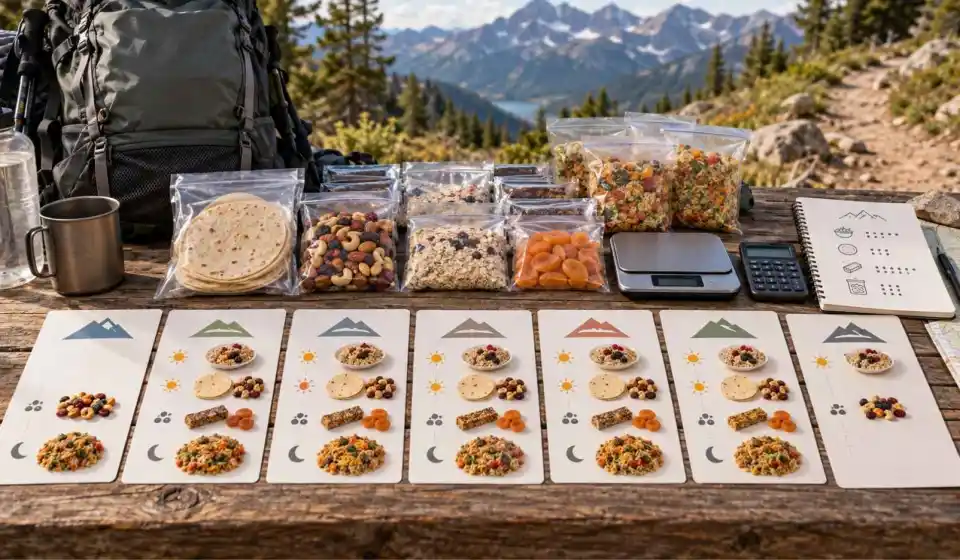
Create a worksheet with five columns: Day, Meals Required, Calories Planned, Food Ounces, and Cumulative Food Weight. ✏️ Fill in the meals first, calculate calories second, convert those calories into approximate ounces using your expected calorie density, and finally track the running food weight. This order prevents calorie targets from becoming disconnected from the actual schedule.
For example, Day 1 might list “afternoon snack + dinner,” Days 2 through 6 might contain complete menus, and Day 7 might show “breakfast + trail snack.” Once those rows are filled in, the difference between seven calendar days and the actual number of food-day equivalents becomes visible immediately. That worksheet can then connect naturally to your food weight per day, calories per ounce, calorie-needs, and seven-day menu calculations.
The Better Seven-Day Backpacking Calculation
A seven-day trip should begin with one question: when does your backpack actually become responsible for feeding you? 🎯 Count everything from that first carried meal through the final food you expect to eat before exiting the trail, then convert those meals into full and partial food-day equivalents. Only after that should you calculate total calories, ounces, food volume, and menu combinations.
This approach will not always create a dramatic weight reduction, and that is not the goal. Sometimes an early start and late finish really do require almost seven complete days of food, while another seven-day itinerary may require closer to six. Accurate backpacking meal planning means letting the timeline determine the food requirement instead of letting the calendar determine it automatically.