Calories Per Ounce vs Calories Per Liter: Which Backpacking Food Density Metric Actually Matters?
Backpacking food advice often revolves around one famous number: calories per ounce, or how much energy you get for every ounce carried on your back. 🎒 That measurement is incredibly useful because food weight adds up quickly when several days of meals must fit inside a backpack. But weight is only half of the packing problem, because your food must also physically fit inside your pack, food bag, or bear-resistant container.
That introduces a second measurement that receives much less attention: calories per liter, which estimates how much energy fits within a given amount of physical space. A food can score well in calories per ounce while still taking up an awkward amount of room because of its shape, trapped air, or bulky packaging. Understanding both measurements gives backpackers a better way to decide whether they are facing a weight problem, a space problem, or both.
What Calories Per Ounce Actually Measures
Calories per ounce is simply a measurement of weight efficiency, calculated by dividing the calories in a food by its weight in ounces. If a four-ounce portion contains 500 calories, for example, the calculation is 500 ÷ 4, giving 125 calories per ounce. ⚖️ Higher numbers generally mean you can carry the same amount of food energy while putting fewer ounces into your backpack.
This explains why foods containing substantial amounts of fat often perform strongly in backpacking calorie-density comparisons, because dietary fat contains about 9 calories per gram, while carbohydrate and protein contain roughly 4 calories per gram. Water contributes weight but no calories, which is why dried foods usually look much better on a calories-per-ounce chart than fresh fruits, cooked vegetables, or other moisture-rich foods. Cal/oz therefore answers an important question: How much energy am I carrying for each unit of food weight?
What Calories Per Liter Measures
Calories per liter looks at the same food from a completely different direction by measuring space efficiency instead of weight efficiency. 📦 The basic concept is simple: estimate how many calories occupy a known volume, such as 250 milliliters, one cup, or one liter, and then convert everything into the same unit for comparison. A backpacker with 4,000 calories occupying two liters of space has an average food density of approximately 2,000 calories per liter.
Unlike calories per ounce, however, volume measurements are less standardized because the same food can occupy different amounts of space depending on how tightly it is packed. Broken ramen, whole ramen blocks, crushed crackers, loose nuts, compressed tortillas, and food stored in rigid commercial packaging can all produce different volume measurements despite having identical nutrition. That means calories per liter should usually be treated as a practical packing estimate rather than a perfectly fixed nutrition number.
Why Two Foods With Similar Cal/Oz Can Pack Differently
Imagine two foods that both provide around 120 calories per ounce but have very different physical structures. One might be a compact bar with almost no empty space, while another might consist of irregular crackers with substantial air gaps between individual pieces. 🍫 Their weight efficiency may look nearly identical on a spreadsheet, yet the crackers could occupy significantly more room inside the food bag.
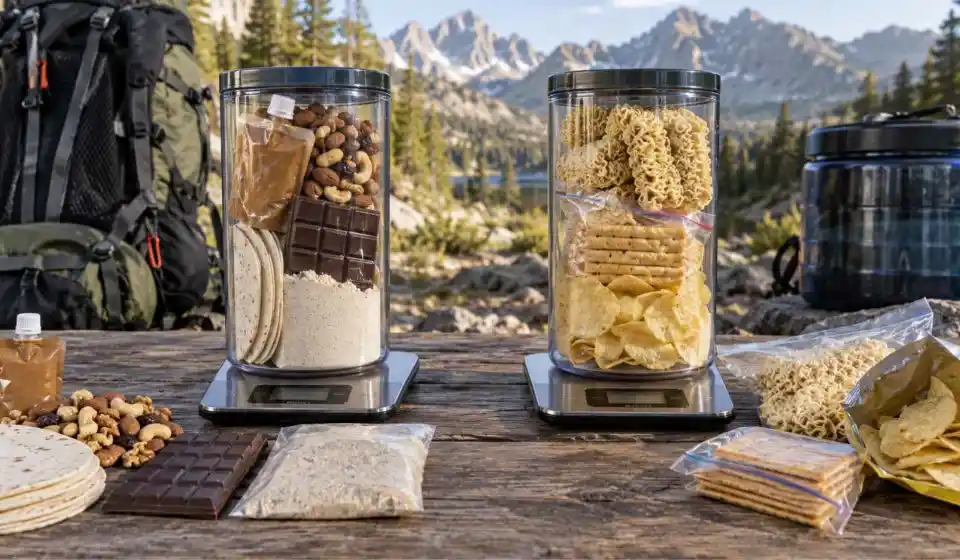
This difference becomes especially obvious when comparing categories such as oils, nut butters, nuts, chocolate, chips, ramen, crackers, bars, and powdered foods. Oil contains almost no internal air space and packs into the exact shape of its bottle, while chips and crackers combine low-density structures with substantial empty spaces created by their shapes. Ramen sits somewhere between these extremes because it can be relatively lightweight but its dry noodle structure traps considerable air unless it is broken or crushed.
The Food-Shape Problem Changes Everything
Nutrition labels tell you calories and weight, but they do not tell you how efficiently a food occupies the strangely shaped spaces inside your backpack. 🧩 Round nuts settle differently than rectangular bars, tortillas can lie flat against a container wall, and rigid noodles may leave empty pockets that cannot easily be filled. Two foods with similar nutritional density can therefore behave completely differently when you actually attempt to pack them.
Packaging can make the difference even larger because manufacturers often use bags containing considerable air to protect fragile foods during transportation. Repackaging into appropriately sized lightweight food bags can reduce unnecessary bulk, although crushing certain foods may affect convenience, texture, mess, or preparation. For practical backpacking planning, volume density is partly a property of the food and partly a property of how that food is packaged.
A Two-Axis Backpacking Food Comparison
Exact volume measurements vary by brand, package shape, crushing, and portion size, so the most useful comparison is often directional rather than pretending every trail food has one universal calories-per-liter value. The table below shows how familiar food categories commonly behave when judged across both dimensions. 📊 Numbers are approximate planning examples rather than guaranteed values for every product, so actual nutrition labels and measured packed volume should be used when precision matters.
| Food type | Typical calorie range | Approx. cal/oz | Approx. volume efficiency | Approx. cal/L tendency | Packability |
|---|---|---|---|---|---|
| Olive oil | Very high | ~240 | Extremely high | Extremely high | Excellent if leak-proof |
| Nut butter | High | ~165–190 | Very high | Very high | Excellent |
| Mixed nuts | High | ~160–180 | High | High | Very good |
| Chocolate | High | ~145–170 | High | High | Very good |
| Energy bar | Moderate-high | ~110–140 | High | Moderate-high | Excellent |
| Dried fruit | Moderate | ~80–100 | Moderate-high | Moderate-high | Very good |
| Tortillas | Moderate-high | ~80–100 | High when stacked | Moderate-high | Excellent |
| Ramen | Moderate-high | ~120–135 | Low-moderate uncrushed | Moderate | Bulky unless broken |
| Crackers | Moderate | ~110–140 | Low-moderate | Moderate | Air gaps and breakage |
| Chips | High by weight | ~140–160 | Low | Low-moderate | Bulky and fragile |
The important lesson is not that one column identifies the universally superior food. Oil and nut butter perform impressively on both axes, while something like ramen may look stronger by weight than by volume because of its physical structure. A useful backpacking menu normally combines several food types rather than trying to maximize a single mathematical number across every meal.
When Weight Matters More Than Volume
For many ordinary backpacking trips, weight remains the dominant constraint, particularly when your pack has enough unused space for the amount of food being carried. A three-day trip might allow a hiker to pack several bulky foods comfortably, making the difference between 2,000 and 2,500 calories per liter relatively unimportant. 🥾 In that situation, reducing unnecessary food weight may provide a clearer practical benefit than aggressively compressing every meal.
Cal/oz also becomes particularly useful when estimating daily food weight, because a planned calorie target can be converted into a rough number of ounces carried per day. If someone plans 3,000 food calories at an average density of 120 calories per ounce, the theoretical food weight is about 25 ounces before considering packaging. Increasing the menu average to 130 calories per ounce would reduce that same theoretical total to roughly 23 ounces, showing exactly why calorie density receives so much attention among lightweight backpackers.
When Volume Becomes The Bigger Problem
Volume becomes increasingly important as the distance between resupply points grows because several days of food must occupy the same limited container or backpack space. 🐻 A bear-resistant canister makes this especially obvious because its internal volume cannot expand simply because your menu happens to be bulky. Seven days of lightweight but fluffy food can therefore create a packing problem even when its total weight looks perfectly reasonable.
This is where foods with strong calories-per-liter characteristics become valuable, including compact bars, nut butters, nuts, powdered foods, chocolate, tightly packed tortillas, and other foods that minimize wasted air space. Breaking noodles, removing excessive commercial packaging, or arranging flat items against container walls can also improve real-world packing efficiency without changing their nutrition. The relevant question becomes: How many days of usable food can physically fit inside the space available?
Why Calories Per Liter Is Harder To Standardize
Calories per ounce can normally be calculated directly from a nutrition label because manufacturers already provide calories and serving weight. Calories per liter requires an additional measurement: the actual packed volume of the food, which can change depending on preparation and packaging. 🔬 That makes volume density more experimental, but it also makes it perfect for a practical Camp Kitchen Lab comparison.
A simple home test can provide useful results by weighing a realistic portion, recording its calories, and measuring how much container space it occupies after being packed normally. Someone comparing multiple foods can use the same container and packing method to keep the experiment reasonably consistent. The goal does not need laboratory precision—the goal is discovering whether certain foods are unexpectedly bulky relative to the calories they provide.
Weight-Limited Trips Vs Volume-Limited Trips
A useful planning system begins by identifying the actual constraint rather than automatically optimizing every menu for maximum calories per ounce. 🎯 If your backpack is comfortably large but your total carried weight is high, emphasize cal/oz and consider replacing moisture-heavy or low-density foods. If your weight is acceptable but your food bag or bear canister will not close, shift attention toward calories per liter and physical packability.
Some trips will be limited by both factors, particularly long food carries where several days of calories must remain reasonably lightweight and compact simultaneously. In those situations, foods performing reasonably well across both dimensions often become more useful than foods that dominate only one measurement. The objective is not mathematical perfection but a menu that delivers enough food while remaining carryable, packable, edible, and practical.
How To Use Both Numbers When Planning Food
Start with calories per ounce because weight is straightforward to measure and directly affects your carried load, then check whether the resulting menu actually fits into your available food-storage space. If volume becomes a problem, identify the foods producing the most bulk and determine whether compact alternatives, better packaging, or simple rearrangement solves it. 🎒 You do not necessarily need to replace every low-volume-efficiency food because variety, convenience, preparation time, cost, and personal preference still matter.
A simple rule is Cal/oz for your shoulders, Cal/L for your container. Use the first number when asking, “How heavy will my food be?” and use the second when asking, “Will all of this food actually fit?” Once backpackers begin viewing trail food on both axes, the familiar search for the “most calorie-dense backpacking food” becomes a more useful question: dense according to which constraint?
The Metric That Actually Matters
Neither calories per ounce nor calories per liter deserves to replace the other because they measure different problems. Calories per ounce remains the better primary metric for reducing carried food weight, while calories per liter becomes increasingly important when pack space, long resupply intervals, or bear-canister capacity creates a hard limit. 🏕️ A good trail-food system therefore treats calorie density as two-dimensional rather than reducing every food to one ranking.
That also explains why something like ramen can remain completely reasonable despite looking bulky beside nut butter or chocolate. A food does not need to dominate every efficiency metric to earn a place in a trail menu; it only needs to make sense within the trip’s actual constraints. Measure weight when weight is your problem, measure volume when space is your problem, and use both when the trail gives you no room to ignore either one.