Why Hikers Can’t Copy Bodybuilder Macros: What Changes on an Endurance Day
A macro split that looks perfectly reasonable for someone organizing meals around gym sessions does not automatically translate into a good backpacking food plan. 🥾 A hiker may spend many consecutive hours walking, climbing, descending, and carrying a loaded pack while simultaneously carrying nearly every calorie that will be eaten. That combination changes the practical questions from simply “How much protein, carbohydrate, and fat should I eat?” to “Which foods provide enough energy without making my pack unnecessarily heavy?”
This does not mean hikers need one special universal ratio, nor does it mean bodybuilding nutrition is somehow wrong outside the gym. Instead, backpacking macros have to account for duration, total energy needs, food weight, eating opportunities, intensity, recovery, and personal tolerance in ways that may matter differently during resistance training. The useful comparison is therefore not bodybuilder versus hiker as competing diets, but how the demands of two very different activities change what each macronutrient contributes.
Why Bodybuilding And Backpacking Create Different Food Problems
A resistance-training workout may place heavy demands on muscle, yet a backpacking day can keep someone moving for much of the day rather than concentrating work into a shorter training session. 🚶 A 15- or 20-mile hiking day may include hours of repeated muscular contractions, changing terrain, elevation gain, and a pack that adds to the work being performed. That longer duration makes total food energy and carbohydrate availability especially relevant when planning what goes into the food bag.
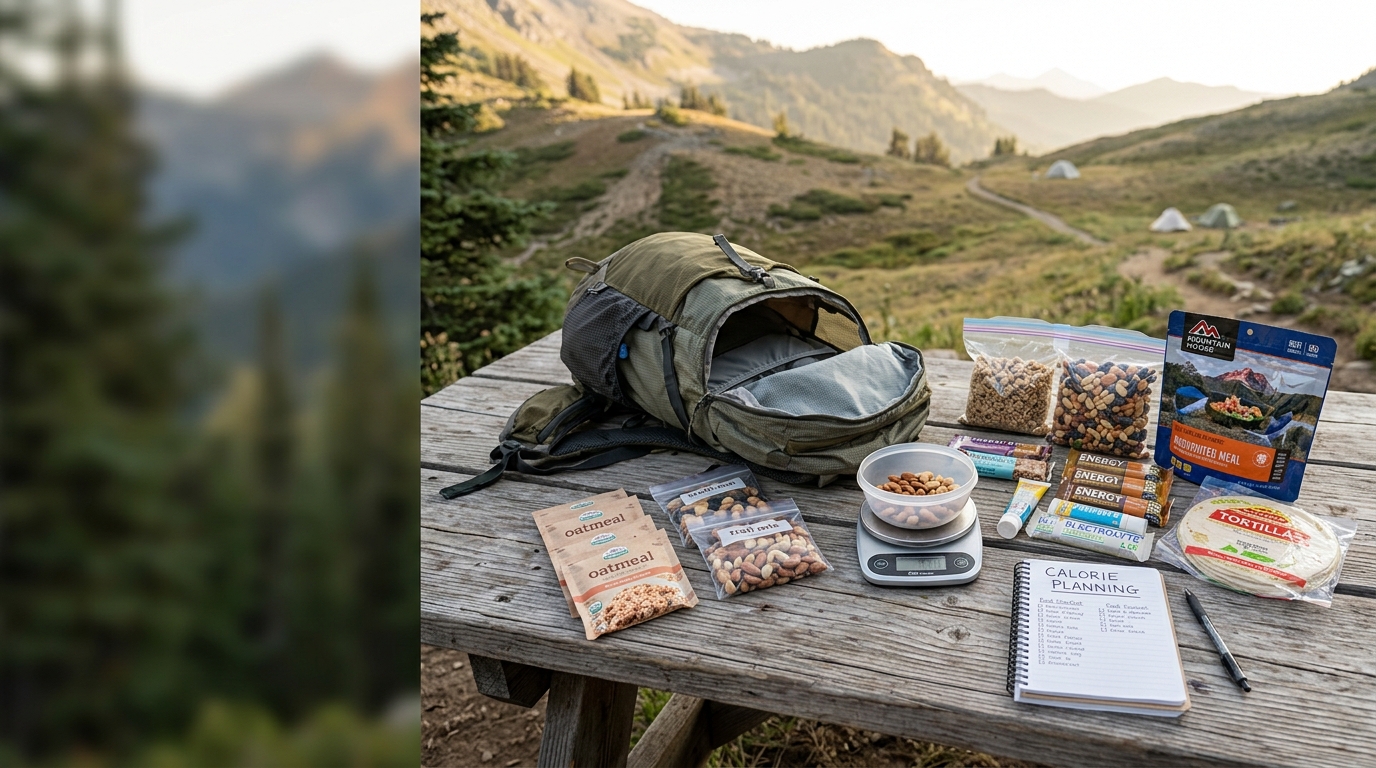
There is another difference that a kitchen-based meal plan can ignore: backpackers physically carry the food they intend to consume. Someone eating at home can choose a bulky, water-rich, low-calorie meal without worrying that dinner must travel twenty miles on their shoulders, while a backpacker may care intensely about calories per ounce. 🎒 Consequently, hiking nutrition is partly a nutrition problem and partly a logistics and weight-management problem, which is why macro percentages alone never tell the entire story.
What Carbohydrates Contribute During A Long Hiking Day
Carbohydrate provides approximately 4 calories per gram, the same caloric value per gram commonly assigned to protein on food-label calculations. 🍚 Carbohydrate also plays an important role in supporting prolonged exercise, with sports-nutrition guidance placing greater emphasis on carbohydrate availability as exercise duration and workload increase. That does not mean every hiking calorie needs to come from carbohydrate, but it helps explain why copying a deliberately carbohydrate-restricted eating pattern can create a different equation on an all-day hike.
Hiking intensity is not constant either, which makes the subject more nuanced than saying walking simply “burns carbs” or “burns fat.” A relaxed flat section, sustained climb, technical ascent, fast push toward camp, and rest break can involve different mixtures of energy sources, while duration continues accumulating throughout the day. ⛰️ For practical menu planning, this means carbohydrates are useful not because they belong to a particular bodybuilder-style percentage, but because prolonged movement creates repeated demand for readily available energy.
Where Dietary Fat Changes The Backpacking Equation
Fat creates an almost opposite advantage: it provides approximately 9 calories per gram, compared with roughly 4 calories per gram from carbohydrate or protein. 🥜 On paper, that makes fat extraordinarily attractive to backpackers trying to squeeze more calories into fewer ounces, which is why foods containing nuts, seeds, oils, nut butters, cheese, and other fat-rich ingredients often appear in calorie-dense trail menus. The arithmetic is simple—when you must carry your food, more calories per gram can translate into a lighter theoretical food load.
That still does not mean hikers should maximize dietary fat and minimize everything else, because real trail meals must be edible, tolerable, practical, and nutritionally useful across the entire day. A bag of oil may have tremendous calorie density, for example, but it is obviously not a complete backpacking menu or a realistic replacement for every carbohydrate- and protein-containing food. 🥜 Fat therefore works best as one tool for increasing calorie density, rather than proof that the highest-fat macro split is automatically the best hiking strategy.
Protein Matters But More Protein Also Has Weight
Protein remains relevant for people who hike because muscle tissue is repeatedly working and recovery still matters after long periods of exercise. Sports-nutrition literature recognizes protein as important to exercise recovery and adaptation, but that does not turn protein into a substitute for sufficient total energy and carbohydrate in prolonged endurance activity. 💪 A backpacker therefore has little reason to assume that simply copying a very high-protein fitness diet will automatically produce the most efficient trail menu.
From a packing standpoint, protein also supplies about 4 calories per gram, meaning pure protein offers less than half the calories per gram of pure fat. If you increase protein calories while holding total calories constant, something else has to decrease, and the foods used to achieve that protein target may also contain water, fiber, carbohydrate, fat, and packaging weight. 🎒 This is why “more protein” and “lighter backpack” are not synonymous, even though an adequate amount of protein can remain an important part of a complete hiking food plan.
What 3,500 Calories Looks Like Under Three Macro Splits
Consider a hypothetical hiker planning 3,500 calories for one day, with three different ways of dividing those calories among carbohydrate, fat, and protein. 📊 These examples are not nutritional recommendations; they exist only to reveal what percentage changes actually mean once percentages are converted into grams. Because carbohydrate and protein contribute about 4 calories per gram while fat contributes about 9, raising the percentage from fat reduces the theoretical mass required to supply the same number of calories.
| Mathematical Example | Carbs | Fat | Protein | Carb Grams | Fat Grams | Protein Grams | Pure Macro Weight |
|---|---|---|---|---|---|---|---|
| Higher-carbohydrate | 55% | 30% | 15% | 481 g | 117 g | 131 g | ~729 g / 25.7 oz |
| Balanced example | 50% | 35% | 15% | 438 g | 136 g | 131 g | ~705 g / 24.9 oz |
| Higher-fat pack | 40% | 45% | 15% | 350 g | 175 g | 131 g | ~656 g / 23.1 oz |
Notice that all three examples contain exactly 3,500 calories and the same 15% protein, yet their theoretical macronutrient weights differ by roughly 73 grams, or about 2.6 ounces, from one extreme to the other. The reason is not that one ratio has magically created energy; more calories are simply coming from fat, which contains more than twice as many calories per gram as carbohydrate or protein. 🔢 Over multiple food days that mathematical difference can accumulate, which helps explain why long-distance hikers often pay attention to dietary fat when studying calorie density.
Why Theoretical Macro Weight Is Not Food-Bag Weight
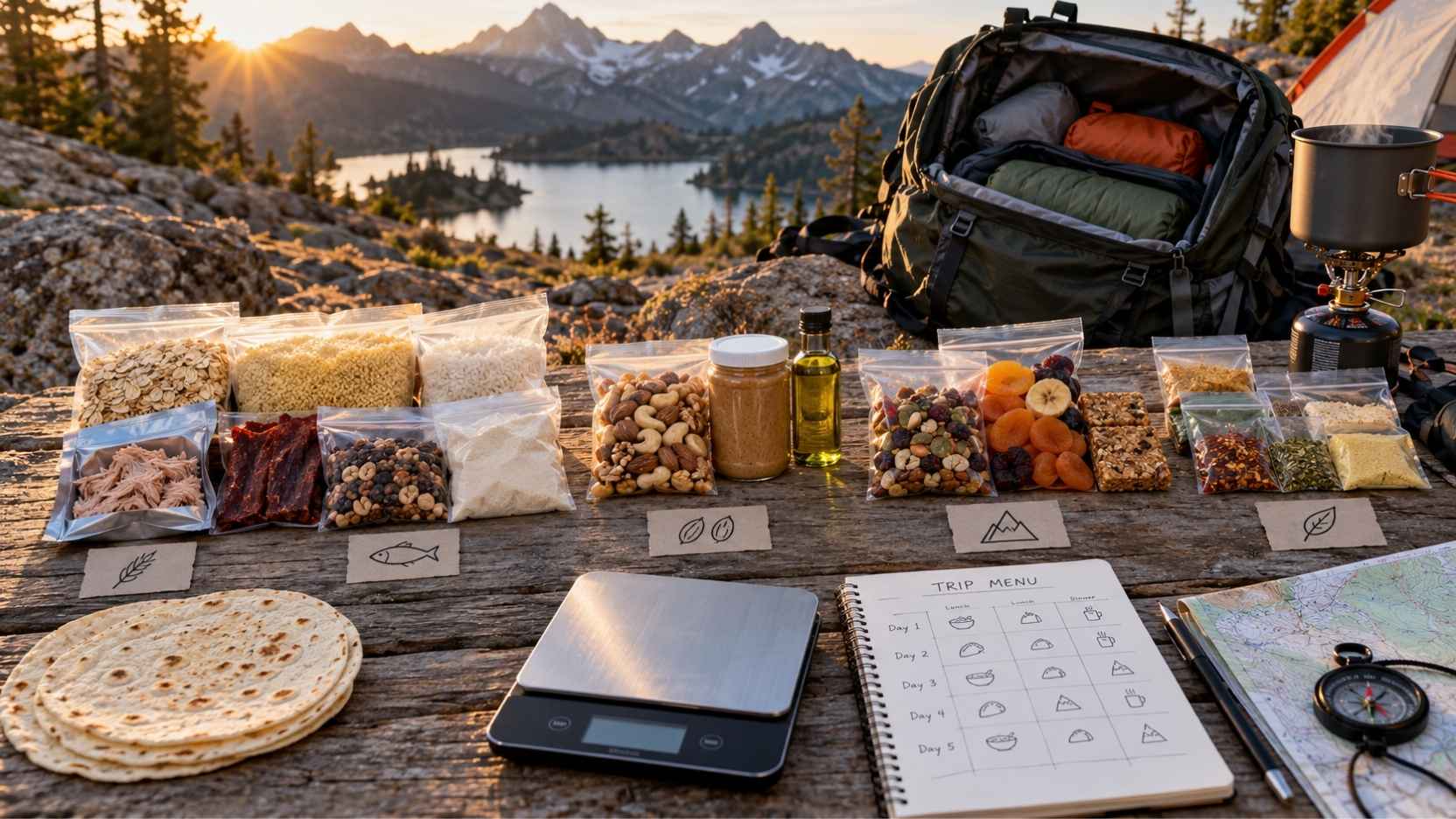
The table above contains an important trap because nobody hikes with three bags labeled “pure carbohydrate,” “pure protein,” and “pure fat.” Actual tortillas, oatmeal, nuts, dried fruit, powdered meals, jerky, chocolate, cheese, and trail mix contain combinations of macronutrients plus water, fiber, minerals, and other components. 📦 Packaging also weighs something, meaning the calculated 23 to 26 ounces of macronutrients should never be mistaken for the actual weight of a 3,500-calorie trail-food bag.
This distinction is useful when evaluating seemingly perfect macro ratios posted online, because identical percentages can be achieved with foods having dramatically different calorie densities. A 50/35/15 menu built from dehydrated foods and compact ingredients may weigh much less than another 50/35/15 menu filled with water-rich fresh foods, even though their macro percentages match perfectly. ⚖️ For backpacking, food selection and moisture content can matter just as much as the macro split itself.
Why There Is No Universal Backpacking Macro Ratio
A weekend hiker covering eight relaxed miles does not necessarily have the same food problem as someone completing twenty mountainous miles each day for a week. Trip length changes how aggressively food weight matters, elevation and pace can change workload, weather can influence food preferences, and access to resupply can completely reshape what is practical to carry. 🏕️ Personal appetite and digestive tolerance matter too, because a mathematically elegant food bag accomplishes little if the hiker repeatedly avoids eating its contents.
This is why ratios such as 50/35/15, 55/30/15, or 40/45/15 should be treated as planning examples rather than universal targets. A useful backpacking menu begins with estimated total energy requirements and then considers food density, carbohydrate availability, adequate protein, acceptable fat, meal timing, preparation, preferences, and the specifics of the trip. Anyone needing individualized nutrition guidance because of a medical condition, medication, or other health consideration should work with an appropriately qualified healthcare professional.
Carbs Vs Protein For Hiking Is The Wrong Either-Or Question
Searches for “carbs vs protein for hiking” make the issue sound like one nutrient must defeat the other, but hiking meals work better when each macronutrient is understood according to its job. 🍌 Carbohydrate can play a major role in supporting prolonged activity, protein contributes to the broader recovery and tissue-maintenance picture, and fat provides concentrated dietary energy that can help reduce food weight. The planning challenge is balancing those advantages rather than choosing a single macro and treating the others as unnecessary.
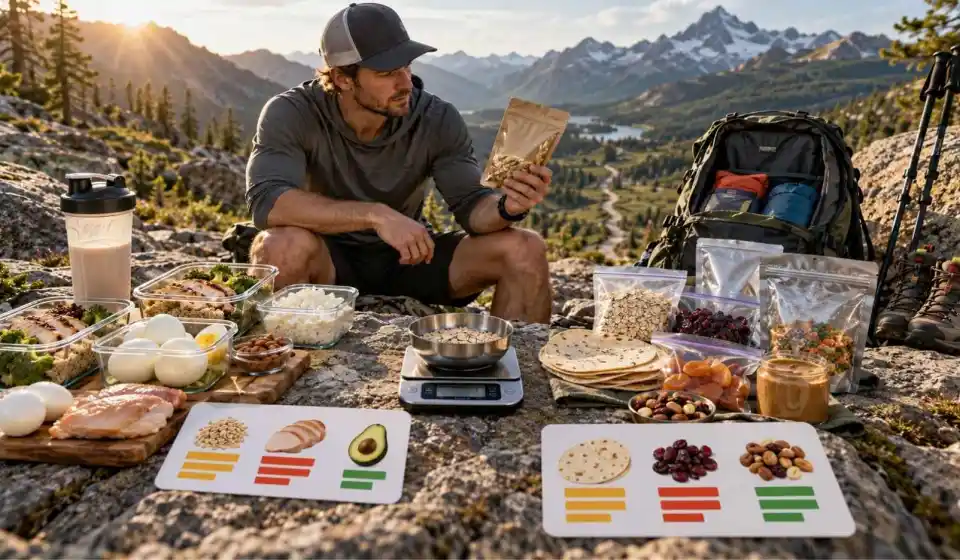
That also explains why bodybuilding macro advice should not simply be copied into a spreadsheet labeled “backpacking.” A macro strategy built around physique goals, resistance training, ordinary kitchen access, and food stored in a refrigerator is solving a different practical problem from feeding someone who will move for hours while carrying several days of meals. 🥾 The trail changes the equation because duration and pack weight become part of nutrition planning itself.
Build The Macro Split Around The Trip
For a short day hike, shaving a few ounces from lunch may be practically meaningless, giving hikers much more freedom to prioritize familiar foods and convenience. For a multi-day backpacking trip, however, every day’s food multiplies across the pack, making calorie density increasingly valuable while the need for meals that remain enjoyable and practical does not disappear. 🎒 This is where understanding both carbs versus fat on the trail and calories per ounce becomes more useful than blindly chasing a fashionable macro percentage.
The most useful takeaway is therefore simple: do not ask what macro ratio hikers are supposed to use before asking what the hike actually looks like. Mileage, duration, climbing, total calories, number of food days, food preferences, cooking system, and acceptable pack weight all affect the menu that ultimately makes sense. 🔥 Backpacking macros are not a bodybuilding formula transported outdoors—they are one part of a larger trail-fueling system built around the work, the food, and the miles ahead.