Cold-Soak Time Chart: How Long Do Oats, Couscous, Ramen, Potatoes, Farro, and Rice Actually Need?
Cold soaking sounds almost too simple: put dry food in a container, add water, keep hiking, and return later to something resembling dinner. 🥣 The problem is that “later” might mean 10 minutes for one food and more than an hour for another, while some ordinary grains may never develop the texture hikers expect without actual cooking. That uncertainty matters when you are trying to plan lunch around a water source, eliminate a stove, or avoid discovering at camp that dinner is still crunchy.
The most useful cold-soak chart therefore cannot simply declare that every carbohydrate needs 30 minutes and move on. Food processing, particle size, water temperature, water ratio, and whether the starch was previously cooked all influence how quickly something becomes pleasant to eat. 🎒 A better approach is to separate fast rehydrators, moderate rehydrators, slow or variable foods, and foods that should not be treated as cold-soak substitutes for cooking.
What Counts As Successfully Cold Soaked?
Cold soaking is primarily rehydration, not cold-water cooking, which is why foods that have already been cooked and dehydrated usually perform better. Instant mashed potatoes, instant rice, many ramen noodles, dehydrated beans, and similar products have undergone processing before reaching your food bag, so water mostly needs to restore moisture. Foods such as intact raw grains still require heat-driven changes to become conventionally cooked, meaning hours in cold water do not necessarily solve the problem.
Texture also makes “done” subjective because one hiker may happily eat chewy rolled oats while another wants something resembling hot oatmeal. 🥄 For this guide, successfully cold soaked means the food is hydrated enough to chew comfortably, has no obviously hard center, and resembles a texture most people could reasonably eat as a trail meal. That standard is more useful than waiting for cold food to duplicate the exact softness of a freshly cooked meal.
A Practical Cold-Soak Time Chart
The following ranges are best treated as starting points for meal planning, because manufacturers, ingredient thickness, temperature, and personal texture preference can move the finish time significantly. Testing your exact brand at home is one of the easiest ways to avoid disappointing trail meals. ⏱️ Start checking near the low end of the range, then give the food additional time if the center remains dry or unpleasantly firm.
| Food | Practical Starting Range | Cold-Soak Suitability | Main Consideration |
|---|---|---|---|
| Instant mashed potatoes | 5–10 min | Excellent | Already cooked and dehydrated |
| Instant oats | 10–20 min | Excellent | Thin, highly processed flakes |
| Poha | 10–20 min | Very good | Flattened, parboiled rice |
| Quinoa flakes | 10–20 min | Very good | Thin flakes hydrate quickly |
| TVP | 10–20 min | Very good | Small pieces rehydrate fastest |
| Couscous | 20–30 min | Excellent | Conventional couscous is precooked |
| Rolled oats | 20–40 min | Very good | Thicker than instant oats |
| Ramen | 30–45 min | Good | Breaking noodles speeds hydration |
| Instant rice | 30–60 min | Good | Brand and grain size matter |
| Thin rice vermicelli | 30–60 min | Variable-good | Thickness matters greatly |
| Dehydrated cooked beans | 45–90+ min | Variable-good | Flakes rehydrate faster than whole beans |
| Quick-cooking farro | 60+ min | Variable | Only appropriate if precooked |
| Regular farro | Not recommended | Poor | Intact grain still needs cooking |
| Regular raw rice | Not recommended | Poor | Use precooked instant rice instead |
These are deliberately ranges rather than promises because a 15-minute meal at home may need considerably longer beside a cold mountain stream. Smaller particles generally hydrate more rapidly because water has less distance to penetrate, which explains why potato flakes can be ready long before large dehydrated bean pieces. 🌡️ Breaking noodles, choosing flakes instead of whole pieces, and starting with sufficiently processed ingredients are often more effective than simply extending the soak indefinitely.
Oats And Couscous Are Among The Easy Options
Instant oats are one of the most forgiving foods for stove-free breakfasts because their small, thin pieces absorb water rapidly. Rolled oats are thicker and normally need more time, but giving them roughly 20 to 40 minutes creates a useful planning window for hikers who begin soaking breakfast while breaking camp. 🥜 Nut butter, powdered milk, seeds, dried fruit, or other additions can raise calorie density, although thicker mixes may require additional water.
Couscous is similarly useful because common quick-cooking couscous has already been steamed and dried during manufacturing, making rehydration relatively straightforward. A starting range around 20 to 30 minutes is practical, although cooler water or a drier preferred texture can shift the result. Couscous is especially interesting for backpackers because it can move easily between savory lunches, cold salads, and higher-calorie dinners depending on what you mix into it.
Ramen, Potatoes, And Instant Rice Need Different Expectations
Ramen noodles can cold soak, but they generally require more patience than instant oats or potato flakes because water must work through a larger noodle structure. 🍜 Breaking the noodle brick into smaller pieces increases exposed surface area, and a 30-to-45-minute starting window is more realistic than expecting instant results simply because the package says “instant.” Texture will also differ from boiled ramen, with cold-soaked noodles often remaining somewhat firmer.
Instant mashed potatoes sit at the opposite extreme because they consist of cooked potato that has already been dehydrated into thin flakes or granules. 🥔 They can begin thickening almost immediately after water is added, so five to ten minutes is usually plenty as a planning range before adjusting water and seasonings. Instant rice generally takes longer, commonly making 30 to 60 minutes a more useful starting window, while ordinary uncooked rice should not be substituted because soaking it does not equal cooking it.
Farro Shows Why Not Every Grain Works
Farro is exactly the kind of food that exposes the limitation of calling cold soaking a cooking method. Standard farro consists of relatively dense wheat kernels that normally require boiling or simmering, so simply putting regular dry farro in cold water can soften it somewhat without producing the same fully cooked grain. 🌾 That means “cold-soak farro” only makes practical sense when the product is specifically precooked, quick-cooking, or previously cooked and dehydrated.
Even quick-cooking farro belongs in the slow and variable category rather than alongside couscous because the pieces remain substantially larger and denser. A precooked version may become usable after an extended soak, but hikers should test the specific package at home rather than planning dinner around a universal 60-minute promise. For stove-free menus, couscous, poha, instant rice, or another precooked grain is usually a more predictable choice.
Temperature Can Change Your Trail Schedule
Water temperature influences hydration because warmer water generally moves into dry food and softens starch structures faster than very cold water. ❄️ A meal that reaches a comfortable texture quickly in a warm kitchen may take noticeably longer when prepared with icy water collected from a high-elevation stream. This is one reason trail reports can disagree dramatically even when two hikers appear to be soaking the same food.
Instead of treating the lowest possible soak time as your target, build extra time into colder trips and evaluate texture before eating. Starting your dinner soak during an afternoon water stop can be more dependable than waiting until you reach camp and expecting everything to hydrate immediately. That strategy costs virtually no additional pack weight and turns walking time into passive meal-preparation time.
When Should You Start Soaking?
For a 15-minute food, start when you stop to organize camp, filter water, or prepare the rest of the meal because instant potatoes, instant oats, poha, and TVP usually do not require much advance planning. ⏰ For foods closer to 30 minutes, such as couscous or rolled oats, begin soaking at the final substantial break before breakfast or lunch rather than after you become hungry. Foods requiring 45 to 60 minutes are better started while you are still walking toward the place where you plan to eat.
A simple hiking-day rule is to work backward from your intended meal: 10–20 minute foods at the meal stop, 20–40 minute foods at the previous break, and 45–60+ minute foods well before reaching camp. Longer-soaking foods become increasingly inconvenient unless they offer another meaningful benefit such as preferred taste, menu variety, or particularly easy packaging. 🥾 The goal is not necessarily finding the fastest food but selecting a soak time that fits naturally into the day’s movement.
How To Test Cold-Soak Foods At Home
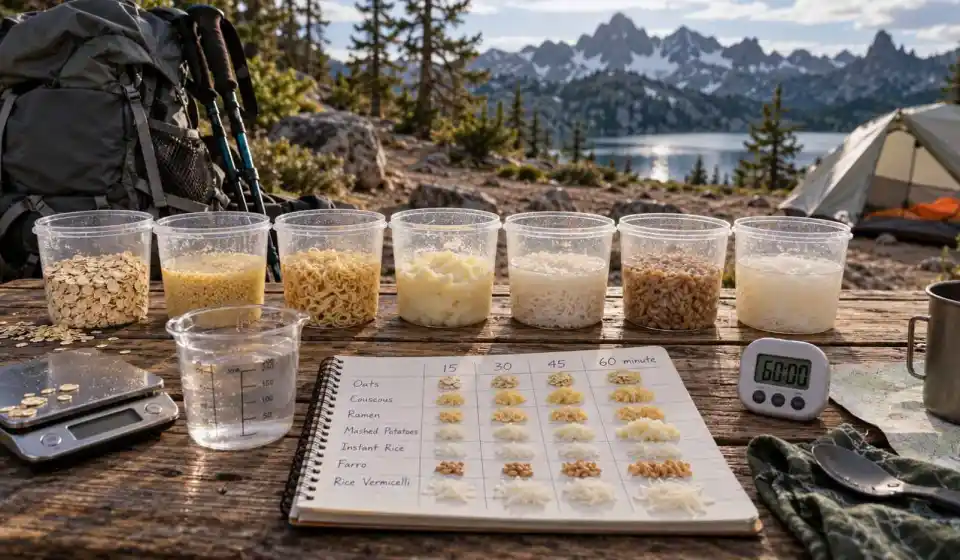
Camp Kitchen Lab testing works best when every food receives the same basic treatment: weigh the dry serving, record the amount of water, note room or water temperature, and check texture at predetermined intervals. ⚖️ Useful checkpoints are 15, 30, 45, and 60 minutes, followed by longer checks for stubborn foods such as large dehydrated beans or quick-cooking grains. Recording final hydrated weight also shows exactly how much water the meal absorbed rather than relying on visual impressions.
Calories per dry ounce should be calculated from the food before water is added because trail calorie density concerns the weight you actually carry from the trailhead. Water collected during the trip increases meal weight temporarily but ordinarily does not belong in the dry-food calorie-density calculation if you did not carry it from the beginning. This distinction connects cold-soaking experiments directly to caloric density, pack-out design, and stove-versus-no-stove comparisons.
Cold Soaking Is Really A Scheduling Problem
The biggest lesson from comparing these foods is that cold soaking is less about discovering one perfect number and more about matching processing, texture, temperature, and hiking schedule. Instant potatoes and oats can fit spontaneous meals, couscous works nicely around a short break, ramen and instant rice demand more planning, and intact grains such as regular farro or raw rice belong in a different preparation category. 🥣 Understanding that hierarchy prevents the frustrating experience of opening a container after an hour and discovering that your supposedly “soaked” dinner is still essentially raw grain.
For Camp Kitchen Lab, that makes cold soaking a useful bridge between Trail Nutrition Science and Trail Cooking Techniques rather than merely an ultralight trick. A lighter kitchen system may save stove, fuel, and cookware weight, but those savings only matter if the foods you bring rehydrate predictably and fit the schedule of your hike. 🎒 Test the exact foods you plan to carry, record the results, and your personal cold-soak chart becomes far more useful than any universal internet stopwatch.