Can A Vegan Backpacking Menu Reach 150 Calories Per Ounce? A 3-Day Food-Bag Test
A vegan backpacking food bag can contain plenty of calorie-dense ingredients, so 150 calories per ounce sounds achievable until you try building an entire breakfast, lunch, snack, and dinner system around that number. 🥜 Peanut butter, nuts, seeds, olive oil, granola, tortillas, dried fruit, couscous, instant rice, and textured vegetable protein can all travel well, but they do not contribute equal amounts of energy for their weight. Once lower-density foods enter the bag, maintaining a 150-calorie-per-ounce average becomes surprisingly difficult.
That makes this a better experiment than a rule, because there is nothing magical about 150 cal/oz, and a lower-density food bag is not automatically badly designed. A hiker may willingly carry a few additional ounces to get more variety, easier meals, familiar foods, or ingredients they actually enjoy eating after several hours on trail. 🎒 Our test therefore asks a narrower question: can an entirely plant-based three-day menu mathematically reach 150 calories per ounce, and what compromises are required to do it?
What Does 150 Calories Per Ounce Actually Mean?
Calories per ounce is simply the total calories in a food or menu divided by its total weight in ounces, so a 3,000-calorie food bag weighing 20 ounces averages exactly 150 cal/oz. The same 3,000 calories at 125 cal/oz would weigh 24 ounces, while a 100-cal/oz menu would require 30 ounces. ⚖️ Over one day those differences may look small, but across several days they begin accumulating inside the backpack.
For our three-day example, we will use 9,000 total calories, or an illustrative 3,000 calories per day, without suggesting that every backpacker needs that amount. At 150 cal/oz, those calories require 60 ounces of food, equal to 3.75 pounds, while 125 cal/oz requires 72 ounces, or 4.5 pounds. The experiment therefore has a clear target: can we remove those 12 ounces without producing an absurd or impractical menu?
The Rules Of Our 3-Day Food-Bag Experiment
Every ingredient must be plant-based, reasonably obtainable through supermarkets or common grocery channels, shelf-stable for the trip, and measured according to the food itself rather than including carried cooking water. 🌱 Water added at camp does not count toward packed food weight because a dehydrated ingredient should not be penalized for water collected later on the route. Packaging is also excluded so we can isolate the food-density calculation, although real backpackers obviously need to account for bags, bottles, and containers separately.
Nutrition labels vary among brands, so the numbers below should be treated as working menu estimates rather than universal values. For context, current package examples put peanut butter around 190 calories per 33 grams and raisins around 90 calories per 28 grams, illustrating how differently two common trail foods behave by weight. Olive oil is an extreme case, with a current label showing 120 calories in a tablespoon containing roughly 14 grams of fat, which explains why small amounts dramatically raise a menu average.
Our Vegan Trail Foods Ranked By Calories Per Ounce
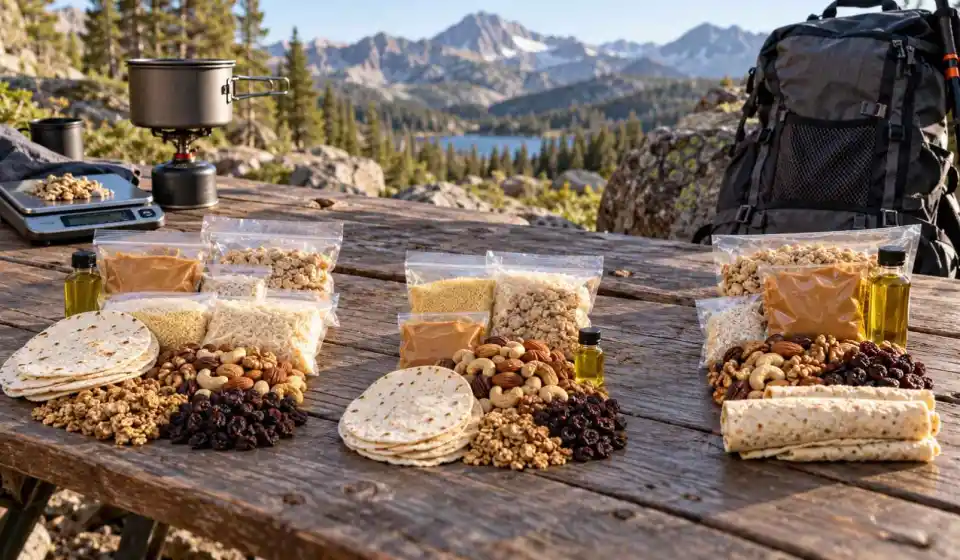
The easiest way to understand the experiment is to rank common vegan backpacking foods by their approximate energy density before building meals. 🧮 Exact values should always be recalculated from the package you actually buy, particularly for tortillas, bars, granola, cereals, and flavored foods whose recipes can vary considerably. The table below therefore uses rounded representative working values suitable for understanding the menu mathematics.
| Trail Food | Approx. Calories Per Ounce | Density Role |
|---|---|---|
| Olive oil | 240+ | Extremely high |
| Peanuts and many nuts | 160–175 | Very high |
| Peanut butter | 160–170 | Very high |
| Seeds and seed butters | 150–175 | Very high |
| Nut-heavy granola | 120–145 | Moderate to high |
| Vegan snack bars | 105–145 | Highly variable |
| Dry couscous | 100–110 | Moderate |
| Dry instant rice | 100–110 | Moderate |
| Dry TVP | 100–115 | Moderate |
| Flour tortillas | 85–105 | Moderate to low |
| Raisins and dried fruit | 80–100 | Lower |
Notice what happens immediately: most carbohydrate-heavy staples sit well below 150 cal/oz, meaning they lower the total average every time they enter the bag. Oil, peanut butter, nuts, and seeds therefore have to compensate for tortillas, dried fruit, couscous, cereal, or TVP if the entire food bag is expected to remain near 150. 🥜 The experiment is less about finding one miraculous ultralight food and more about balancing several foods whose densities pull the average in opposite directions.
Building Day One Toward 150 Cal/Oz
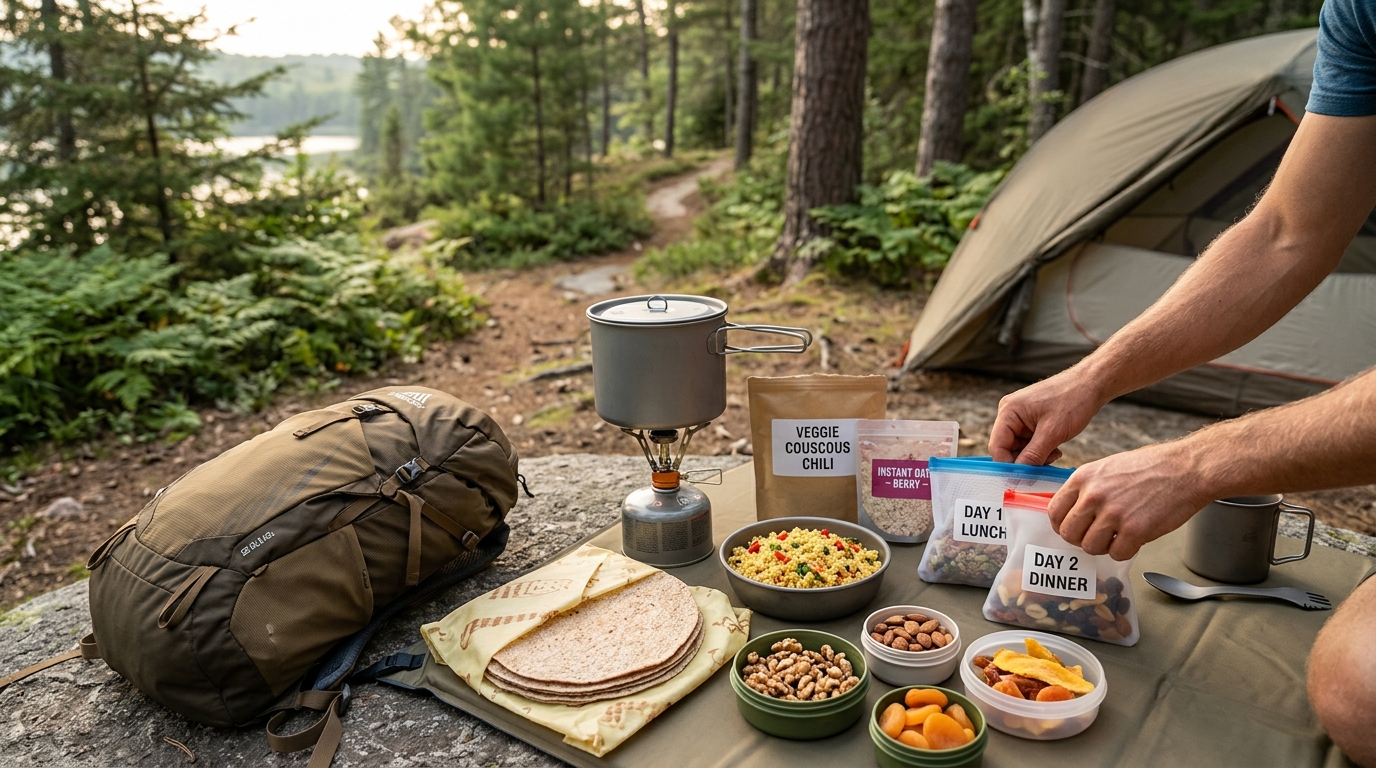
Imagine Day One containing a compact granola-and-peanut-butter breakfast, peanuts and a small amount of dried fruit during the day, tortillas with peanut butter at lunch, and couscous with TVP plus olive oil for dinner. By shifting more of the day’s weight toward nuts, peanut butter, and added oil, a theoretical 20-ounce food allocation can approach roughly 3,000 calories. 🎯 That puts the day close to the 150-cal/oz target without requiring any animal-derived food.
The mathematics works, but the menu reveals the first problem: maintaining the number requires an unusually large share of calories to come from highly concentrated foods. A generous amount of peanut butter, nuts, and several tablespoons of oil may look wonderful on a calorie-density spreadsheet while becoming repetitive or awkward when repeated meal after meal. The experiment therefore proves technical feasibility, not that this particular combination is an ideal three-day eating plan.
Can Days Two And Three Stay Above 150 Cal/Oz?
Day Two becomes harder the moment we add more variety, such as extra dried fruit, additional tortillas, more cereal, or a larger portion of couscous. 🍇 Those foods can be perfectly practical backpacking ingredients, yet because many sit around 90 to 120 calories per ounce, they pull the total food-bag average downward. Maintaining 150 then means adding more high-density ingredients somewhere else rather than simply choosing foods because they happen to be lightweight and dry.
By Day Three, the pattern becomes obvious: a normal grocery-store vegan menu might naturally settle somewhere around 110–125 cal/oz, while a deliberately weight-conscious menu can be pushed higher by emphasizing nuts, nut butters, seeds, granola, and oils. Reaching roughly 150 is possible, but the available menu space for lower-density foods becomes increasingly limited. 🎒 The target effectively creates a calorie-density budget in which every ounce of raisins, tortillas, or dry grain must be balanced by something substantially denser.
Three Versions Of The Same 3-Day Food Bag
Suppose all three versions contain the same illustrative 9,000 calories, but we progressively redesign the ingredient mix rather than changing the energy total. A normal supermarket-style vegan menu averaging 120 cal/oz would weigh about 75 ounces, or 4.69 pounds, while a more carefully optimized 135-cal/oz bag would weigh about 66.7 ounces, or 4.17 pounds. 📉 The aggressive 150-cal/oz version reaches exactly 60 ounces, or 3.75 pounds.
That means moving from 120 to 135 cal/oz saves about 8.3 ounces over three days, while going all the way from 120 to 150 saves 15 ounces. Those are real savings, especially for hikers already optimizing the rest of their equipment, but the difference is still measured in ounces rather than multiple pounds on a short trip. The comparison helps prevent calorie density from becoming a competition where hikers sacrifice enjoyable food merely to achieve a prettier spreadsheet number.
What You Give Up When You Chase Calorie Density
The biggest sacrifice is often menu flexibility, because water-free carbohydrate foods are not automatically extremely calorie-dense. 🍚 Couscous, instant rice, dried fruit, cereal, tortillas, and TVP can all make sense in backpacking meals while simultaneously reducing the average compared with oil or nuts. Chasing 150 relentlessly can therefore push a menu toward similar high-fat ingredients even when another food would provide better texture, flavor, convenience, or personal appeal.
Food volume and preparation also matter because olive oil is wonderfully efficient by weight but cannot simply replace every breakfast, snack, and dinner ingredient. A theoretical food bag dominated by oil and nut butter may reach extraordinary calorie density while becoming less appealing after several days, especially if the hiker prefers crunchy snacks, savory grains, fruit, or larger meals. 🥄 This is why calorie density should remain one design variable, alongside taste, preparation time, cost, food tolerance, storage, and the likelihood that the food will actually be eaten.
150 Cal/Oz Vs 125 Cal/Oz: How Much Weight Do You Save?
This is where the experiment becomes genuinely useful because the savings can be calculated without arguing that either number is universally better. At an illustrative 3,000 calories per day, a 125-cal/oz menu requires 24 ounces per day, while a 150-cal/oz menu requires 20 ounces. ⚖️ The difference is exactly four ounces per day, assuming both menus provide the same number of calories.
Across three days, that saves 12 ounces, or 0.75 pound; across five days it becomes 20 ounces, or 1.25 pounds; and across seven days it reaches 28 ounces, or 1.75 pounds. Those savings become increasingly meaningful as trip length grows, which helps explain why calorie-density optimization matters more on long carries between resupplies than on a short overnight. 🏕️ The correct question is therefore not simply “Can I hit 150?” but “How many ounces will this target actually save on my specific trip?”
So Can A Vegan Backpacking Menu Really Reach 150 Cal/Oz?
Yes—a vegan backpacking food bag can mathematically reach approximately 150 calories per ounce, because plant foods include extremely calorie-dense ingredients such as oils, nuts, seeds, and nut butters. 🌱 The challenge is not finding plant-based calories but maintaining enough menu variety while keeping the weighted average that high. Once you add larger amounts of dried fruit, tortillas, grains, TVP, cereal, or other moderately dense foods, the number starts falling unless higher-fat foods compensate.
For many hikers, something closer to 125–140 cal/oz may ultimately create an easier balance between food weight and practical meals, but that is a menu-design choice rather than a universal prescription. The real Camp Kitchen Lab lesson is that 150 cal/oz is possible, measurable, and useful as an experiment—but it should be treated as a tool, not a requirement. 🥾 Build the menu you will actually eat, calculate what it weighs, and then decide whether removing another four ounces per day is worth changing what is inside the bag.