Homemade Trail Mix vs. Store-Bought Packs: Which Costs Less per Calorie? 🥜
Introduction
Trail mix is one of the easiest snacks to pack for a hike, road trip, workday, or busy afternoon. It combines calorie-dense ingredients such as nuts and seeds with dried fruit, chocolate, or crunchy extras, making it convenient when you need energy without carrying bulky food.
But is homemade trail mix actually cheaper than buying ready-made packs?
The answer depends on what you put in the mix, where you shop, and whether you compare bulk bags or individually portioned snacks. A homemade blend made mostly with peanuts and raisins can be inexpensive, but adding lots of cashews, pecans, and premium chocolate can quickly raise the cost. Meanwhile, store-bought multipacks charge more per ounce in exchange for convenience and portion control.
The fairest comparison is cost per calorie, alongside cost per ounce and serving size. This helps you understand how much usable energy you get for your money, especially when planning backpacking meals on a budget.
For a real-world example, we’ll use published Walmart US price listings and a September 2026 ingredient-price comparison, with calculations clearly identified as estimates where nutrition values vary. Prices are a snapshot, not a guarantee of what your local store charges today.
1. The Real Price Comparison: Homemade vs. Store-Bought
A useful starting point is comparing a homemade classic mix with a ready-to-eat snack pack sold by Walmart.
$0.24/oz
Approximately $3.81 per pound
A published September 2026 ingredient-price comparison estimated the cost of a blend containing peanuts, raisins, chocolate chips, and almonds at 23.8 cents per ounce, before packaging or labor.
$0.47/oz
$6.52 for eight 1.75 oz packs
The listed price works out to approximately 46.6 cents per ounce. Each pouch contains 240 calories and 7 grams of protein, according to the product listing.
At these listed prices, homemade classic mix costs approximately 49% less per ounce than the individual snack packs.
However, the comparison changes when you buy a large bag of ready-made trail mix. A 26 oz Great Value Mountain Trail Mix bag was listed at $6.28 in another Walmart result, equivalent to about 24.2 cents per ounce. That’s nearly the same ingredient cost as the homemade classic mix.
The takeaway is important: homemade isn’t automatically cheaper than every packaged option. It has its clearest price advantage over individually portioned packs and premium blends.
2. Which Costs Less per Calorie?
Trail mix is calorie-dense because nuts and seeds contain substantial amounts of fat, which provides about 9 calories per gram. Dried fruit and chocolate contribute additional energy.
To compare the options fairly, use this formula:
\[ \text{Cost per 1,000 calories} = \frac{\text{Cost per ounce}}{\text{Calories per ounce}}\times 1,000 \]
Using approximate calorie values for the ingredients, we can estimate the following:
| Trail mix option | Cost per ounce | Estimated calories per ounce | Cost per 1,000 calories |
|---|---|---|---|
| Homemade classic | $0.238 | 138 | $1.72 |
| Homemade fruit and nut | $0.354 | 145 | $2.44 |
| Homemade pecan and dark chocolate | $0.453 | 150 | $3.02 |
| Individual store-bought packs | $0.466 | 137 | $3.40 |
Homemade ingredient costs are from the September 2026 comparison; packaged calories use the listed 240 calories per 1.75 oz pouch. Homemade calorie figures are estimates based on typical ingredient nutrition values, not laboratory-tested recipe results. Actual values vary by brand and ingredient proportions.
In this example, the budget homemade mix costs roughly half as much per calorie as the individual snack packs.
But notice the premium homemade blend: using more expensive nuts and chocolate increases its cost considerably. Your recipe matters as much as your decision to make it yourself.
3. Three Homemade Trail Mix Formulas to Try
These formulas use ingredient percentages by weight. Weighing ingredients makes it easier to calculate cost, calories, and pack sizes accurately.
Mix 1: Budget Trail Mix
Lowest estimated cost
- 30% peanuts
- 25% raisins
- 25% almonds
- 20% semi-sweet chocolate chips
Estimated ingredient cost: $0.238/oz, or $3.81 per pound.
This is the strongest choice when your priority is affordable calories. Peanuts and raisins help keep the cost down, while almonds and chocolate add variety.
Homegrown
Mix 2: Fruit, Nut, and Seed Mix
- 25% cashews
- 25% almonds
- 20% dried cranberries
- 15% pumpkin seeds
- 15% banana chips
Estimated ingredient cost: $0.354/oz, or $5.67 per pound.
This blend offers more variety in texture and flavor. Pumpkin seeds add crunch, while dried cranberries provide a tart-sweet contrast. It costs more than the budget blend because several ingredients are more expensive.
Mix 3: Premium Hiking Mix
- 30% pecans
- 30% cashews
- 20% dark chocolate chips
- 20% dried cranberries
Estimated ingredient cost: $0.453/oz, or $7.25 per pound.
This is a richer, more premium-tasting blend. It’s suitable when flavor variety matters more than getting the absolute lowest cost per calorie.
Homegrown
How to make a one-pound batch
For a 16 oz batch of the budget mix, use:
- 4.8 oz peanuts
- 4 oz raisins
- 4 oz almonds
- 3.2 oz chocolate chips
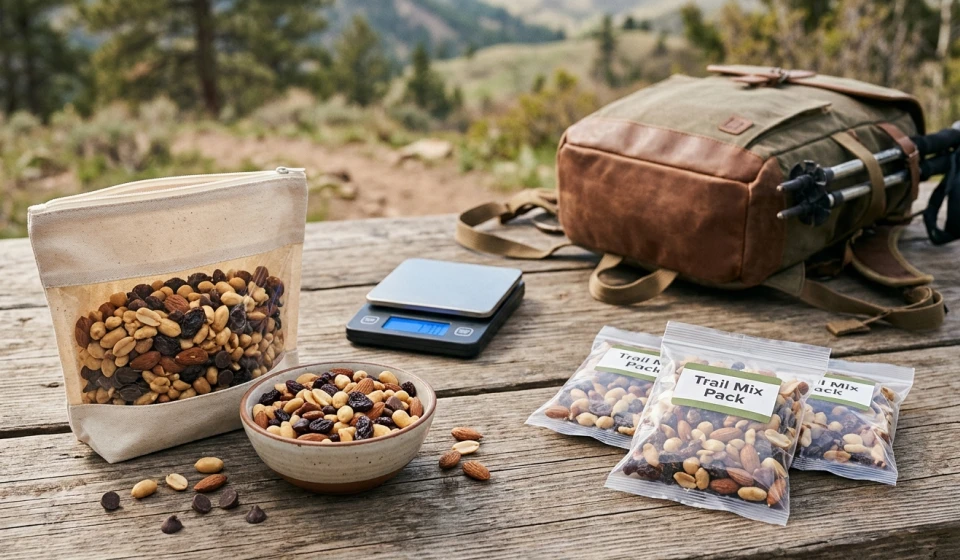
Combine the ingredients in a clean, dry bowl and mix thoroughly. Divide into portions using a kitchen scale.
If you want to prepare ten servings of 1.6 oz each, weigh each portion rather than relying on cup measurements. Different ingredients settle differently, so equal volumes do not always have equal weights or calories.
4. The Hidden Costs of Homemade Trail Mix
Ingredient prices tell only part of the story.
Before deciding that homemade mix is cheaper, consider these additional factors.
- Packaging: Reusable containers have an upfront cost, while disposable bags add a small expense to each batch.
- Food waste: Buying a large bag of an ingredient you rarely use can erase savings if it becomes stale.
- Storage: Nuts contain fats that can develop stale or rancid flavors when stored poorly or for too long.
- Preparation time: Mixing trail mix is simple, but measuring and portioning take time.
- Shopping differences: Bulk discounts, warehouse clubs, store brands, and sales can change the comparison significantly.
For a realistic calculation, divide the total cost of each ingredient by its package weight to get the cost per ounce. Multiply that figure by the number of ounces used in your recipe, then add packaging costs if you want to compare the full cost of packed servings.
Do not count the entire price of a bag of almonds as the cost of one batch if you use only part of it. The remaining ingredients can be used in future batches, provided they are stored properly.
5. Portion Sizes Matter More Than You Might Think
Trail mix is convenient, but it is easy to eat more than intended when snacking directly from a large bag.
A 1 oz serving is a useful starting point for everyday snacking, although appropriate portions depend on individual energy needs and the rest of your diet.
For backpacking, a larger portion may be useful because energy requirements can increase substantially with prolonged activity. In that situation, calories per ounce and the amount of food you need to carry become important planning measurements.
For example, if you pack a 1.75 oz portion containing approximately 240 calories, four portions provide 960 calories in total. The exact energy content will depend on the mix.
Pre-portioning also makes it easier to calculate the food weight for a trip and reduces the temptation to consume your entire supply early.
6. Allergen Safety: Check Before You Mix ⚠️
Homemade trail mix gives you control over the ingredients, but it does not automatically make the snack allergen-safe.
Common allergens in trail mix include peanuts, tree nuts, and, depending on the ingredients, milk or soy in chocolate products.
If you or someone sharing your food has an allergy:
- Read ingredient labels and allergen statements on every package.
- Check whether products warn about possible cross-contact with other allergens.
- Use clean utensils and containers.
- Avoid sharing scoops or mixing equipment that may have contacted allergens.
- Choose appropriate alternatives only after checking their labels and manufacturing information.
Sunflower seeds or roasted chickpeas may work in some nut-free recipes, but they are not automatically safe for every person with an allergy. For a serious allergy, follow the person’s medical guidance and use products that meet their safety requirements.
7. Heat and Storage: What Hikers Should Know ☀️
Trail mix is convenient for hiking because it generally contains little moisture and does not require cooking. However, heat can still affect its quality.
Chocolate may melt in a hot backpack, and warm conditions can accelerate rancidity in nuts and seeds. Dried fruit can also become sticky, especially when exposed to moisture.
To help maintain quality:
- Store trail mix in a clean, airtight container in a cool, dry place.
- Keep it out of direct sunlight and away from hot vehicles.
- Use a resealable pouch or food-safe container for hiking.
- Consider a chocolate-free formula for hot-weather trips.
- Follow package storage instructions, particularly for ingredients labeled for refrigeration after opening.
For longer storage, refrigeration or freezing can help preserve nuts and seeds, provided they are protected from moisture and odors. Allow chilled containers to reach a suitable temperature before opening if condensation is a concern.
Trail mix should not be treated as immune to food spoilage simply because it is dry. Discard it if it develops visible mold, unusual odors, or clear signs of spoilage.
Final Thoughts 💚
Homemade trail mix can be an excellent way to reduce snack costs, customize flavors, and control portion sizes. The biggest savings often come from choosing affordable ingredients, buying practical package sizes, and avoiding individually wrapped portions.
However, large bags of store-brand trail mix can be surprisingly competitive. If you want convenience without paying a large premium, compare the unit price before assuming that homemade is always the better deal.
For budget-conscious hikers, a simple mix of peanuts, raisins, almonds, and a modest amount of chocolate is a useful starting point. Premium nuts and specialty ingredients can make a delicious upgrade, but they also increase the cost per calorie.
The best trail mix is the one that fits your budget, provides the energy you need, travels well, and is enjoyable enough that you actually want to eat it. 🥾