Does Hiking Downhill Burn More Calories Than Walking Flat?
Hiking downhill calories burned is a surprisingly misunderstood topic, especially among hikers who finish a mountain descent with tired legs, aching knees, and sore quadriceps. 🥾 Walking downhill can feel harder than walking on flat ground, even when your breathing seems comfortable and your heart rate remains relatively low. However, the surprising scientific answer is that downhill walking often burns fewer calories than level walking, depending on the slope, speed, and terrain.
The confusion comes from assuming that greater muscular discomfort always means greater energy expenditure, but those two experiences measure different things. Your muscles work to control your body against gravity during descent, even though gravity is helping move you downward. Understanding this difference makes estimating trail calories more accurate and helps hikers plan food without overestimating their energy requirements.
Why Hiking Downhill Feels Harder Than Expected 🏔️
Most hikers expect climbing to be difficult because every step requires lifting the body against gravity, while descending appears to offer a free ride. However, the downward journey requires constant balance adjustments, controlled foot placement, and repeated braking movements to prevent accelerating uncontrollably. These demands become particularly noticeable on rocky switchbacks, loose gravel, slippery surfaces, or trails with long stretches of steep descending.
The sensation of difficulty also changes throughout a hike because muscles may already be fatigued from climbing before the descent begins. Your knees and thighs can feel increasingly uncomfortable as the quadriceps repeatedly control your body’s downward motion. Importantly, muscle fatigue, joint stress, and calorie expenditure are related aspects of physical activity, but they are not interchangeable measurements.
How Your Muscles Control The Body’s Descent
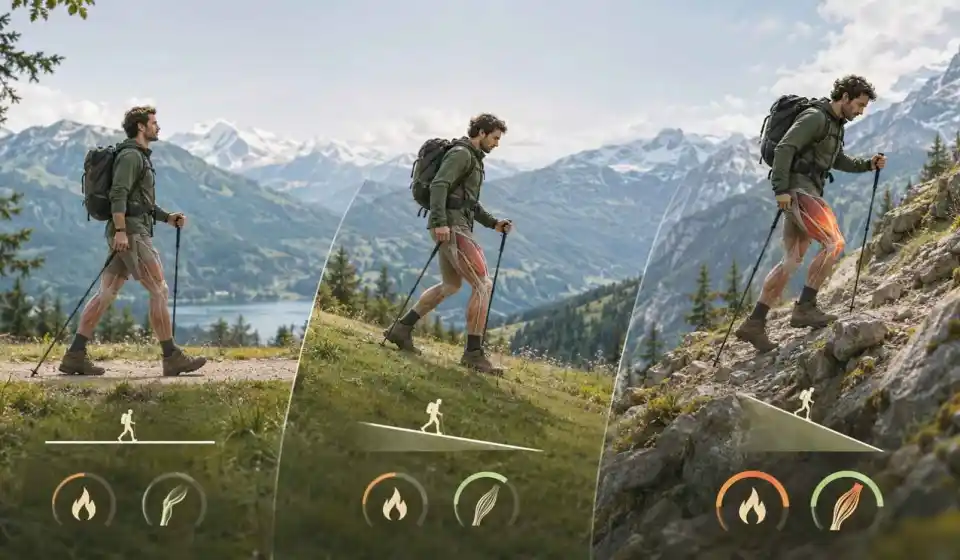
During uphill hiking, muscles produce force while shortening to help lift your body, a process commonly called concentric muscle contraction. During downhill hiking, many of those muscles produce force while lengthening, creating what exercise scientists call eccentric muscle contractions. 🦵 Your quadriceps perform substantial braking work as your knees bend to absorb the impact of each descending step.
Eccentric muscle contractions can generate considerable force with relatively low metabolic energy requirements compared with concentric contractions. That means your legs can experience substantial mechanical loading without the same increase in oxygen consumption associated with climbing. Research on downhill walking also shows that unfamiliar or prolonged descents can produce muscle soreness afterward, even when the cardiovascular workload during the activity was comparatively modest.
Does Walking Downhill Burn Fewer Calories Than Walking Flat?
For many moderate downhill slopes, the answer is yes, walking downhill generally requires less metabolic energy per unit of distance than walking on level ground. Gravity assists the downward movement, reducing the amount of energy your muscles need to spend moving your body forward and upward. This does not mean descending burns zero calories, because walking still requires muscle activation, coordination, balance, and controlled movement.
The relationship changes when slopes become exceptionally steep, because preventing uncontrolled acceleration requires increasingly substantial braking effort. As a result, downhill calorie expenditure does not follow a simple rule in which every additional degree of decline makes walking easier. Instead, the energy-cost curve generally falls during moderate descent before rising again as the downhill grade becomes sufficiently steep.
What Scientific Research Actually Shows 🔬
A 1993 study published in The Journal of Physiology examined walking energetics across different gradients and identified the lowest metabolic cost at approximately a 10% downhill grade. Researchers explained this pattern through differences between positive muscular work, which raises or accelerates the body, and negative work, which controls lowering or deceleration. Their findings demonstrate why a moderately descending trail can require less metabolic energy than level walking despite noticeable muscular effort.
A 2002 study in the Journal of Applied Physiology expanded the investigation to extremely steep gradients, revealing that walking energy cost increased again beyond the most economical downhill slope. At approximately a 10% decline, the reported minimum metabolic cost per distance was about half the minimum measured on level ground under the study conditions. These findings describe controlled treadmill experiments, so their exact percentages should not be applied automatically to every outdoor hiker carrying a backpack.
Why A 5% Descent And A 20% Descent Are Different
A negative 5% grade means the trail drops approximately five meters vertically for every 100 meters of horizontal travel, producing a relatively gentle downhill section. At this gradient, gravity assists movement while your muscles perform manageable braking and balance tasks, often reducing metabolic demand compared with equivalent-speed level walking. 🌿 A smooth descending forest trail may therefore feel comfortable without requiring the same energy expenditure as a flat route of similar distance.
A negative 20% grade represents approximately 20 meters of vertical descent per 100 meters horizontally, creating much stronger braking demands. Your steps may become shorter and more deliberate, especially when the ground offers limited traction or includes rocks and uneven surfaces. Although this steeper decline may increase metabolic cost compared with a moderate descent, it does not automatically burn more calories than flat walking in every circumstance.
Flat Walking Vs Gentle Downhill Vs Steep Downhill
The easiest way to understand downhill hiking calories is to separate muscle workload from metabolic energy expenditure rather than treating them as identical. A controlled walking experiment can reveal differences in oxygen consumption that are difficult to recognize through physical sensations alone. The comparison below illustrates the expected pattern under broadly comparable walking conditions, rather than promising exact calorie numbers for every trail.
| Walking terrain | Main muscular demand | Typical metabolic pattern |
|---|---|---|
| Flat ground, 0% | Repeated propulsion and support | Baseline for comparison |
| Gentle downhill, around -5% | Moderate braking and stabilization | Often lower than flat |
| Steep downhill, around -20% | Greater braking and balance demands | Higher than the most efficient downhill grade, but variable relative to flat |
One important detail is that the lowest energy cost per kilometer is not necessarily the lowest energy expenditure per minute. Walking faster can increase the rate at which calories are burned, even if the terrain remains relatively efficient for covering distance. Consequently, meaningful comparisons should consider walking speed, distance, gradient, and whether researchers are measuring total or activity-only energy expenditure.
Why Some Calorie Calculators Struggle With Negative Grades 📱
Many basic walking calorie calculators use equations designed primarily for level walking or uphill treadmill exercise. Some estimate oxygen consumption using walking speed and an uphill grade term, which becomes problematic when users enter negative slopes outside the equation’s intended application. Applying such formulas incorrectly can produce unrealistically low estimates or even mathematically impossible negative oxygen-consumption values.
More sophisticated models account for the nonlinear relationship between descending gradients and metabolic cost rather than extending an uphill formula indefinitely below zero. A 2019 study published in Medicine & Science in Sports & Exercise developed and evaluated an equation intended to estimate energy expenditure across level, uphill, and downhill walking. Nevertheless, outdoor terrain, backpack loads, individual walking patterns, and changing speeds introduce additional uncertainty beyond controlled laboratory conditions.
How To Estimate Calories On An Uphill-And-Downhill Route
Consider a six-mile mountain route consisting of three miles of climbing followed by three miles of descending, with the same starting and ending elevations. 🗺️ It would be misleading to classify the entire hike as flat simply because the net elevation change equals zero. The climbing section requires additional energy to gain elevation, while the descending section has a different metabolic cost shaped by its gradient and walking conditions.
A practical approach is to divide the route into uphill, downhill, and relatively flat segments before estimating energy expenditure for each section. Record the distance, approximate average grade, expected speed, body weight, backpack load, and walking duration, then use an estimation method that explicitly supports the relevant terrain. Add the individual segment estimates to obtain a more realistic planning range rather than assuming the entire trip has one constant calorie-burning rate.
Why Real Trails Change The Calorie Calculation
Laboratory walking experiments typically use controlled surfaces and relatively predictable movement patterns, while natural hiking routes introduce obstacles that alter walking mechanics. Loose rocks, mud, roots, uneven steps, and frequent changes in direction can force hikers to slow down, stabilize their bodies, or use additional muscular effort. 🎒 Carrying a heavy backpack also changes the physical demands of descending, although the precise energy difference depends on more than pack weight alone.
Individual characteristics further complicate the calculation because body mass, walking technique, fitness, fatigue, and preferred pace influence actual energy expenditure. Trekking poles may help redistribute some physical loading and assist with balance, but their overall effect on calories depends on how they are used. Therefore, a downhill calorie estimate should be treated as a useful approximation rather than an exact measurement of what happened on the trail.
What Downhill Calorie Burning Means For Trail Nutrition 🍌
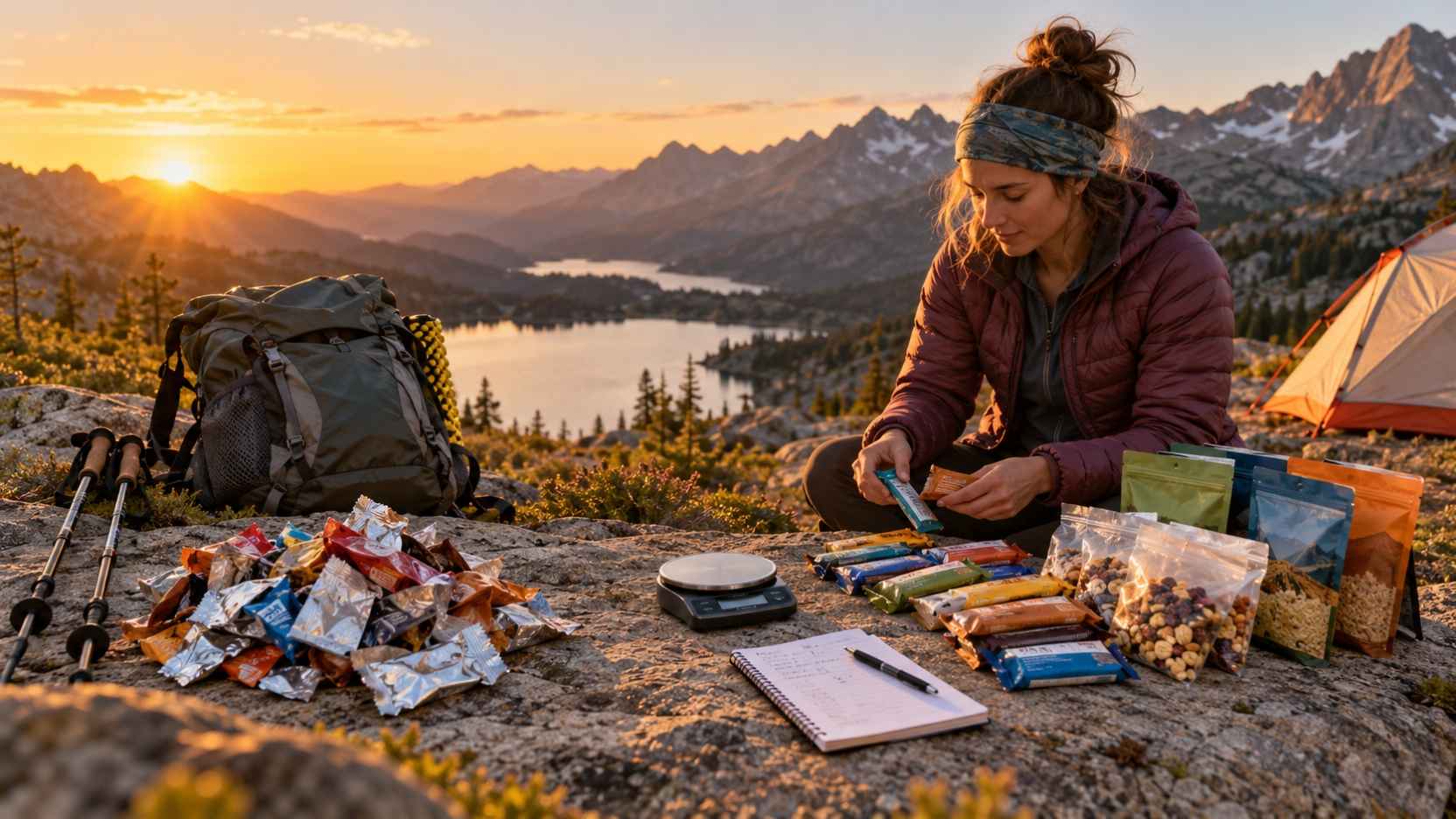
For backpackers, understanding downhill energy expenditure can improve food planning by preventing the assumption that every difficult-feeling mile requires the same additional calories. A steep uphill section may impose greater metabolic demands than a moderate descent of comparable distance, even when the descent leaves your legs feeling sore. However, total hiking nutrition still depends on the entire day’s walking duration, carried weight, route conditions, and overall energy needs.
A practical fueling strategy considers the complete route rather than trying to match every snack to momentary leg fatigue. Hikers can estimate daily energy requirements, organize convenient carbohydrate-containing foods, and adjust their menus based on trip duration and personal experience. For individualized nutrition requirements involving health conditions or specific medical concerns, consulting a qualified healthcare professional is more appropriate than relying entirely on generic calorie calculators.
Does Downhill Hiking Count As Exercise?
Downhill hiking absolutely counts as physical activity because muscles remain active, joints support body weight, and the nervous system continually coordinates movement. The relatively low metabolic cost of moderate descent does not eliminate the mechanical workload experienced by the lower body. In fact, the combination of controlled muscle lengthening and repeated braking helps explain why descending can feel challenging despite lower oxygen consumption.
The distinction is especially important when hikers evaluate their experiences using heart rate, perceived exertion, or next-day soreness. None of these measurements independently tells you exactly how many calories a particular downhill section burned. A more meaningful understanding combines terrain information with duration, speed, metabolic research, and realistic uncertainty about personal energy expenditure.
Final Verdict: Does Hiking Downhill Burn More Calories Than Walking Flat?
Most moderate downhill walking burns fewer calories per unit distance than comparable level walking, while very steep downhill sections can increase energy requirements again. 🏔️ This explains why a gentle descent may feel metabolically easy while an aggressive mountain descent creates significant muscular fatigue. The apparent contradiction disappears once you recognize that controlling body movement and consuming metabolic energy are not the same physical process.
For hikers building a reliable trail nutrition plan, the most useful lesson is to calculate energy needs across the complete route rather than judging calorie expenditure by how tired the legs feel. Elevation gain, elevation loss, gradient, walking speed, distance, and backpack weight all deserve consideration when estimating an outing’s demands. Ultimately, better calorie estimates come from understanding the terrain, not assuming the hardest-feeling section always burns the most energy.