Can You Catch Up on Missed Trail Calories? The Math Behind Fueling Too Late
You packed enough food, calculated your trail calories, and started the day with a neat fueling plan, but several hours later half the snacks are still sitting untouched in your pack. The obvious solution seems simple: eat the missed calories later and finish the day with the same total intake you originally planned. 🥾 Mathematically, however, catching up becomes increasingly awkward because every skipped eating period pushes more food into fewer remaining hours.
This does not mean every hiker must eat exactly the same amount every hour, nor does it mean missing one snack automatically creates a problem. Hiking intensity, body size, terrain, temperature, trip goals, pre-hike meals, and individual preferences can all change how much food makes sense, so the numbers below are a planning model rather than a prescription. What the model reveals is something much simpler: delaying calories does not erase them from your plan—it concentrates them later.
The Fueling Gap Nobody Calculates
Suppose you plan an eight-hour hiking day and allocate 200 calories per hiking hour, giving you 1,600 calories of planned on-trail food. If you actually consume roughly that amount across the day, the packing math is straightforward because each hour accounts for one-eighth of the planned trail calories. 🎒 Your schedule might not be perfectly precise, but the food workload remains relatively evenly distributed.
Now imagine that after three hours you have eaten only 200 calories instead of the planned 600 calories. Your original plan said 600 calories by that point, so your fueling gap is 400 calories, even though the food itself is still sitting safely inside your backpack. You have not lost those calories; you have simply moved the task of eating them into the remaining five hours.
One Missed Snack Doesn’t Stay Small
The easiest way to understand the problem is to treat every skipped 200-calorie interval as a small piece of accumulating debt. Miss one planned interval and you are 200 calories behind; miss two and the gap becomes 400 calories, three becomes 600 calories, and four becomes 800 calories. 📊 Nothing complicated is happening—the arithmetic simply compounds because the planned intake continues while the actual intake does not.
That growing number matters because the hiking day has a fixed endpoint. An 800-calorie gap at noon would not be remarkable if another eight hours of eating remained, but an 800-calorie gap with only three or four hiking hours left completely changes the schedule. The closer you get to the trailhead, camp, or finish line, the fewer opportunities remain for the original food plan to work as designed.
Why “I’ll Eat More Later” Changes The Menu
Imagine that you planned four separate 200-calorie snacks for four hours but ate none of them. You are now carrying 800 calories of planned food that still needs a place in the schedule, which might represent several bars, trail-mix portions, tortillas, dried fruit packets, or other trail foods depending on what you packed. 🍫 Catching up therefore becomes a question not merely of calories but of food quantity, portion size, accessibility, and remaining eating opportunities.
Suppose four hiking hours remain and you still want to reach the original 1,600-calorie trail target. Instead of averaging 200 calories during each remaining hour, you would need to account for the new calories scheduled for those hours plus the 800-calorie backlog, effectively increasing the amount of food assigned to the second half of the day. The daily total has not changed, but its distribution has become much more concentrated.
An 8-Hour Hiking Example
Consider an illustrative schedule in which a hiker assigns 200 calories to every hiking hour: Hour 1 = 200, Hour 2 = 200, Hour 3 = 200, Hour 4 = 200, and the same pattern continues through Hour 8. At the end of eight hours, planned trail intake equals 1,600 calories, and each eating period represents 12.5% of that total. ⏱️ The benefit of this example is not that 200 calories is ideal for everyone, but that the simple number makes the scheduling consequences easy to see.
Now suppose the hiker eats 200 calories during Hour 1, skips Hours 2 and 3, and then resumes eating during Hour 4. By the start of Hour 4, the original schedule called for 600 calories consumed while actual intake is only 200, producing a 400-calorie gap. If the hiker waits another two hours before addressing that difference, the mathematical problem can grow even though the total amount packed has never changed.
Front-Loading, Even Spacing And Catch-Up Compared
Three hikers could carry exactly the same 1,600 trail calories while using completely different schedules. One could front-load more food early, another could distribute approximately 200 calories across each hour, and a third could eat relatively little early before concentrating more food near the end. 🥨 From a pure calorie-total perspective, all three schedules can theoretically reach 1,600 calories.
The difference appears when you measure how much intake remains at different points in the day. After six hours, an evenly spaced 200-calorie plan would have allocated about 1,200 calories and leave approximately 400, while someone who had consumed only 600 calories would still have 1,000 calories remaining from the same 1,600-calorie trail plan. Neither calculation declares one universal physiological winner; it simply shows that late catch-up requires fitting considerably more food into a shorter remaining window.
The Catch-Up Rate Makes The Difference Obvious
You can make the calculation even more useful with a simple formula: remaining planned calories ÷ remaining hiking hours = average calories that must be scheduled per remaining hour. If you have 800 calories left with four hours remaining, the average remains a manageable 200 calories per hour, exactly matching the original example. 🧮 If the same 800 calories remain with only two hours left, your schedule has effectively increased to 400 calories per remaining hour.
Push the example further and the logistics become clearer: 800 remaining calories with one hiking hour left means the entire 800-calorie backlog has been compressed into that final period if reaching the original target remains the goal. You could decide not to catch up completely, change the timing, or shift some food to your post-hike meal, but those are changes to the original plan rather than proof that the missed calories disappeared. This is why tracking remaining calories alongside remaining time can be more useful than simply asking, “How much food do I have left?”
Turn The Calculation Into A Pack-Out Plan
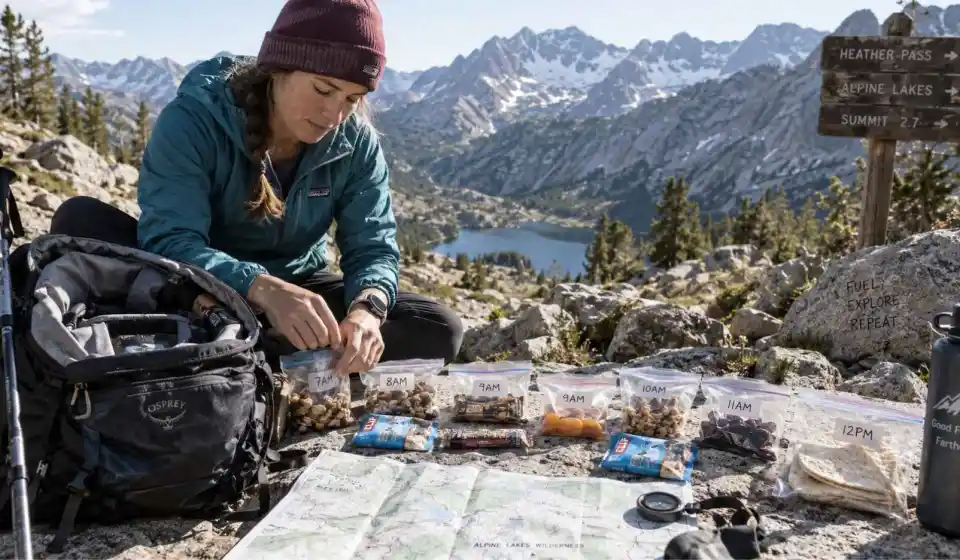
Instead of carrying one large bag of snacks and hoping your intake roughly matches the plan, divide planned trail food into recognizable portions before leaving home. An eight-hour trip using this hypothetical 1,600-calorie plan could become eight approximately 200-calorie packets, four 400-calorie blocks, or another arrangement that suits your preferred eating schedule. 🎒 When one packet remains untouched, you can immediately see how far the actual schedule has drifted from the plan.
Labeling packets by hiking period can also make the system easier to audit without constantly performing mental arithmetic. A simple setup such as “Hours 1–2,” “Hours 3–4,” “Hours 5–6,” and “Hours 7–8” gives each 400-calorie block a clear destination while still allowing flexibility in exactly when you eat it. The objective is not rigid clock-watching; it is preventing several small skipped portions from quietly turning into a large pile of uneaten food late in the day.
Calories Per Ounce Add Another Layer
Once you know how many trail calories you intend to carry, the next useful calculation is calories per ounce, because two foods containing the same energy can require very different pack weights and volumes. A calorie-dense trail food can place more energy into a smaller weight allowance than a food containing substantial water or other low-energy components. ⚖️ That matters on longer trips where food weight becomes a meaningful percentage of total pack weight.
However, calorie density does not replace scheduling because an extremely energy-dense pack can still be poorly organized. You might carry exactly the intended calorie total yet reach Hour 6 with most of those calories unopened, which leaves the same catch-up mathematics waiting for you. Camp Kitchen Lab’s Calories Per Ounce calculation therefore answers “how efficiently did I pack the energy?” while the fueling schedule answers “when did I plan to use it?”
Build Your Trail Calorie Plan Backward
A practical pack-out system starts with the whole day and works backward instead of randomly adding snacks until the food bag looks full. Estimate the trail-calorie target you want to use for planning, divide it across expected hiking time, choose foods that fit your desired weight and portability, and then group those foods into visible eating intervals. 🗺️ If the route includes long climbs, exposed ridgelines, technical sections, or places where stopping will be inconvenient, the schedule can also account for when eating opportunities are realistically available.
This is where the Camp Kitchen Lab planning chain becomes useful: start with the Daily Calorie Calculator, examine food efficiency through Calories Per Ounce, and then turn the result into an actual hiking day using Menu Templates. Those three calculations answer different questions—how much energy you intend to pack, how much that food weighs, and how you distribute it across the trail. A strong plan connects all three instead of treating calorie totals as an isolated number.
The Real Lesson Is Not To Fear A Missed Snack
Missing a planned eating interval does not automatically ruin a hiking day, and trail nutrition should not become an exercise in obsessively matching a spreadsheet. The useful lesson is simply that missed calories accumulate numerically, so waiting longer makes the original schedule harder to reproduce without changing portion sizes or eating frequency. 🌲 Seeing the calculation early gives you more options than discovering a large quantity of untouched food near the end of the hike.
For an eight-hour day planned at 200 calories per hour, two skipped intervals create a 400-calorie difference and four create an 800-calorie difference—nothing mysterious, just subtraction. Rather than thinking, “I’ll catch up later,” ask a more useful planning question: How many calories remain, how many hiking hours remain, and what does that make my new average per hour? That simple equation turns fueling from guesswork into a trail system you can actually pack, track, and adjust.