Choosing a Food Dehydrator for Backpacking: The Specs That Actually Matter
Making your own dehydrated backpacking meals can save money, reduce packaging, and give you much more control over what goes into your trail food. But before you start drying vegetables, cooked pasta, beans, or meat, there is one important decision to make: choosing the right dehydrator.
The most expensive dehydrator isn’t automatically the best choice for backpacking food. What matters is whether the machine can dry food consistently, handle the quantity you need, maintain appropriate temperatures, and fit your kitchen and budget.
Here are the specifications worth paying attention to before buying one.
Temperature Range Is One of the Most Important Specs
Temperature control matters because different foods require different drying conditions.
A dehydrator should offer a useful range rather than simply having an “on” and “off” setting. Fruits, vegetables, herbs, cooked grains, and proteins may all require different approaches.
For backpacking meals, a machine with adjustable temperature settings is particularly useful because you may want to dehydrate several types of ingredients.
A broad temperature range also gives you flexibility as you experiment with recipes.
Don’t assume that a higher maximum temperature automatically means better performance. Drying food too aggressively can create a hard outer layer while moisture remains inside thicker pieces.
Consistent airflow and appropriate temperature are generally more important than having an extremely high maximum setting.
Airflow Design Matters More Than Marketing Numbers
Two dehydrators may have similar wattage but produce different results.
Airflow determines how efficiently moisture is removed from food.
Machines with horizontal airflow often distribute air more evenly across multiple trays. Vertical airflow designs can also work well, but food placement may matter more because trays can experience different airflow conditions.
If you plan to dehydrate large batches for backpacking trips, consistent airflow becomes particularly important.
You don’t want to rotate trays constantly or discover that the food on one tray dried significantly faster than food on another.
When comparing machines, look for information about fan placement, airflow direction, and whether the manufacturer specifically designs the system for even drying.
Tray Capacity Determines How Much Food You Can Make
Capacity is another practical consideration.
A small dehydrator may be perfectly adequate if you’re making food for one weekend trip. But if you regularly prepare meals for several people, a larger model can dramatically reduce preparation time.
Think about how much food you typically want to process at once.
For example, drying enough vegetables for five meals may be easy with a small machine. Preparing ingredients for 20 meals could require several batches.
Larger machines don’t necessarily consume proportionally more electricity per finished meal because you can process more food during the same drying session.
For frequent backpackers, batch capacity can therefore have a major impact on the overall value of the machine.
Tray Design Should Not Be Ignored
Look closely at the trays.
Are they easy to remove?
Can they accommodate small pieces of vegetables?
Are mesh screens included?
Can you purchase additional trays?
Are the trays dishwasher-safe?
These questions may sound minor, but they become important after repeated use.
Small ingredients can fall through large openings, making liners or mesh inserts necessary.
Solid sheets can be useful for sauces, fruit leather, or other foods with small particles.
If you plan to make complete meals rather than only individual ingredients, having flexible tray accessories can make the dehydrator much more versatile.
Square or Rectangular Designs Can Be Convenient
The shape of the trays affects how efficiently you use the available space.
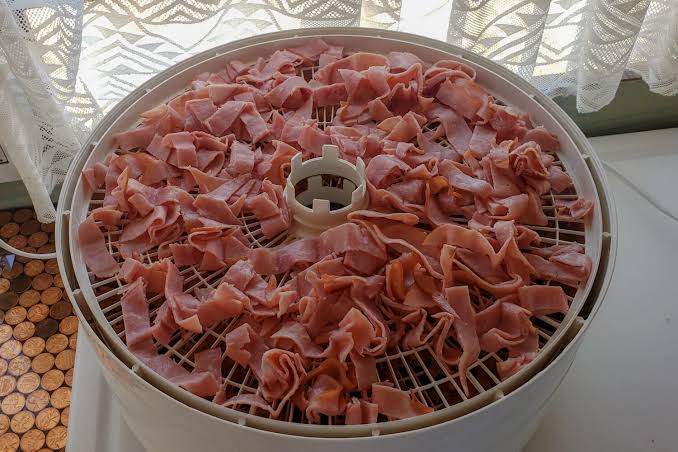
Round dehydrators often have a central hole or circular layout. Rectangular and square designs can provide more continuous drying space.
This can be useful when drying meal components that you want to spread into thin, even layers.
A rectangular tray can also be easier to organize when you’re preparing different ingredients.
Neither shape is automatically superior, but it is worth considering how the tray geometry fits your kitchen and recipes.
Wattage Isn’t the Whole Story
Many buyers focus heavily on wattage.
A higher-wattage machine may have a powerful heating element and fan, but wattage alone doesn’t tell you how efficiently the machine dries food.
You should consider wattage together with capacity, airflow, temperature control, and drying performance.
A 1,000-watt dehydrator that handles a large batch efficiently may be more practical than a lower-powered machine that requires several additional cycles.
For people who dehydrate frequently, the real question is how much usable food you can dry per batch rather than simply how many watts the machine consumes.
Noise Can Matter in a Small Home
Dehydrators often run for many hours.
That means noise can become surprisingly important.
If your kitchen is next to a living area, bedroom, or home office, a loud fan can become annoying during overnight drying.
Manufacturers don’t always provide comparable noise measurements, so customer reviews can sometimes provide useful clues.
If you regularly dehydrate overnight, look for a model known for reasonably quiet operation.
Timer and Automatic Shutoff Are Valuable Features
A built-in timer can make dehydrating much easier.
Food may need several hours to dry, and not everyone wants to monitor a machine throughout the process.
An automatic shutoff is particularly useful if the drying cycle finishes while you’re asleep or away from the kitchen.
These features don’t necessarily improve drying quality directly, but they improve convenience and reduce the need for constant supervision.
Cleaning Should Be Part of the Buying Decision
Backpacking meals can create plenty of crumbs, sauce residue, and small food particles.
A dehydrator with difficult-to-clean trays can become frustrating quickly.
Look for removable trays and surfaces that are easy to wash.
Check the manufacturer’s instructions before putting components into a dishwasher. Not every tray or accessory is dishwasher-safe.
Also inspect the fan area. Food should not be allowed to accumulate where it could interfere with airflow or sanitation.
Expandability Is Useful for Serious Backpackers
Some dehydrators allow additional trays to be added.
This can be valuable if your food preparation needs grow.
You might begin by drying small batches of fruit and vegetables, then gradually move into complete backpacking meals.
Instead of replacing the entire machine, an expandable design may allow you to increase capacity.
However, don’t assume that adding more trays always produces the same drying performance. More trays can change airflow, so follow the manufacturer’s recommendations.
What Specs Should You Prioritize?
For backpacking meals, a practical priority list is:
- Reliable temperature control
- Consistent airflow
- Sufficient tray capacity
- Easy-to-clean trays
- Useful accessories
- Timer and automatic shutoff
- Reasonable noise level
- Expandability
- Energy efficiency
- Price
Notice that maximum wattage is not at the top.
That’s intentional.
A dehydrator is a food-processing tool, not simply a high-powered heater.
Final Thoughts
The best dehydrator for backpacking meals is the one that matches how you actually prepare food.
A casual weekend hiker may be perfectly happy with a compact, affordable machine.
A family preparing months of trail food may benefit from a larger model with strong airflow, expandable capacity, and durable trays.
Before buying, think about the foods you plan to dehydrate, how many meals you make at once, how much kitchen space you have, and how often you’ll use the machine.
The goal isn’t to find the dehydrator with the longest specification sheet.
The goal is to find one that consistently produces thoroughly dried food, handles your typical batch size, and is convenient enough that you’ll actually use it.