How Much Vegan Trail Food Should You Carry? A 4-Day Resupply Math Guide
Packing four days of vegan trail food sounds simple until you realize that “four days of food” is not actually a weight measurement. 🥾 Two hikers could each carry 12,000 calories, yet one food bag might weigh several pounds more because it contains bulky foods with more water and fewer calories per ounce. The useful question is therefore not simply how many meals you need, but how many total calories you plan to carry and how efficiently those calories fit into your food bag.
This matters especially on longer backpacking routes where every resupply changes the amount of weight sitting on your shoulders. A four-day stretch may be comfortable with one menu but unnecessarily heavy with another, even when both menus provide the same total calories. 🎒 Instead of prescribing one calorie intake for every hiker, this guide shows how to insert your own example daily requirement into a simple formula and estimate what your vegan food bag could weigh.
Why Four Days Of Food Does Not Tell You Your Pack Weight
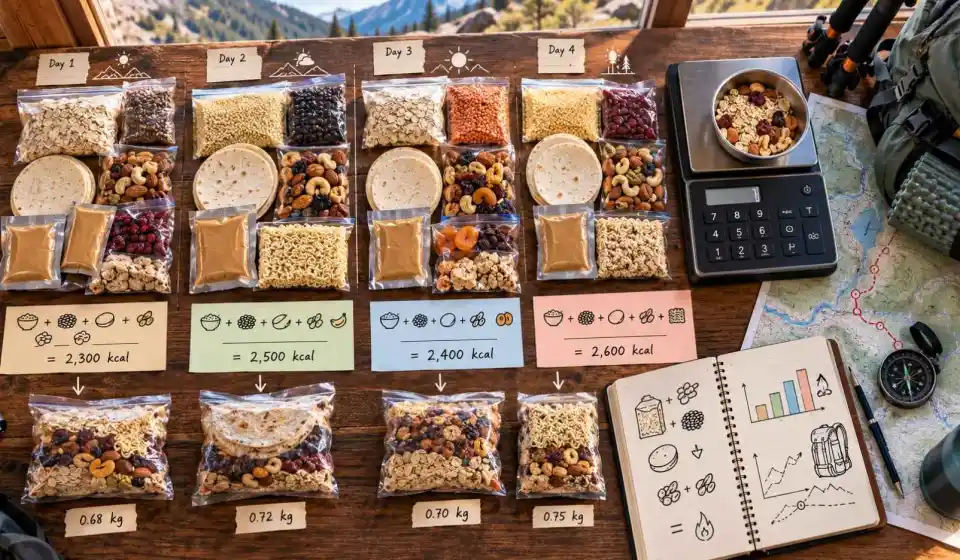
Imagine two hikers preparing for exactly the same four-day section, with both planning around an illustrative 3,000 calories per day. Each hiker needs to pack roughly 12,000 calories for the planned four days, but one chooses mostly dried foods, nuts, peanut butter, tortillas, and other dense ingredients while the other relies heavily on low-density foods. 🌱 Their total calorie requirement is identical, yet their starting food weight can be dramatically different.
That difference is explained by caloric density, usually expressed as calories per ounce when discussing backpacking food. If your entire food bag averages 100 calories per ounce, carrying 12,000 calories requires about 120 ounces, while averaging 125 calories per ounce lowers that same calorie load to about 96 ounces. The number of trail days matters, but average calories per ounce determines how those trail days translate into pounds of food.
Step 1: Start With Your Example Daily Calorie Number
Your first input is the daily energy amount you intend to use for planning, ideally estimated separately based on factors such as body size, mileage, elevation gain, pace, pack weight, trip duration, and previous hiking experience. 🧮 Camp Kitchen Lab can treat that calculation as its own subject because estimating energy needs is more complicated than simply assigning everyone the same number. For this article, 3,000 calories per day is only an easy mathematical example, not a recommendation for an individual hiker.
If your own planning number is 2,600, 3,200, 3,800, or something else, the method remains identical. Multiply that number by the planned number of days between resupply opportunities, and you have the approximate amount of food energy your menu must contain before any planning margin is considered. This separates two questions that hikers often mix together: “How much energy am I planning for?” and “How much will that amount of food weigh?”
Step 2: Multiply Your Calories By Resupply Days
Using the illustrative 3,000-calorie daily number makes the first calculation straightforward. Three days equals 9,000 calories, four days equals 12,000, five days equals 15,000, and six days equals 18,000 before any additional planning margin. 📆 Extending a resupply interval by only two days therefore adds another 6,000 calories to the example food requirement.
| Resupply Interval | Example Daily Calories | Total Planned Calories |
|---|---|---|
| 3 days | 3,000 | 9,000 |
| 4 days | 3,000 | 12,000 |
| 5 days | 3,000 | 15,000 |
| 6 days | 3,000 | 18,000 |
This is why vague advice such as “carry about five days of food” can be misleading when the actual menu has not been calculated. Five days of low-density food and five days of carefully selected calorie-dense food may occupy very different amounts of backpack space and weight. 🎒 Once total calories are known, however, you can move to the calculation that makes the biggest difference to your food-bag weight.
Step 3: Convert Calories Into Approximate Food Weight
The core formula is simple: total planned calories ÷ average calories per ounce = approximate ounces of food. For the 12,000-calorie four-day example, a food bag averaging 100 calories per ounce would weigh about 120 ounces, or 7.5 pounds, while a 125-calorie-per-ounce menu would weigh about 96 ounces, or 6 pounds. ⚖️ Nothing changed about the total calories carried—the difference came entirely from how concentrated those calories were.
At an average of 110 calories per ounce, the same example comes to roughly 109 ounces or 6.8 pounds, while 140 calories per ounce lowers it to about 86 ounces or 5.4 pounds. That creates a difference of more than two pounds between the 100- and 140-calorie-per-ounce examples before considering packaging or other food-related gear. The lesson is not that every backpacker must reach 140 calories per ounce, but that caloric density has a measurable effect that becomes increasingly important as resupply intervals grow.
| Average Food Density | 12,000 Calories Requires | Approximate Weight |
|---|---|---|
| 100 cal/oz | 120 oz | 7.5 lb |
| 110 cal/oz | 109 oz | 6.8 lb |
| 125 cal/oz | 96 oz | 6.0 lb |
| 140 cal/oz | 86 oz | 5.4 lb |
Building A Four-Day Vegan Food Bag
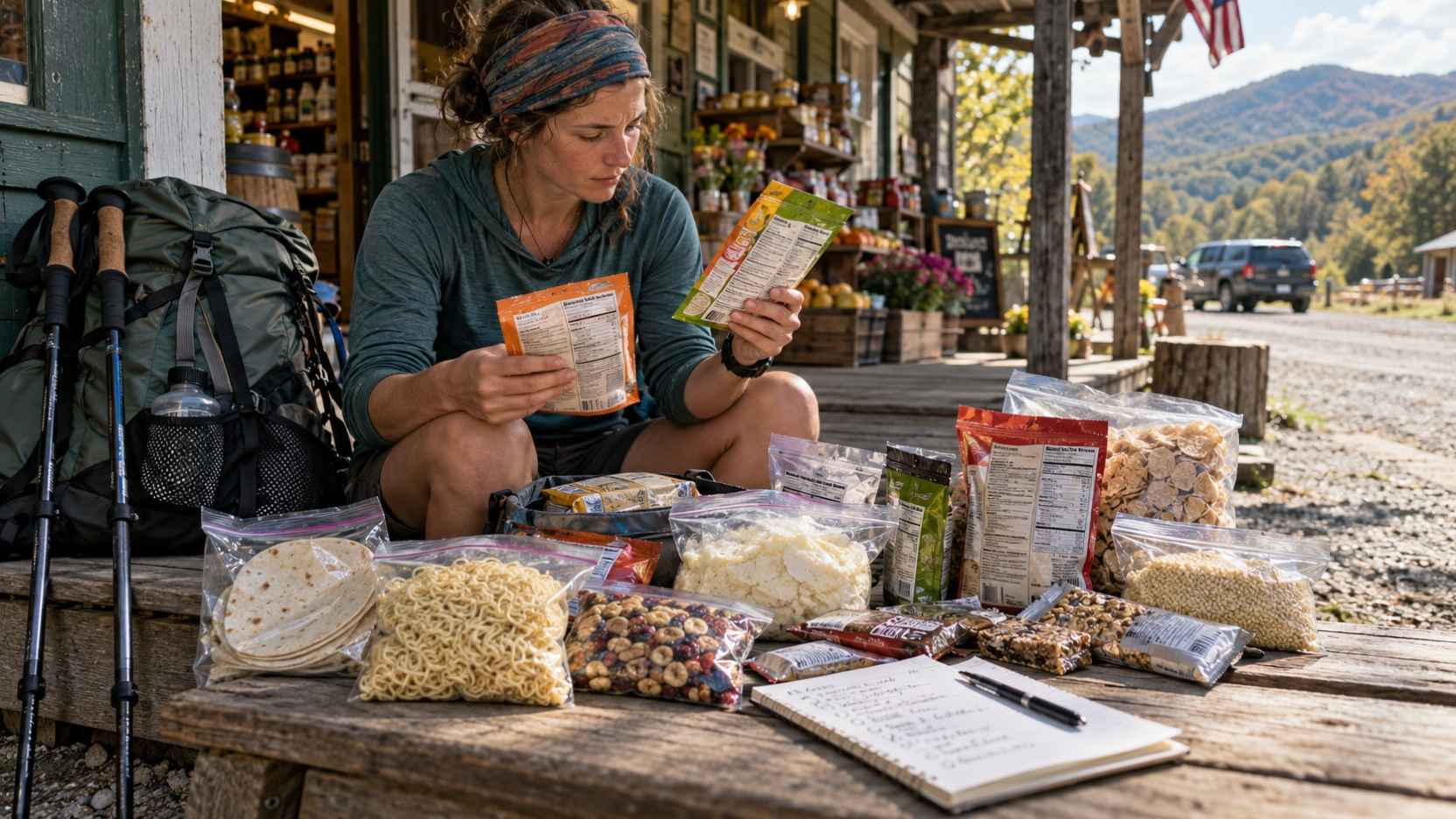
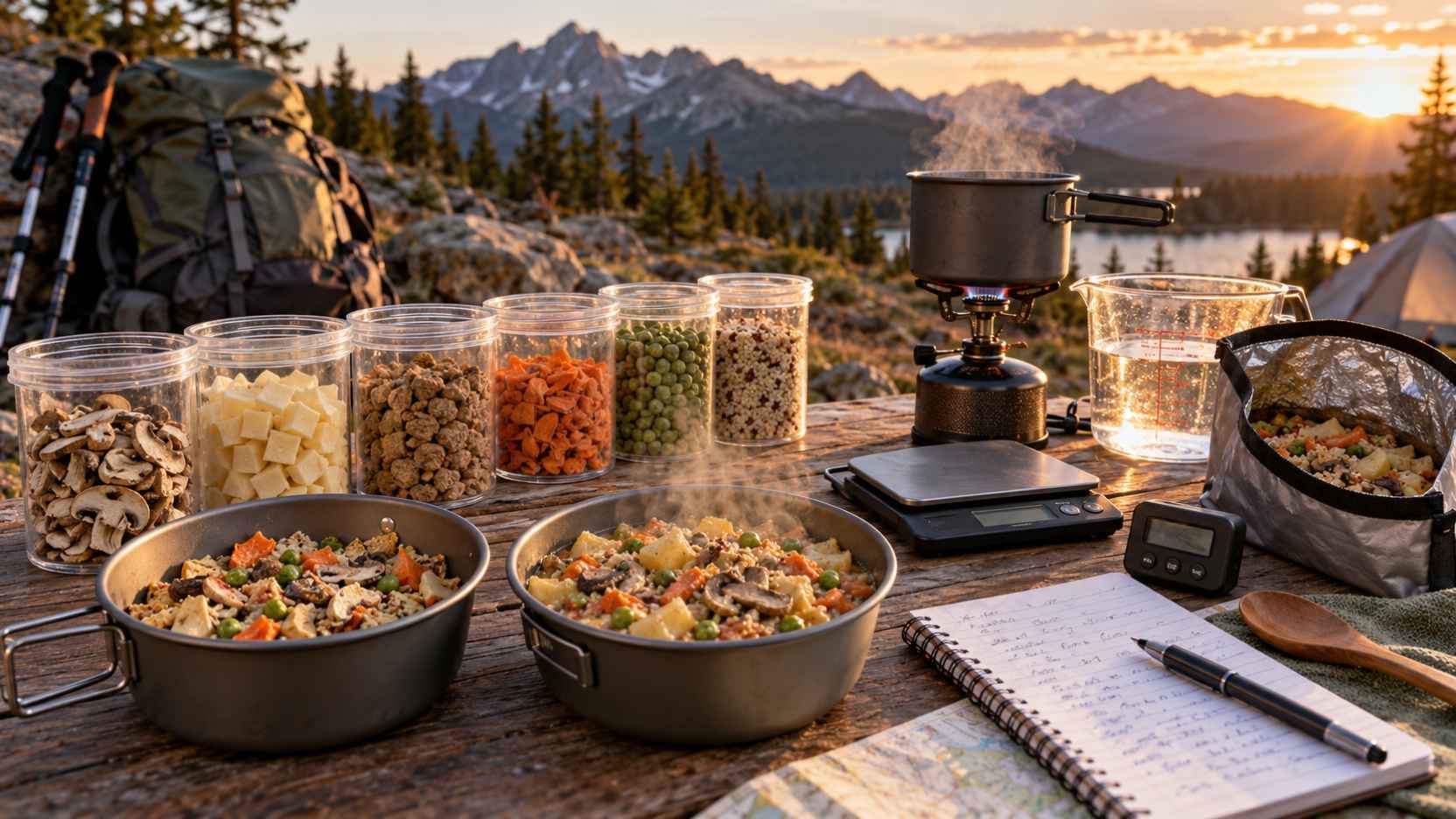
A practical vegan backpacking menu can draw from oats, peanut butter, tortillas, couscous, dehydrated beans, nuts, dried fruit, ramen, textured vegetable protein, instant potatoes, powdered ingredients, and shelf-stable seasonings. 🌯 These foods do not all have the same caloric density, so the useful strategy is to consider how the entire menu averages out instead of judging every ingredient individually. A somewhat lower-density ingredient can still belong in the food bag when it contributes taste, texture, convenience, protein, carbohydrate, or simply something you actually look forward to eating.
For example, nuts and peanut butter usually provide substantially more calories per ounce than cooked beans or water-rich fresh foods, while dehydrated beans remove much of the water that makes prepared beans heavy. Dry couscous, ramen, tortillas, oats, dried fruit, and TVP can contribute carbohydrates or protein without requiring you to transport large amounts of food water from town. 🥜 Combining foods with different characteristics allows you to build a usable menu rather than chasing the highest calorie-density number at the expense of everything else.
What Happens When Caloric Density Falls
Suppose your four-day menu accidentally averages only 90 calories per ounce because it includes numerous bulky or moisture-heavy foods. The 12,000-calorie example would then require about 133 ounces of food, which is roughly 8.3 pounds before packaging. 📦 Raising the average to 120 calories per ounce reduces that same calorie load to 100 ounces, or approximately 6.25 pounds.
That is more than a two-pound difference created without changing the total planned food energy at all. This is why foods that appear wholesome, filling, or physically lightweight in your hand can still perform poorly when evaluated as calories carried per ounce of backpack weight. Fresh fruit, ready-to-eat cooked grains, prepared beans, and other water-rich foods may still be enjoyable early in a trip, but carrying substantial quantities across long resupply stretches creates a different weight equation.
Do Not Optimize Every Ingredient Into Oblivion
Caloric density is useful, but treating it as the only rule can create a mathematically impressive food bag that you dislike eating. 😅 A hiker could theoretically raise the average calories per ounce by increasing high-fat foods because fat contains about nine calories per gram compared with roughly four for carbohydrate and protein. That does not mean your backpacking diet should simply become a bag of oil, nut butter, and nuts because palatability, food variety, macronutrient needs, preparation, tolerance, and personal preference still matter.
A better approach is to view caloric density as a menu-level measurement rather than a purity test for every individual snack. A lower-density tortilla filling or savory dinner may be completely reasonable when balanced by denser foods elsewhere in the day. 🌱 The goal is to understand what each choice does to your total carry weight so that an extra pound enters your backpack because you consciously accepted the trade-off, not because you never calculated it.
How Much Buffer Food Should You Carry?
Backpacking schedules rarely behave exactly like spreadsheets because weather, trail conditions, transportation problems, mileage changes, store hours, appetite shifts, or an unexpectedly long section can alter a resupply plan. A reasonable planning process therefore includes some margin rather than assuming every meal will occur at exactly the predicted time and place, but the appropriate amount depends on the trip. 🗺️ A heavily traveled route with frequent town access presents a different planning problem from a remote section where the next practical food source is much farther away.
Instead of applying a universal extra-day rule, calculate your planned food first and then consciously decide what margin fits the route and your risk tolerance. You can express that margin as extra calories, an additional meal, or another clearly defined amount rather than tossing miscellaneous snacks into the bag until it feels safe. The advantage is that buffer food becomes a visible planning decision instead of hidden weight.
Resupply Strategy Can Change As You Learn
One of the biggest mistakes in long-distance food planning is assuming that the menu you design before the trail will remain perfect hundreds of miles later. Your preferred portions, flavors, meal structure, cooking habits, and willingness to eat the same snack repeatedly can change once you gain real trail experience. 🔄 That makes flexibility especially useful for vegan hikers who may encounter towns where the available selection varies significantly.
A hybrid resupply strategy can therefore make more sense than purchasing every meal months in advance. Reliable staples can be mailed where selection is limited, while better-stocked towns can provide opportunities to rebuild upcoming food bags according to what you are actually eating at that stage of the trip. This approach treats your trail menu as something to calibrate, rather than assuming your pre-trip spreadsheet deserves permanent authority.
Build Your Own Four-Day Resupply Calculation
Start with the daily calorie figure you are using for planning, multiply it by four, and write down the resulting total calories. Next, estimate the average caloric density of the foods you intend to pack and divide your total calories by that number to produce approximate food ounces. ✏️ Divide ounces by 16 if you want the result in pounds, then add whatever deliberately chosen buffer and unavoidable packaging weight applies to your trip.
For example, 3,200 calories × four days = 12,800 calories, and a menu averaging 125 calories per ounce would require approximately 102 ounces, or about 6.4 pounds of food before packaging and planning margin. Change the density to 105 calories per ounce and the same energy requirement becomes about 122 ounces, or roughly 7.6 pounds. That simple comparison shows why food selection matters: your calorie requirement can stay exactly the same while your starting backpack weight changes substantially.
The Real Goal Is Better Resupply Math
There is no single correct number of pounds of vegan food that every backpacker should carry for four days. 🥾 Food weight depends on the calories you are planning for, the density of the menu, the length and difficulty of the section, available resupply options, your selected margin, and foods you are genuinely willing to eat. Saying “four days equals six pounds” skips the variables that actually determine whether six pounds is appropriate.
The more useful habit is to work backward from calories → days → calories per ounce → food weight, then evaluate the result against the route and your preferences. Once you understand that chain, you can compare a three-day carry with a six-day carry, evaluate an unusually heavy resupply box, or see exactly what happens when you replace dehydrated food with heavier town food. 🌿 That turns vegan backpacking food planning from guesswork into a repeatable system you can refine every time you resupply.