How to Build a Vegan Trail Menu With a Simple Protein and Calorie Calculation 🌱🥾
Introduction
A vegan backpacking menu has to do more than taste good.
It needs to provide enough energy for long days of walking, include useful sources of protein, travel safely without refrigeration, and stay practical enough to carry in a backpack.
The easiest way to plan it is not to start with recipes.
Start with numbers.
You don’t need complicated nutrition software or a spreadsheet with dozens of formulas. A simple system can help you estimate how many calories and how much protein your food provides, then adjust the menu based on the actual nutrition labels of the foods you’re carrying.
The goal is not mathematical perfection. It’s building a menu that is realistic, satisfying, lightweight, and nutritionally sensible. 🎒
🌱 Step 1: Decide How Many Days You Are Planning
Start with the trip length.
For example:
3 days × 3 meals = 9 main meals
Then add snacks for each hiking day.
A simple structure might be:
- Breakfast
- Trail snack
- Lunch
- Trail snack
- Dinner
This prevents one common mistake: planning three large meals while forgetting that hiking often means eating smaller amounts throughout the day.
🔢 Step 2: Estimate Your Daily Calorie Needs
There is no single calorie number that works for every backpacker.
Energy needs vary based on factors such as:
- Body size
- Hiking distance
- Elevation gain
- Pack weight
- Hiking speed
- Terrain
- Weather
- Trip duration
- Individual metabolism
Instead of copying someone else’s calorie target, start with your normal daily intake and adjust it based on the demands of your trip.
For a practical planning exercise, suppose you decide that your menu should provide approximately:
2,800 calories per hiking day
This is a planning target, not a universal requirement.
If the trip becomes more demanding, your actual needs may be higher.
💪 Step 3: Choose a Protein Target
Protein needs also vary from person to person.
Rather than assigning every backpacker the same number, use your usual dietary needs or a target appropriate for your individual situation.
Then check whether your planned foods collectively provide enough protein.
For example, suppose your planning target is:
90 g protein per day
Now you have two numbers to work with:
Calories: 2,800 kcal/day
Protein: 90 g/day
The rest becomes simple arithmetic.
🥜 Step 4: Choose Protein-Dense Vegan Foods
Not every vegan backpacking food provides the same amount of protein.
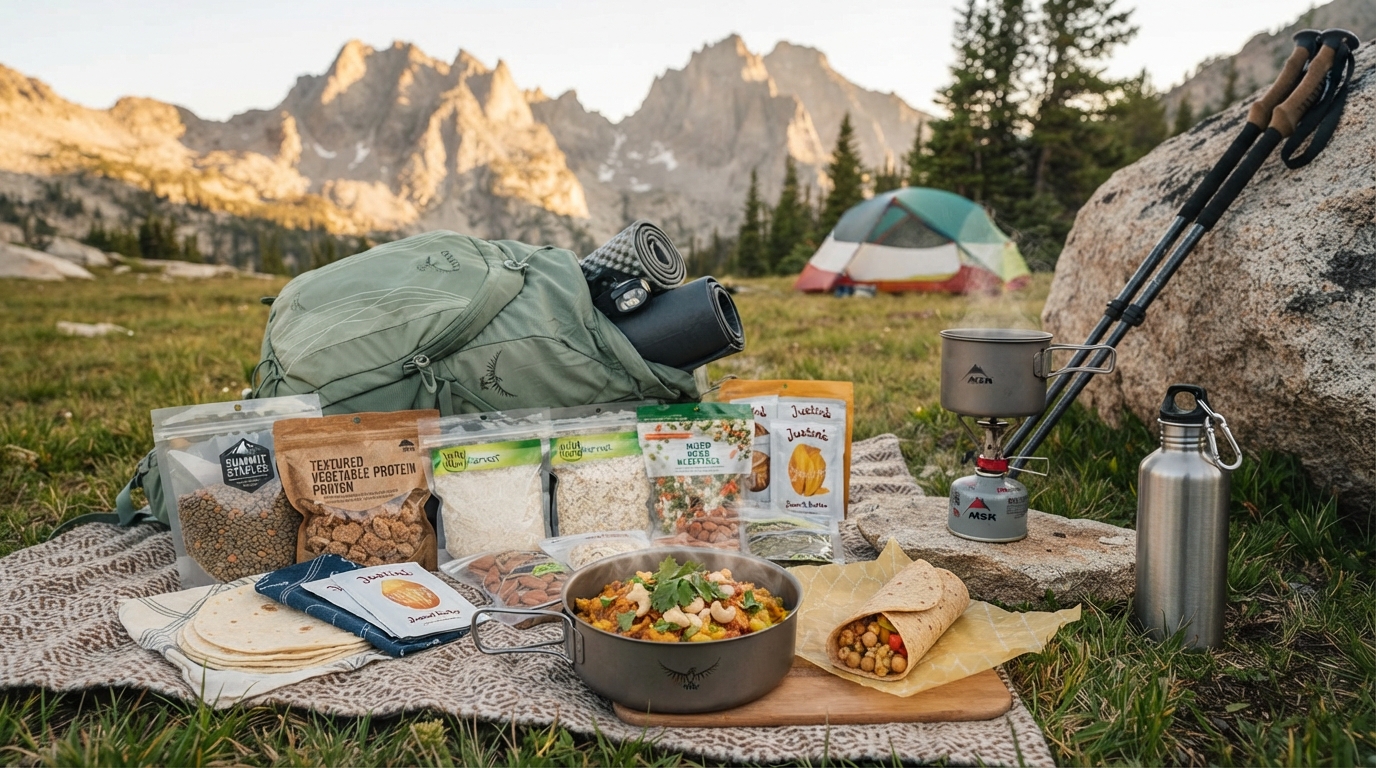
Some useful shelf-stable choices include:
| Food | Why it works |
|---|---|
| TVP | Lightweight and protein-rich |
| Dehydrated lentils | Protein plus carbohydrates |
| Dehydrated beans | Protein and carbohydrates |
| Peanut butter | Protein and calorie-dense fat |
| Nuts | Calories, fat, and some protein |
| Seeds | Protein, fat, and minerals |
| Soy products | Convenient concentrated protein |
| Vegan protein powder | Easy way to increase protein |
| Roasted chickpeas | Portable snack option |
Always use the actual nutrition label when calculating your menu.
Different brands can have substantially different calorie and protein values.
🍚 Step 5: Build Each Meal With a Formula
A simple backpacking meal formula is:
Carbohydrate + protein + fat + flavor
For example:
Breakfast
Oats + peanut butter + chia seeds + dried fruit
Lunch
Tortilla + dehydrated beans + nutritional yeast + seasoning
Dinner
Instant rice + TVP + dehydrated vegetables + olive oil + curry seasoning
This approach makes menu planning much easier because you can substitute ingredients without redesigning the entire meal.
🧮 Step 6: Calculate Calories the Easy Way
Suppose your breakfast contains:
- Instant oats: 300 kcal
- Peanut butter: 190 kcal
- Chia seeds: 60 kcal
- Dried banana: 120 kcal
Total:
300 + 190 + 60 + 120 = 670 calories
That’s your estimated breakfast contribution.
Now repeat the process for every meal and snack.
You don’t need to calculate everything from memory.
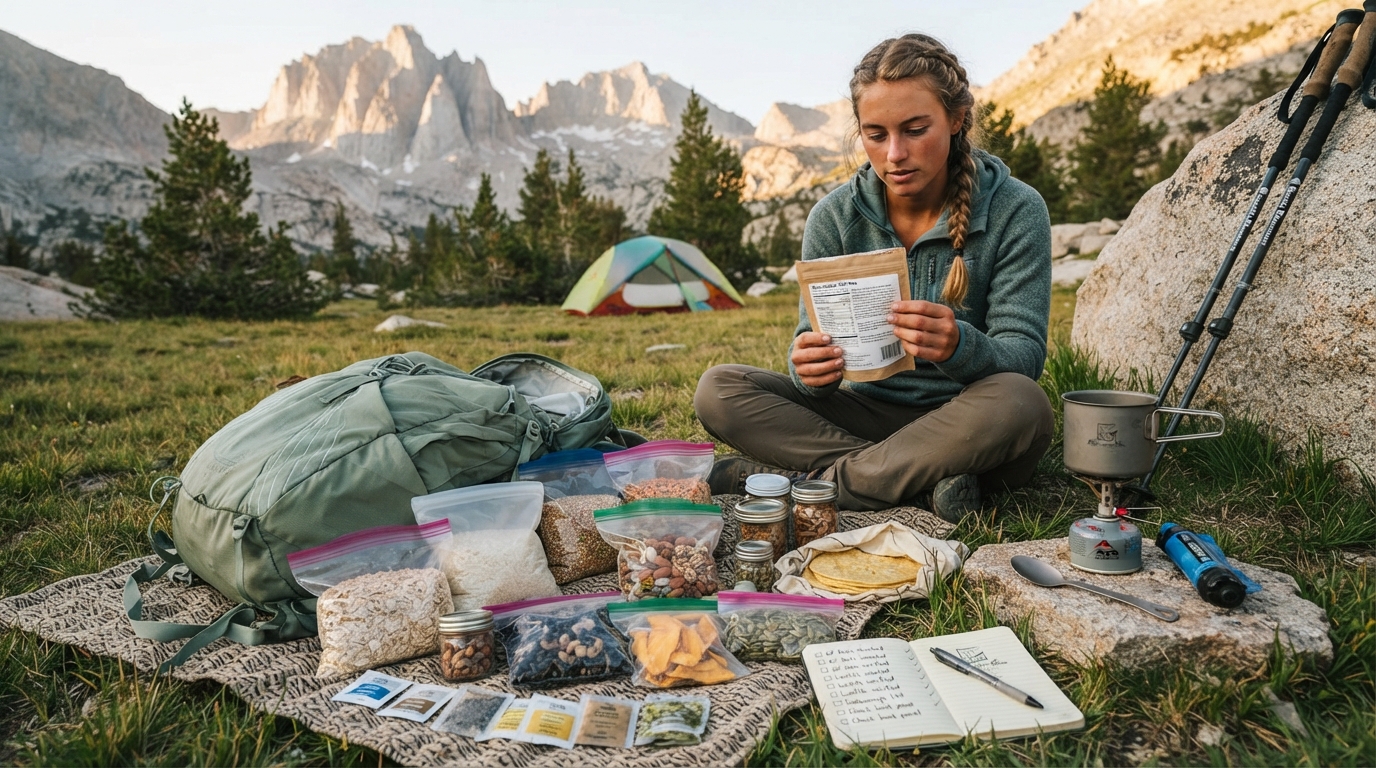
Use the nutrition label.
💪 Step 7: Calculate Protein Separately
Use the same process for protein.
Imagine your breakfast contains:
- Oats: 10 g
- Peanut butter: 7 g
- Chia seeds: 2 g
- Dried banana: 1 g
Total:
10 + 7 + 2 + 1 = 20 g protein
Now you know that breakfast contributes approximately 20 g toward your daily protein target.
Repeat this for lunch, dinner, and snacks.
📊 A Simple Example Day
Let’s build a hypothetical vegan trail day with a target of approximately 2,800 calories and 90 g protein.
| Meal | Calories | Protein |
|---|---|---|
| Peanut butter oatmeal | 670 kcal | 20 g |
| Trail snack | 400 kcal | 10 g |
| Bean tortilla lunch | 600 kcal | 20 g |
| Nut and fruit snack | 400 kcal | 10 g |
| TVP curry rice dinner | 730 kcal | 30 g |
| Daily total | 2,800 kcal | 90 g |
This is an example of the calculation method, not a universal backpacking prescription.
Your actual food quantities should come from the nutrition labels of the products you choose.
🎒 Step 8: Check Calories Per Weight
Calories aren’t the only thing that matters on a backpacking trip.
Food weight matters too.
Suppose two foods provide:
Food A: 500 calories from 100 g
Food B: 500 calories from 200 g
Food A provides more calories per gram.
The calculation is simple:
Calories ÷ food weight in grams
For Food A:
500 ÷ 100 = 5 calories/g
For Food B:
500 ÷ 200 = 2.5 calories/g
This can help you compare ingredients when reducing pack weight.
Foods such as nuts, seeds, nut butters, oils, and some dehydrated products can be useful in a lightweight menu because they provide substantial energy for their weight.
But calories-per-gram shouldn’t be your only criterion. You still need variety, protein, carbohydrates, fiber, hydration, and foods you actually enjoy eating.
🌱 Step 9: Spread Protein Across the Day
You don’t have to put most of your protein into dinner.
A more practical approach is to include a protein source at several eating opportunities.
For example:
Breakfast
Oats + peanut butter + seeds
Snack
Nuts + roasted chickpeas
Lunch
Dehydrated bean tortilla
Snack
Vegan protein bar
Dinner
TVP + rice + vegetables
This makes the menu feel more balanced and gives you multiple opportunities to consume protein throughout the day.
🍝 Step 10: Don’t Forget Carbohydrates
One mistake in high-protein menu planning is becoming so focused on protein that carbohydrates disappear.
Backpacking involves prolonged physical activity, so carbohydrate-rich foods can be useful sources of energy.
Good trail options include:
- Oats
- Rice
- Pasta
- Couscous
- Tortillas
- Instant potatoes
- Crackers
- Dried fruit
A vegan backpacking meal doesn’t need to be extremely high in protein while neglecting the rest of the diet.
Think balanced meal, not “protein at all costs.”
🫒 Step 11: Use Fats to Increase Energy Without Huge Portions
Fat can make it easier to increase the energy content of a meal without dramatically increasing food volume.
Useful options include:
- Peanut butter
- Almond butter
- Tahini
- Olive oil
- Nuts
- Seeds
For example, adding olive oil to a rice and TVP meal can increase its energy content without requiring another large portion of food.
However, don’t suddenly consume much more fat than you’re accustomed to while hiking. Your trail menu should be based partly on foods you already tolerate well.
📦 Step 12: Calculate the Whole Trip
Once you’ve calculated one day, multiply it by the number of hiking days.
If your example menu provides:
2,800 calories/day
For 4 days:
2,800 × 4 = 11,200 calories
If it provides:
90 g protein/day
Then:
90 × 4 = 360 g protein
Again, these are planning figures.
You should adjust them to your own needs and the demands of your trip.
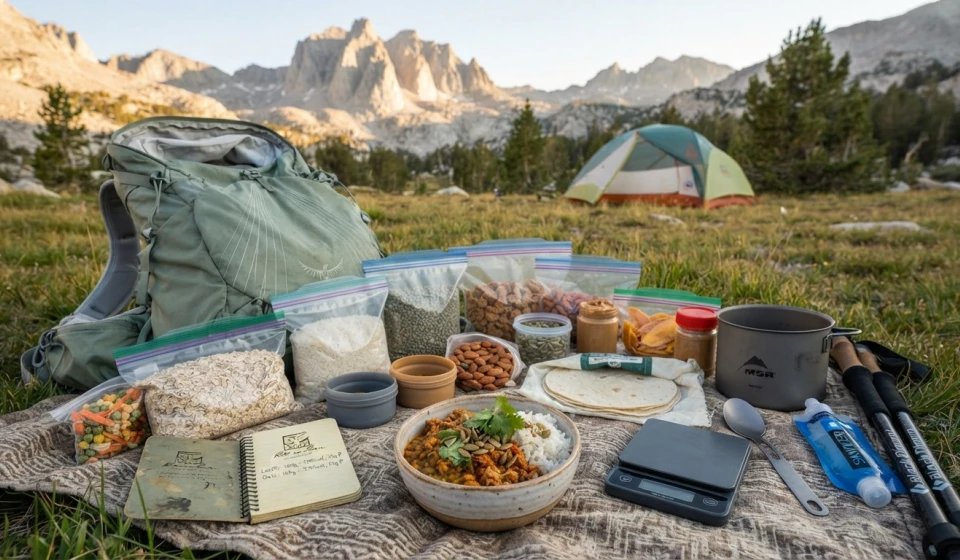
⚖️ Step 13: Calculate Total Food Weight
Now add the weight of every ingredient.
For example:
| Food | Weight |
|---|---|
| Oats | 600 g |
| TVP | 300 g |
| Dehydrated beans | 350 g |
| Nuts and seeds | 500 g |
| Dried fruit | 300 g |
| Rice and pasta | 700 g |
| Seasonings and extras | 150 g |
| Total | 2,900 g |
Your real numbers will depend entirely on the products and quantities you choose.
Don’t forget to include small items such as oil, drink mixes, sauces, and seasonings if you’re calculating the complete food weight.
🧮 Use a Simple Backpacking Food Spreadsheet
You can make the process even easier with five columns:
| Food | Weight | Calories | Protein | Meal |
|---|---|---|---|---|
| Oats | 80 g | Label | Label | Breakfast |
| Peanut butter | 40 g | Label | Label | Breakfast |
| TVP | 60 g | Label | Label | Dinner |
| Rice | 100 g | Label | Label | Dinner |
Then add the totals.
This lets you quickly see whether your menu is:
✅ High enough in energy
✅ Providing your planned protein amount
✅ Too heavy
✅ Missing snacks
✅ Over-reliant on one ingredient
A spreadsheet also makes it easy to change one ingredient without recalculating the entire menu manually.
🥾 Don’t Forget the “Will I Actually Eat This?” Test
Nutrition numbers are useful, but they don’t tell you whether you’ll enjoy the food after hiking for eight hours.
Before packing a menu, ask:
Would I happily eat this when I’m tired?
Does it taste good?
Is the texture appealing?
Can I prepare it easily?
Does it require too much water?
Does it create excessive cleanup?
Have I eaten these foods before during physical activity?
A theoretically perfect menu that you don’t want to eat is not a practical trail menu.
🧪 Test the Menu Before Your Trip
Prepare at least one complete day of your menu at home.
Measure the ingredients.
Prepare the meals using your planned method.
Then record:
- Actual food weight
- Preparation time
- Water required
- Fuel required
- Calories
- Protein
- Taste
- Portion size
- How satisfying the meal feels
This gives you an opportunity to fix problems before they happen on the trail.
🌱 A Simple Vegan Trail-Menu Formula
If you want the entire process reduced to a few steps, use this:
1. Choose your daily calorie target
Base it on your individual needs and expected activity.
2. Choose your protein target
Use your individual dietary requirements rather than a one-size-fits-all number.
3. Select shelf-stable foods
Prioritize lightweight ingredients that are safe and practical for your trip.
4. Build every meal
Use:
Carbohydrate + protein + fat + flavor
5. Read the labels
Record calories and protein for every ingredient.
6. Add everything
Calculate daily totals.
7. Check food weight
Compare calories and protein against the weight you’re carrying.
8. Test the menu
Eat it before the trip.
9. Adjust
Increase or decrease portions based on your needs, preferences, and trip conditions.
🌿 Final Thoughts
Building a vegan trail menu doesn’t require complicated nutrition mathematics.
Start with a realistic daily calorie target and an appropriate protein target. Then build meals from shelf-stable vegan foods such as oats, rice, pasta, beans, lentils, TVP, nuts, seeds, nut butter, dried fruit, and dehydrated vegetables.
Use the nutrition labels to calculate calories and protein, then check the total food weight.
Most importantly, remember that a backpacking menu has to work in the real world. It needs to be easy to prepare, pleasant to eat, safe to carry, and practical after a long day on the trail. 🥾🌱
The best menu isn’t the one with the most complicated calculations. It’s the one where the numbers, food weight, preparation, and actual eating experience all make sense together.