Should You Add Oil Before or After Dehydrating Backpacking Meals?
Oil creates an interesting problem for anyone designing high-calorie backpacking meals: fat is one of the most weight-efficient sources of food energy you can carry, yet adding a lot of it before home dehydration can work against what dehydration is supposed to accomplish. 🥾 Homemade backpacking meals are often easier to dry and store when their base ingredients are relatively lean, while oil can be carried separately and mixed in when the meal is rehydrated. For hikers concerned with oil in dehydrated backpacking meals, that separation creates an opportunity to improve both meal design and calorie mathematics.
The question therefore is not simply whether olive oil belongs in backpacking food, because it clearly can provide substantial calories in very little weight. The more useful question is when the oil should enter the system: during cooking before dehydration, inside the stored dried meal, or at camp immediately before eating. 🔬 Looking at calories per ounce reveals why a low-fat dehydrated base plus a separate calorie booster can be an efficient strategy without pretending that every hiker needs the same amount of dietary fat.
Why Homemade Dehydrated Meals Often Start Lower In Fat
Drying preserves food primarily by removing enough available water to limit microbial growth, which is why vegetables, cooked grains, beans, sauces, and other suitable foods become dramatically lighter after dehydration. Fat behaves differently because oil itself does not evaporate away like water, so adding more oil does not give the dehydrator additional removable weight. Instead, much of that oil remains in the finished food while being exposed to heat, oxygen, and later storage conditions.
Fat-containing foods can also develop rancid flavors as fats oxidize, especially as storage time, heat, light, and oxygen exposure increase. 🧪 This does not mean every trace of fat makes a homemade meal unusable, nor does it mean hikers should try to eliminate dietary fat altogether. It means a relatively lean dehydrated base can be simpler for homemade meal preparation, while shelf life and handling should always follow appropriate food-preservation guidance for the specific ingredients.
Why Fat Changes Trail-Food Mathematics
From a backpacking perspective, fat has one enormous advantage: fat provides about 9 calories per gram, compared with approximately 4 calories per gram from carbohydrate or protein. That fundamental difference explains why oils, nut butters, nuts, seeds, tahini, and other high-fat foods frequently appear in calorie-dense trail menus. 🫒 Removing water makes food lighter, but adding concentrated fat can push calorie density higher still.
Pure oil demonstrates the idea particularly well because one ounce of olive oil supplies roughly 250 calories, with some variation according to measurement and product. A hiker does not need a large amount of additional carried weight to change the energy total of a dinner substantially. That makes olive oil backpacking calories especially useful when illustrating the difference between reducing meal weight through dehydration and increasing energy density through added fat.
What Happens When You Add Olive Oil?
Imagine that your homemade dehydrated dinner weighs 4 ounces and contains 400 calories, giving it a starting density of exactly 100 calories per ounce. If you add half an ounce of olive oil providing approximately 125 calories, the finished meal becomes 525 calories while weighing 4.5 ounces. 📊 Its calorie density therefore rises from 100 to about 117 calories per ounce.
Add a full ounce of oil instead, and approximately 250 additional calories bring the same dinner to 650 calories at a total weight of 5 ounces. The new density becomes approximately 130 calories per ounce, meaning one ounce of additional weight raised the meal’s total energy by about 63 percent. This is why looking only at “extra ounces” misses part of the story—the important number is how many calories each additional ounce contributes.
| Olive Oil Added | Approx. Calories Added | Final Meal Weight | Final Calories | Approx. Calories/Oz |
|---|---|---|---|---|
| 0 oz | 0 | 4 oz | 400 | 100 |
| 0.25 oz | 63 | 4.25 oz | 463 | 109 |
| 0.5 oz | 125 | 4.5 oz | 525 | 117 |
| 0.75 oz | 188 | 4.75 oz | 588 | 124 |
| 1 oz | 250 | 5 oz | 650 | 130 |
Oil Before Or After Dehydrating?
For many homemade backpacking meals, adding most of the extra oil after dehydration is the cleaner design approach because the base can be dried without deliberately loading it with additional free oil. You can cook suitable ingredients, dehydrate them thoroughly according to appropriate instructions, package the dried meal carefully, and then carry the calorie-dense fat separately. 🎒 At camp, the oil can be stirred into the food after or during rehydration.
This approach also gives you greater flexibility because one dehydrated recipe can become different-calorie meals simply by changing the amount of oil added. Someone building a lighter lunch may use none, while a dinner intended to contribute more of the day’s calories could receive a measured portion. The important distinction is that this is a meal-design strategy, not a universal food-safety rule that overrides ingredient-specific dehydration instructions.
Olive Oil Vs Peanut Butter Vs Tahini
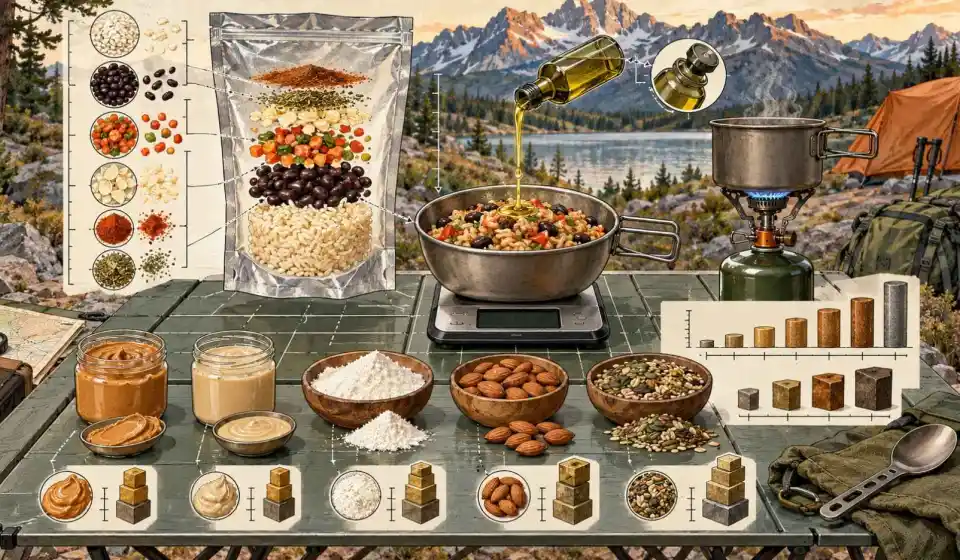
Olive oil generally wins the pure calorie-per-ounce contest because it is almost entirely fat, delivering around 250 calories per ounce while adding virtually no water. Peanut butter is less concentrated because it contains protein, carbohydrate, minerals, and sometimes additional ingredients, but many varieties still provide roughly 160 to 190 calories per ounce. 🥜 It also offers a thicker texture that may be easier to portion for certain meals but harder to mix into others.
Tahini occupies similar territory, typically landing around the upper 160s to 180 calories per ounce depending on the product, while providing the distinctive flavor of ground sesame seeds. Neither peanut butter nor tahini is automatically “better” than oil because their usefulness depends on whether they actually complement the meal being prepared. A spicy noodle bowl may welcome peanut butter, for example, while a couscous or tomato-based dinner might be easier to pair with olive oil.
Where Coconut Milk Powder And Nuts Fit
Powdered coconut milk can work differently because it contributes fat while remaining a dry ingredient that can be portioned directly into certain meal bags. 🥥 Its exact calories per ounce can vary considerably by brand and formulation, so the package nutrition label should be used rather than assuming one universal value. It may not match pure olive oil for calorie density, but it can contribute creaminess, flavor, and calories simultaneously in curries, noodles, rice dishes, or soups.
Nuts and seeds similarly tend to fall below pure oil in calories per ounce but bring texture and can be eaten separately instead of disappearing into a dinner. Their practical advantage is versatility: they can function as snacks during the day, toppings at dinner, or components of another meal. The best booster therefore depends on whether your priority is maximum calories per ounce, flavor, texture, packaging simplicity, or meal variety.
Calories Gained Versus Ounces Carried
Suppose you add one ounce of olive oil to four dinners on a multi-day trip. You have increased your food weight by approximately 4 ounces, but you have also added roughly 1,000 calories to the entire menu. ⚖️ That is a very different tradeoff from carrying four additional ounces of a 100-calorie-per-ounce food, which would contribute only about 400 calories.
This does not mean hikers should pour unlimited oil into meals simply because the mathematics looks attractive. Extremely oily meals may taste unpleasant, feel difficult to eat, leak in a pack, or simply fail to match someone’s appetite, so practical menu testing still matters. Calorie efficiency only helps when the food is usable and enjoyable enough to actually eat.
One Oil Bottle Or Individual Portions?
A single reusable oil container can minimize packaging and allow the amount added to each dinner to be adjusted according to appetite and the meal. The tradeoff is that free-pouring makes calorie tracking less precise, and an inadequately sealed bottle creates one of backpacking’s least pleasant possibilities: oil leaking into the food bag or gear. 😬 A dependable container and secondary leak protection therefore matter more than shaving a tiny amount of packaging weight.
Individually measured portions make the arithmetic easier because each dinner receives a known amount of fat and calories. They also simplify menu planning when several meals require different flavors or calorie targets, although more individual containers or packets create additional packaging. Neither approach always wins—the better choice depends on trip length, portion control, leak management, and how accurately you want to track food weight.
When Maximum Calorie Density Is Not The Only Goal
Olive oil’s numbers look impressive, but the ingredient with the highest calorie density is not automatically the best addition to every backpacking meal. Food has to taste acceptable, mix properly, survive transportation, and fit whatever cooking or cold-soaking system you use. 🍲 Carrying 250 calories per ounce means little if adding that much oil turns dinner into something you no longer want to finish.
This is why peanut butter, tahini, coconut milk powder, cheese where appropriate, nuts, seeds, or another compatible calorie booster may sometimes make more practical sense despite lower theoretical efficiency. A successful high-calorie backpacking meal balances numbers with texture, flavor, preparation, storage, and appetite. Trail-food engineering works best when calorie density becomes one important variable rather than the only variable.
A Sample Dinner Calculation
Consider a dehydrated rice-and-bean dinner weighing 4.5 ounces and providing 450 calories, which places the base at 100 calories per ounce. Adding half an ounce of olive oil contributes approximately 125 calories, creating a 575-calorie meal weighing 5 ounces and producing a final density of about 115 calories per ounce. 🔥 Adding one full ounce instead would create approximately 700 calories at 5.5 ounces, or about 127 calories per ounce.
This simple calculation can be repeated with any homemade meal by using three numbers: the dried meal’s weight, its calories, and the calories and weight of the booster being added. Divide final calories by final ounces to find the new calories per ounce backpacking value. Once you start doing this, “add some olive oil” becomes a measurable menu decision instead of vague backpacking advice.
How This Changes A Multi-Day Food Plan
The largest benefit appears when you zoom out from one dinner to an entire food bag. If several low-fat dehydrated meals begin around 90 to 110 calories per ounce, strategically adding calorie-dense ingredients can raise the average density without redesigning every recipe from scratch. 🏕️ That can help a hiker move a menu closer to a target such as the 125-calorie-per-ounce rule, although any target should remain a planning tool rather than an absolute nutritional requirement.
This is also why the question “oil before or after dehydrating?” belongs inside Trail Nutrition Science rather than only inside food preservation. Dehydration attacks water weight, while separately carried fat attacks a different problem: how many calories each remaining ounce of food provides. Understanding both systems gives backpackers a much stronger foundation for designing menus that match their trip length, pack-weight goals, cooking method, appetite, and preferred foods.