Why Calorie Density Matters for Ultralight Backpacking
When every gram of your pack weight triggers a silent negotiation with your aching shoulders, the concept of calorie density becomes more than a nutritional footnote—it becomes the cornerstone of ultra-efficient food planning. For ultralight backpackers, the difference between a 2,500-calorie daily load weighing 1.5 pounds and one weighing nearly 3 pounds can be the difference between flying down the trail and dragging yourself through camp. This article dives deep into why calorie density is non-negotiable, settles the simmering debate between per-meal and daily density, and offers practical, field-tested tips to pack maximum energy without resorting to weird concoctions.
The Thermodynamics of Trail Weight: Why Calorie Density Matters
Calorie density is simply the number of calories per gram of food, typically expressed as kcal/g. In ultralight backpacking, every gram of food must earn its place by delivering sustained energy. Consider this: a typical Snickers bar (52 g) provides about 250 kcal, yielding a density of ~4.8 kcal/g. A boiled potato of the same weight gives only ~40 kcal. The difference compounds over a week-long trip.
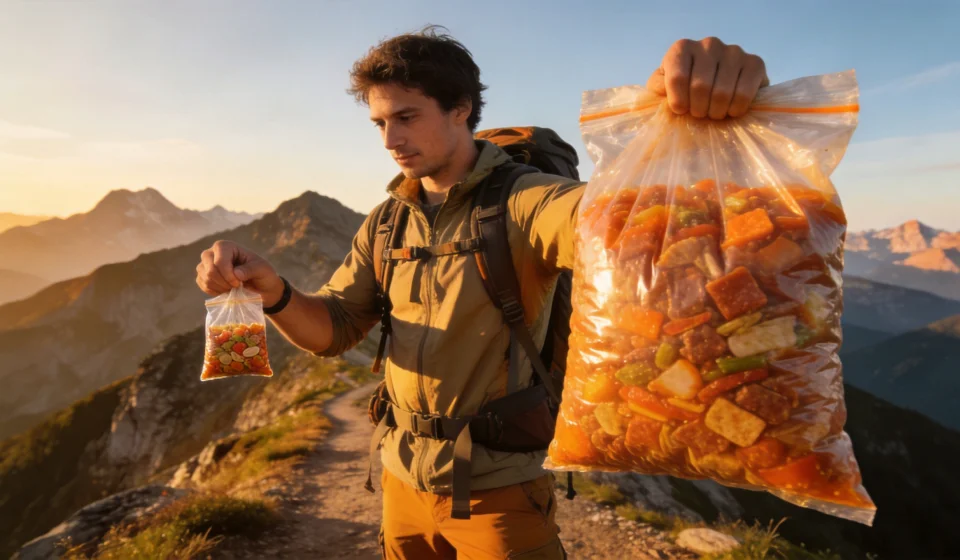
Carrying 3,500 kcal per day for a seven-day trip means a baseline requirement of 24,500 kcal total. At a low density of 1.5 kcal/g (think boiled grains and vegetables), your food weight would be over 16 pounds. At a high density of 5 kcal/g (think nuts, oils, and chocolate), the same energy weighs just under 5 pounds. That’s an 11-pound difference—more than most ultralight shelters weigh. As pack weight influences every step, ounce-loading your food with dense calories directly translates to faster hiking, less fatigue, and greater enjoyment.
“The difference between a 5-pound food bag and a 16-pound one isn’t trivial. It’s the difference between a comfortable 10-mile day and a trudge that turns joy into survival mode.” — Mike Clelland, ultralight author and NOLS instructor
Furthermore, lightweight food reduces mechanical stress on your joints and stabilizes your center of gravity. Every ounce shaved from food allows you to carry more essential gear (or simply enjoy a lighter pack). Therefore, optimizing calorie density isn’t just a nice idea; it’s a fundamental leverage point in the ultralight philosophy.
Battle of the Densities: Per-Meal vs. Daily Focus
A growing number of backpackers argue that you shouldn’t obsess over the density of each individual meal because you can “average out” over the day with high-density snacks. They say, “I’ll eat low-density ramen for dinner, but load up on nut butter during the day—my total daily density will still be fine.” This view sounds reasonable on paper, but it collapses under real-world conditions.
The Case for Per-Meal Density
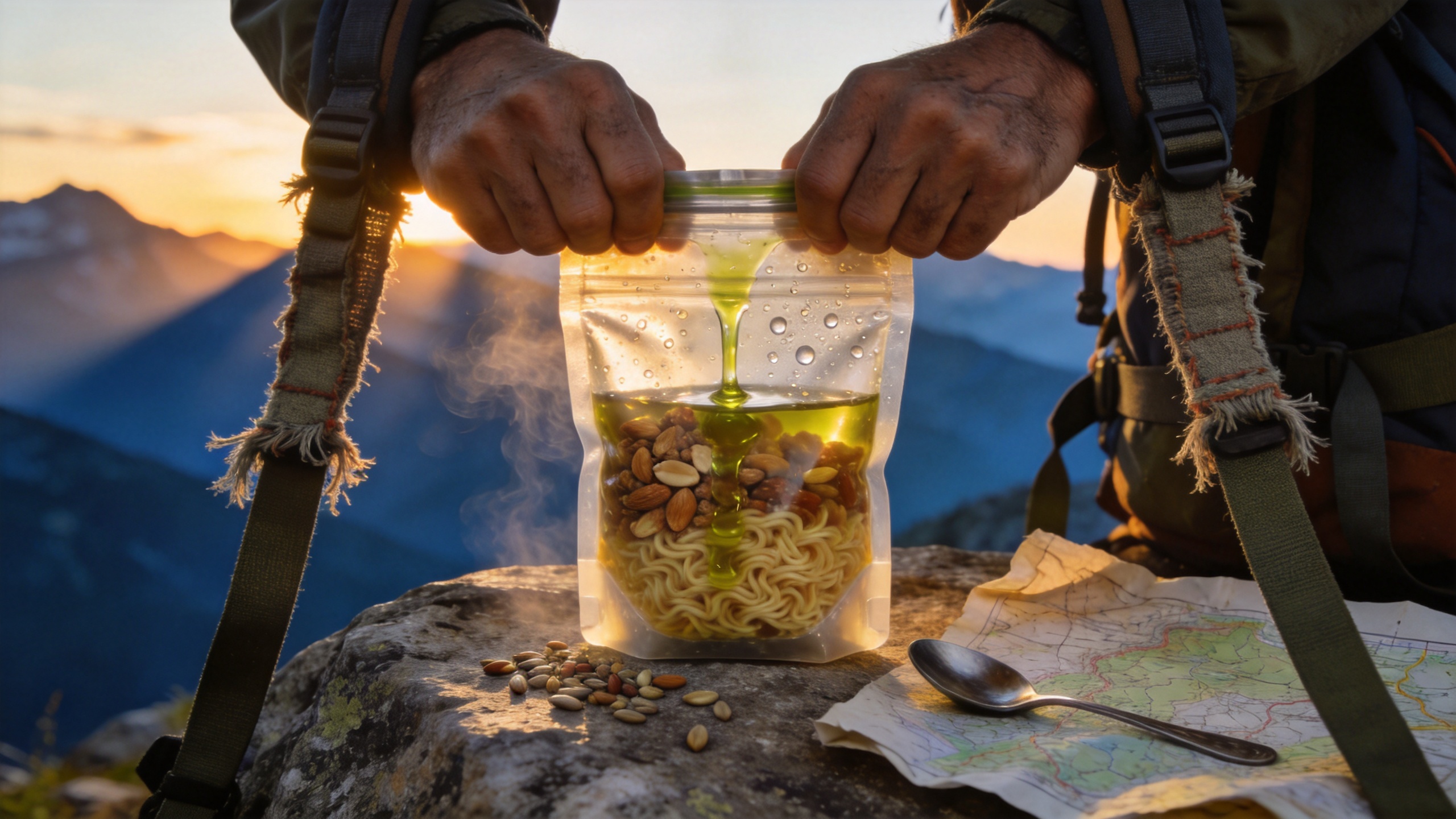
Imagine you hike 12 miles on steep terrain, arriving at camp exhausted. Your dinner is a 300-calorie packet of instant mashed potatoes (about 1.2 kcal/g). To compensate, you plan to eat 700 kcal of trail mix later. But when you’re dead tired, your appetite often shrinks, or you simply forget. The single-meal density directly affects your immediate energy return—the calories hitting your bloodstream when you most need them. A dense dinner (e.g., a peanut-coconut-cocoa blend at 5.5 kcal/g) delivers 600+ kcal in a compact 110 g pouch, giving you a real recovery without needing to scarf down extra bites.
Moreover, per-meal density affects consumption efficiency. Eating low-density meals means larger volumes, which can cause gastric discomfort and slower digestion. Your stomach has a finite capacity; packing it with low-density food leaves less room for dense, energy-packed items later in the day. This is especially critical on days when you’re pushing hard and need frequent, small refueling.
The Flaw in the “Daily Density” Argument
The daily-average approach assumes perfect planning and execution. In reality, trail life is messy. You might lose a snack bag to a marmot, decide to skip lunch because the views are too good, or feel nauseous after a heavy creek crossing. If your individual meals are low-density, any disruption shifts you into an energy deficit fast. High per-meal density acts as a safety buffer, ensuring that even if you only eat three of your planned five daily “meals,” you still consume enough fuel.
Consider this table comparing two hypothetical 2,500 kcal daily menus —one optimized per-meal, the other relying on daily averaging:
| Menu Component | Per-Meal Density Focus (grams / kcal) | Daily Average Focus (grams / kcal) |
|---|---|---|
| Breakfast | 50 g granola + 15 g coconut oil = 65 g, 400 kcal (6.15 kcal/g) | 90 g oatmeal + 10 g brown sugar = 100 g, 350 kcal (3.5 kcal/g) |
| Lunch | 60 g peanut butter tortilla wrap = 60 g, 360 kcal (6.0 kcal/g) | 120 g instant rice with tuna = 120 g, 300 kcal (2.5 kcal/g) |
| Dinner | 70 g dehydrated refried beans + 20 g olive oil = 90 g, 480 kcal (5.3 kcal/g) | 200 g Ramen + pack of dehydrated veggies = 200 g, 450 kcal (2.25 kcal/g) |
| Snacks | 35 g dark chocolate + 30 g almonds = 65 g, 350 kcal (5.4 kcal/g) | 100 g Trail mix (optional) = 100 g, 500 kcal (5.0 kcal/g) |
| Totals | 280 g → 1,590 kcal (5.68 kcal/g avg) | 520 g → 1,600 kcal (3.08 kcal/g avg) |
Notice that the per-meal density menu achieves comparable calories in 46% less weight —that’s 240 grams saved per day, or nearly 1.7 pounds over a 7-day trip. And the snacks in the “daily average” approach are often the first to be abandoned or forgotten, leaving you short. In short, aiming for high density in every eating event is more robust, more reliable, and lighter.
Practical Hacks for High Calorie Density Without Weird Concoctions
You don’t need to eat freeze-dried butter powder or strange lab-made bars to hit high densities. The best foods are common, affordable, and taste good after six days on the trail. Here’s a toolkit that balances density, nutrition, and palatability.
Top 7 High-Density Trail Foods (5+ kcal/g)
- Nuts and Seeds (almonds: 6.0, macadamias: 7.2, sunflower seeds: 5.8) – Crush them into a powder and mix into meals, or eat whole.
- Oils and Fats (olive oil: 8.8, coconut oil: 8.6, ghee: 8.8) – Add 1–2 tbsp to dinner for an instant density boost. No weird taste.
- Nut Butters (peanut, almond: ~6.0) – Use as a dip, in tortillas, or stirred into oatmeal.
- Dark Chocolate (85%+: 5.5–6.0) – Also provides magnesium and antioxidants.
- Dehydrated Cheese (parmesan, cheddar powder: ~5.5) – Sprinkle on top of hot meals for savory flavor and extra calories.
- Coconut Flakes (unsweetened: 5.8) – Mix into granola or add to hot cereal.
- Protein Powders / MCT Powder (whey isolate: 4.0–4.5; MCT: 7.0) – Use sparingly if you want a calorie boost without bulk.
Avoid These Common Density Traps
- Instant oatmeal packets – Most are sweetened and low-density (3.5–4.0 kcal/g). Instead, buy plain rolled oats and add coconut oil and nuts—the density jumps above 5.5.
- Rice and pasta (alone) – Even dehydrated, they’re around 3.5–4.0 kcal/g. Always pair with fat or protein powder to bring up the density.
- Commercial “energy bars” – Many are loaded with air and fillers (2.5–3.5 kcal/g). Read labels and seek bars like GOMAD BROS or DIY Nut-Based Bars (e.g., combine dates, peanut butter, cocoa powder, and dehydrated milk – yields ~5.5 kcal/g).
- Freeze-dried “healthy” meals – Often low in fat, high in volume. Add a pack of olive oil (120 kcal per tbsp) to any freeze-dried meal without compromising taste.
Two Sample Daily Menus (Per-Meal Optimized)
Here’s a real-world example that you can actually enjoy, without any bizarre ingredients. The goal is to stay above 5 kcal/g for each eating event:
- Menu A: Sweet & Savory Hybrid (Total: 2,200 kcal, 380 g – 5.79 kcal/g)
- Breakfast: 50 g powdered whole milk + 30 g granola + 20 g coconut oil + 10 g sugar (110 g, 600 kcal). Mix in cold water.
- Lunch: 80 g peanut butter (on 2 tortillas) + 20 g dark chocolate (100 g, 540 kcal).
- Dinner: 70 g instant mashed potatoes + 25 g olive oil + 15 g parmesan (110 g, 550 kcal).
- Snacks: 30 g almonds + 30 g dried mango (60 g, 310 kcal).
- Menu B: Fatty & Dense Mexican Style (Total: 2,400 kcal, 430 g – 5.58 kcal/g)
- Breakfast: 60 g oatmeal + 20 g MCT powder + 15 g peanut butter (95 g, 510 kcal).
- Lunch: 100 g flour tortilla (2) with 40 g refried bean powder + 30 g cheddar cheese powder (170 g, 720 kcal).
- Dinner: 50 g instant rice + 30 g freeze-dried beef crumbles + 25 g coconut oil + 20 g sour cream powder (125 g, 680 kcal).
- Snacks: 40 g macadamia nuts (40 g, 290 kcal).
Both menus rely on adding a high-fat component (oil, nut butter, cheese) to otherwise-low-density bases. The result is food that tastes normal, feels satisfying, and weighs far less than a typical grocery-store backpacking haul.
Conclusion: Density Dictates Distance
In the ultralight game, every decision cascades. Ignoring calorie density means carrying unnecessary weight that slows you down, threatens your energy buffer, and forces you to eat more volume than your stomach can handle. By focusing on per-meal density and using simple, whole-food ingredients with strategic fats, you can pack a 7-day food bag under 5 pounds. That’s not weird—it’s smart, delicious, and the difference between a sufferfest and a sublime journey.