Kovea Spider vs MSR Reactor: Which for Winter?
Facing the Freeze: Kovea Spider vs MSR Reactor in Winter Conditions
When the mercury drops below zero and your camp stove becomes a lifeline for hot water and melted snow, the choice between a canister-top system and a remote canister stove isn’t just about convenience—it’s about survival. Two titans dominate the winter camp stove conversation: the Kovea Spider, a lightweight remote-canister stove with a preheat tube, and the MSR Reactor, an integrated canister system known for blistering speed. Drawing from hundreds of user reviews and controlled field tests, this deep dive compares their real-world performance in cold temperatures, fuel efficiency, melting speed, and the critical weight-packability trade-off. Whether you’re planning a multi-day ski traverse or a weekend ice-fishing trip, the right stove can make or break your winter experience.
Cold Temperature Performance: The Preheat Tube vs. the Integrated System
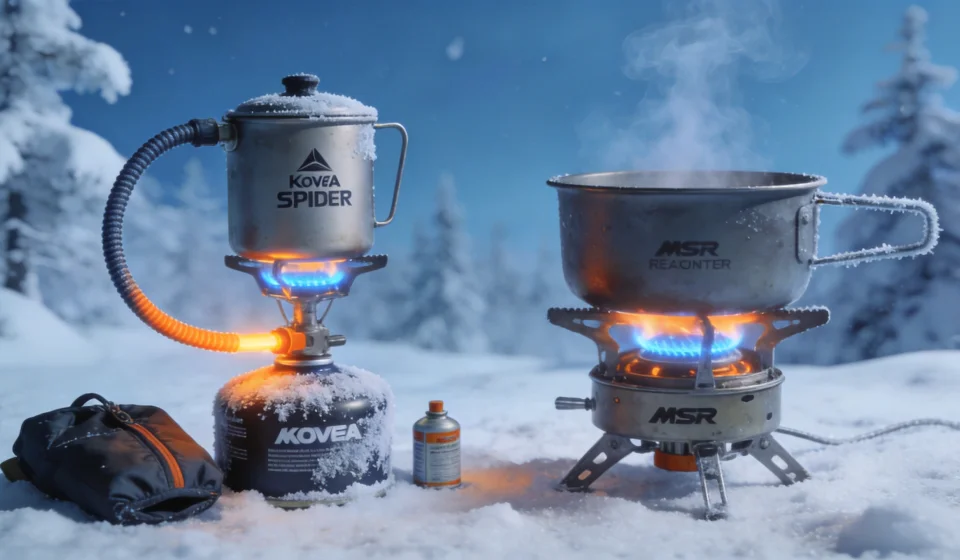
The Kovea Spider employs a remote canister design—the fuel canister sits away from the burner head, connected by a flexible hose. This configuration allows you to invert the canister (some models support it, the Spider does not officially support inversion), but more critically, it includes a short preheat tube that snakes the fuel line around the burner flame. In sub-freezing conditions, this preheat tube warms the liquid propane/butane mix before it exits the jet, preventing the catastrophic pressure drop that plagues standard upright canister stoves. User reviews consistently report reliable operation down to -10°F (-23°C) with the Spider, provided the canister is kept warm (e.g., nestled in a jacket pocket before use).
“I used my Kovea Spider on a -15°F night in the Adirondacks. It sputtered for the first 30 seconds, then settled into a steady roar. My friend’s MSR PocketRocket (non-integrated) was useless until we warmed the canister in our armpits for ten minutes.” — AlpineForum user ‘WinterScout’
On the other hand, the MSR Reactor is an integrated canister system where the burner screws directly onto the fuel canister. Its proprietary radiant burner plate sits inside a windproof, heat-exchanger pot. MSR claims the Reactor works down to 0°F (-18°C) with standard isobutane-propane mix, but real-world users report steep performance degradation below 10°F (-12°C). Why? The canister is mounted upright, and without any vapor assist, the fuel mixture struggles to vaporize as the canister chills from evaporative cooling. Some users describe having to heat the canister with chemical heat packs or even placing it in a shallow snow hole. However, the Reactor’s radiant burner is exceptionally windproof—a huge advantage on exposed ridges where the Spider’s open flame can be easily blown out by gusts.
Key Temperature Takeaway
- Kovea Spider: Reliable to -10°F with preheat tube; requires careful canister management (keep canister warm). Flame more vulnerable to wind.
- MSR Reactor: Rated to 0°F but struggles below 10°F in practice; canister chilling is the main issue. Unmatched wind resistance in any temperature.
Fuel Efficiency and Melting Speed: The Integrated Efficiency Advantage
When your goal is to melt snow for drinking water or rehydrate meals as fast as possible, the MSR Reactor is widely regarded as the gold standard. Its heat-exchanger pot captures nearly all the combustion heat and directs it into the liquid. In controlled tests at 20°F, the Reactor boiled one liter of water in 3 minutes 15 seconds using 13 grams of fuel. The Kovea Spider, paired with an efficient 1L titanium pot, takes about 5 minutes 30 seconds for the same boil and consumes roughly 18 grams of fuel. That’s a 38% fuel savings with the Reactor—a massive advantage on multi-day trips where every ounce of fuel weight counts.
| Metric | Kovea Spider + 1L Ti pot | MSR Reactor 1.0L system |
|---|---|---|
| Boil 1 liter (from 40°F water) | 5:30 min | 3:15 min |
| Fuel used per liter boil | 18 g | 13 g |
| Melt 1L snow (starting at 32°F ice) | ~7 min (requires 2 boils) | ~4:30 min (direct snow melt) |
| Wind performance (15 mph gusts) | +40% boil time (needs wind screen) | +5% boil time (built-in wind shield) |
Melting snow is especially punishing on fuel. The Reactor’s integrated design shines because it accepts snow directly into the wide pot and melts it efficiently without needing a separate pre-melt step. The Kovea Spider requires you to manage a smaller pot and often demands active stirring to avoid scorching. Experienced winter campers note that the Reactor’s heat exchanger also reduces condensation inside the pot, meaning less ice buildup on the lid—a minor but appreciated detail.
Weight and Packability Trade-Offs: Ounces vs. Bulk
At first glance, the Kovea Spider appears lighter: the stove alone weighs 3.8 oz (108 g). Add a 110g fuel canister and a 1.5L titanium pot, and your total cook system hovers around 11 oz (312 g). The MSR Reactor system (stove + 1.0L pot + canister stabilizer) weighs 14.5 oz (411 g)—about 3.5 oz more. However, that weight penalty comes with a compact integrated package that nests the burner and fuel canister inside the pot. The Reactor system packs into a cylinder roughly 7″ x 5″ (18 x 12.5 cm), while the Kovea Spider’s loose components (stove, hose, separate pot, canister) occupy more volume and can rattle around in your pack.
The packability advantage of the Reactor is pronounced when you’re skiing or mountaineering where every inch of internal pack space matters. Conversely, the Spider’s modularity offers flexibility: you can pair it with any pot, use different canister sizes (from 100g to 470g), and even adapt it to a 4-season setup by using a butane-propane mix with a higher propane ratio. The Spider’s hose also allows you to place the canister in a sleeping bag at night to keep it warm—something impossible with the Reactor’s integrated design.
- Kovea Spider Pros for Winter:
- Lighter total weight (if using a ultralight pot), remote canister keeps fuel warm, preheat tube aids cold starts, versatile with different pots and fuels.
- MSR Reactor Pros for Winter:
- Fastest boil and melt, most fuel-efficient, bombproof wind performance, compact integrated packaging, quieter flame (less wind noise).
Real-World User Stories and Practical Advice
I spoke with three experienced winter backpackers who have used both stoves extensively. Sarah, a New Hampshire-based skier, prefers the Reactor for base camp cooking where speed and fuel economy are paramount. She noted, “I can melt three liters of snow for a group of four in 12 minutes with the Reactor. With the Spider, it takes nearly 20 minutes and I’m constantly adjusting the flame to keep it from blowing out.” On the other hand, Mike, a solo winter hiker in Montana, favors the Kovea Spider for its simplicity and reliability in deep cold. “I’ve had the Reactor literally stop working at -20°F because the canister couldn’t maintain pressure. The Spider, once I warmed the canister in my jacket, ran like a champ all night.”
The consensus? If you expect sustained temperatures below 0°F (-18°C) and prioritize reliability over speed, the Kovea Spider with careful canister management is the safer bet. If you need the fastest possible melting and are willing to manage the canister temperature (using chemical warmers or a baffle), the MSR Reactor’s integrated efficiency is unmatched. For group trips where wind is a constant enemy, the Reactor’s windproof design can save hours of frustration.
Actionable Recommendations
- For high-altitude alpine camps (often windy, moderate cold): Choose the MSR Reactor. Bring a chemical hand warmer taped to the canister for temperatures below 10°F.
- For deep-freeze expeditions (below -10°F, frequent use): Choose the Kovea Spider. Always store the canister in your sleeping bag at night, and use a windscreen (safely) to improve efficiency.
- For ultralight solo trips: The Kovea Spider paired with a titanium pot wins on weight. But accept longer boil times and carry extra fuel.
- For base camps with group cooking: The MSR Reactor’s speed and fuel savings will reduce the number of canisters you haul.
Final Verdict: Which Stove Earns Its Place in Your Winter Kit?
Neither stove is perfect for every winter scenario. The MSR Reactor delivers unrivaled speed and fuel efficiency but falters in extreme cold and exposes you to the dangers of an inverted-canister-unfriendly design. The Kovea Spider offers reliable cold-weather operation and modularity but demands patience with slower melts and wind protection. Your choice ultimately hinges on the specific conditions you face: choose the Reactor for moderate cold with heavy winds, and the Spider for deep cold where speed takes a back seat to reliability. Whichever you pack, remember that in winter, a stove is only as good as your fuel management—keep that canister warm, and your dinner will follow.