Your Backpacking Food Is Lighter Than You Think—Until You Count the Packaging
Backpacking food math usually starts with calories, ounces, and calories per ounce, but it often leaves out something still sitting inside your pack: the packaging. 🥾 A meal may contain 4 ounces of food, yet its wrapper, pouch, label, and extra storage bag all add to what your shoulders actually carry. On a short trip the difference can feel tiny, but over many days the gap between net food weight and actual food-system weight can become large enough to affect your pack-out plan.
A better approach is to treat food as a complete system rather than a pile of calories. Your real starting load is edible food + wrappers + freezer bags + meal pouches + shared storage bags, and much of that packaging remains with you as trash until disposal. That does not mean every backpacker should repackage everything, but it does mean backpacking food packaging weight belongs beside calories, ounces, and daily food targets.
The Weight Missing From Most Backpacking Food Calculations
Many backpacking nutrition calculations divide total calories by the net weight of the food itself. That is useful for comparing foods, but it can make a menu look more efficient than the packed version because wrappers, pouches, and organizing bags add weight without adding energy. 📦 A snack bar, drink mix, nut-butter packet, and freeze-dried dinner can each look insignificant alone while collectively creating a meaningful packaging total.
The simplest fix is to separate edible food weight from food-system weight. Edible weight is what you consume, while food-system weight includes the bags, wrappers, pouches, and containers required to carry and use it. This distinction is especially valuable on longer trips and for ultralight hikers who already measure equipment in grams.
Net Food Weight vs Actual Pack Weight
Nutrition labels describe the food product, not necessarily every layer of packaging that enters your backpack. If a meal contains 120 grams of food and its pouch weighs 15 grams, the item occupies 135 grams of pack weight before any secondary storage is added. Put several individually wrapped foods into another zipper bag and that organizer should be counted too.
Packaging also changes real-world caloric density because it increases carried weight without increasing calories. For example, 600 calories in 4 ounces of edible food equals 150 calories per edible ounce, but if packaging raises the carried weight to 4.5 ounces, the density falls to about 133 calories per carried ounce. Both figures are useful, but the second is better for estimating what the complete menu actually weighs.
How Small Wrappers Become Significant Over a Long Trip
One wrapper rarely matters, which is exactly why packaging weight disappears from many food plans. Imagine 20 snack bars with wrappers weighing 3 grams each; together those wrappers would weigh 60 grams, or a little over 2.1 ounces, even though every individual wrapper feels trivial. Add drink packets, instant-food sleeves, nut-butter packets, and dinner pouches and the accumulated packaging can become easier to notice.
Trip length magnifies that effect because many packages repeat every day. A three-day menu may contain only a handful of single-serve items, while a 10- or 14-day pack-out can include dozens unless foods are consolidated. 🧮 That is why food bag weight backpacking calculations work best at the itinerary level rather than item by item.
Individual Packets vs One Bulk Bag
Individual packets offer convenience, portion control, labeling, and easy access, but they usually use more packaging material per serving than one larger container. Suppose ten snack portions each use a 4-gram wrapper; that is 40 grams of packaging, while one 12-gram bulk bag would save 28 grams, or roughly 1 ounce. Whether that ounce matters depends on the trip length, spill risk, food type, and how much organization the hiker wants.
Bulk packing can also create new weight that should be counted honestly. A larger zipper bag, small portion bags, labels, or measuring tools may reduce part of the savings from removing factory wrappers. The goal of ultralight food packaging is not zero packaging; it is the lightest practical system that still protects food and keeps meals manageable.
Freeze-Dried Meal Pouches vs Repackaged Meals
Freeze-dried meal pouches show why packaging comparisons need context. A factory pouch may weigh more than a thin bag, but it can also function as the storage container, rehydration vessel, eating bowl, and instruction label. If you repackage backpacking food but then need another container for cooking or eating, the true system saving may be smaller than the pouch-to-bag comparison suggests.
Repackaging can still make sense when several meals are consolidated, the original pouches are bulky, or you already cook in a pot. Keep important cooking directions, ingredient information, and allergen notes when relevant, and use containers appropriate for the food and temperatures involved. 🍲 The fair comparison is always complete system versus complete system, not simply heavy pouch versus light bag.
Remember That Trash Does Not Disappear
Packaging does not vanish after breakfast just because the calories are gone. Unless you reach a disposal point, wrappers, pouches, and used bags remain in your backpack, often inside another trash or odor-control bag, so their material weight persists. The pack becomes lighter mainly because edible food is consumed, while most of the packaging continues riding with you.
This matters when estimating how quickly food weight will decline through a trip. If you assume an entire packaged item disappears after eating it, you slightly overstate how much weight leaves the pack each day. ♻️ A more accurate model separates consumable food weight from persistent packaging weight.
When Repackaging Is Actually Worth the Trouble
A simple test is to calculate grams saved per day. Subtract the weight of the replacement packaging from the original packaging, then divide by trail days; saving 140 grams over seven days equals 20 grams per day, while saving 14 grams equals only 2 grams per day. That number helps you judge whether the saved weight is worth the time, labeling, measuring, and repacking.
You can also compare packaging with the total food-system weight. If a 6,000-gram food system contains 300 grams of packaging, packaging equals 5% of the starting system; if it contains 600 grams, the share is 10%, and both figures are examples rather than universal averages. This percentage makes it easier to see whether packaging is a meaningful target or a minor detail in your particular menu.
Build Packaging Into Your Cal/Oz Spreadsheet
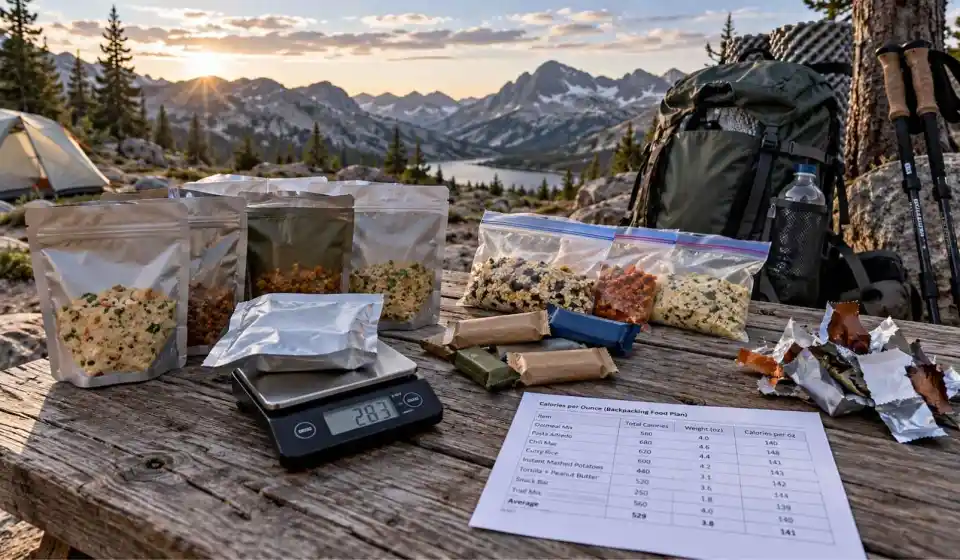
Add separate spreadsheet columns for calories, edible weight, packaging weight, and total carried weight. Then calculate edible caloric density as calories divided by edible weight, and carried caloric density as calories divided by edible weight plus packaging. 📊 This preserves a clean nutrition comparison while revealing what your backpack actually experiences.
In ounces, the practical formula is carried calories per ounce = total calories ÷ total carried ounces. Add shared freezer bags, odor bags, labels, or other group containers at the trip level instead of hiding them outside the calculation. Once packaging is included, two menus with identical calories can show different starting weights, different carried caloric densities, and different amounts of trash that remain in the pack.
The Better Goal Is a Lighter Food System
Packaging weight is easy to overlook because it is scattered across many small objects, but the scale counts every gram. On a weekend trip, repackaging savings may be too small to matter, while on a long or heavily provisioned route they may justify consolidating selected foods. 🏕️ The useful question is not “Should I repackage everything?” but “How much total carried weight does this change actually save?”
Think about backpacking food the same way you think about the rest of your gear: measure the complete system, not only the advertised component. When you count the food, wrapper, pouch, storage bag, and trash you keep carrying, backpacking food packaging weight becomes a real variable instead of an invisible one. That small change makes calories-per-ounce math more honest and gives you a clearer picture of what your food plan weighs from the first mile onward.