🎒 How to Keep Food Packaging From Taking Over Your Backpack
Planning backpacking food is often about calories, weight, and cooking time.
But there is another problem that becomes obvious after a few days on the trail:
packaging.
A few wrappers do not seem like much at home. Put several days of meals, snacks, drink mixes, and condiments into a backpack, however, and all those individual packages can create surprising amounts of bulk.
You may end up carrying boxes inside bags, plastic pouches inside larger bags, cardboard sleeves, and unnecessary air.
The solution is not to remove every piece of packaging.
The goal is to reduce unnecessary packaging while keeping food protected, organized, and safe to carry. 🥾
🗑️ Start by Removing Packaging You Don’t Need
One of the easiest ways to reduce bulk is to look at every food item before your trip and ask:
“Does this package actually need to come with me?”
Many packaged foods have an outer layer that provides information or retail presentation but is not necessary for transportation.
Examples can include:
- Cardboard boxes around individually wrapped foods
- Outer plastic around multiple portions
- Large retail bags containing smaller sealed portions
- Individual packaging for foods you have already portioned yourself
For example, if a food comes in a cardboard box containing several individually sealed servings, you may be able to leave the box at home and carry the individual servings instead.
However, keep important preparation instructions and allergy information available when you need them.
A photo of the cooking instructions or nutrition label on your phone can sometimes be useful, provided you have a reliable way to access it.
📦 Repackage Before You Leave
Repackaging can make a big difference in both organization and space.
Instead of bringing several bulky retail packages, portion food into appropriately sized bags or containers before your trip.
For example:
At home:
Large bag of trail mix → several individual portions
On the trail:
One portion → one day’s snack supply
This reduces the amount of packaging you need to carry and makes it easier to control daily food quantities.
Use packaging that is appropriate for the food and strong enough to survive being packed, unpacked, squeezed, and exposed to normal trail conditions.
🥣 Separate Meals by Day
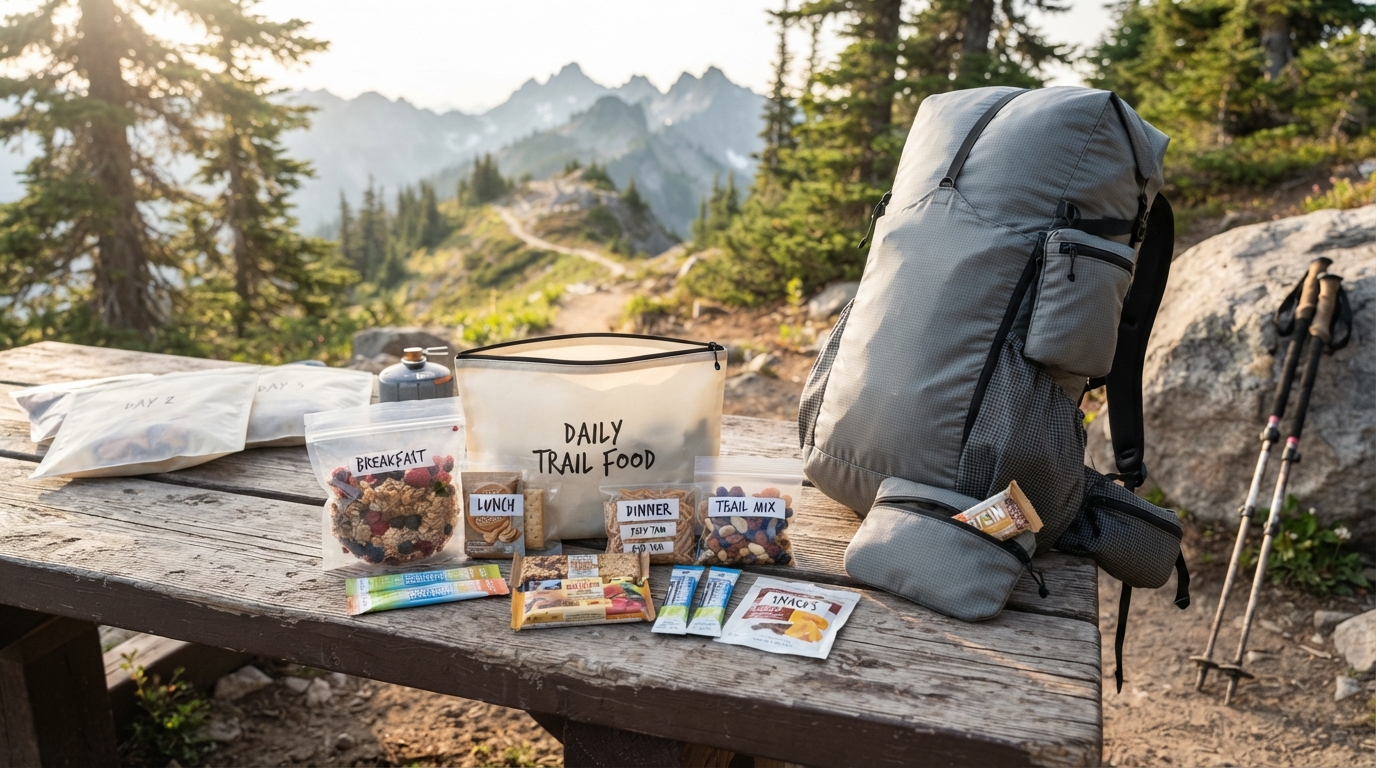
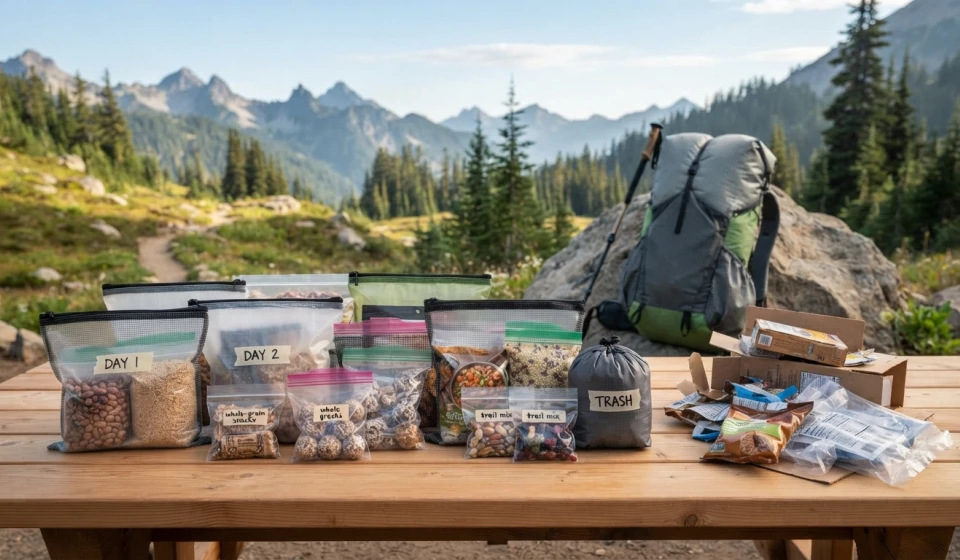
One of the best organizational tricks is to create daily food bags.
Instead of organizing your backpack by food category:
- Breakfast
- Lunch
- Dinner
- Snacks
you can organize certain foods by day:
Day 1 food
Day 2 food
Day 3 food
This can make food easier to manage during a multi-day trip.
A daily bag might contain:
🌅 Breakfast
🥜 Snacks
🥪 Lunch
🍲 Dinner
☕ Drink mix
It also prevents you from opening every food package in your backpack just to find one snack.
🎒 Use a Dedicated Food Bag
Once food has been repackaged, keep it together in a dedicated food bag.
This creates a simple boundary between food and the rest of your gear.
It also makes packing easier.
Rather than fitting individual packages into random gaps throughout the backpack, you have one predictable food-storage system.
Depending on your destination and local requirements, your food-storage method may need to account for wildlife and food odors.
In bear country, for example, follow the specific food-storage regulations and recommendations for the area.
Reducing packaging should never mean compromising required food storage.
🌾 Don’t Automatically Remove Every Original Package
Minimalism can go too far.
Some original packaging is useful.
A sealed package can protect food from:
- Moisture
- Crushing
- Contamination
- Spills
- Odors
- Pests
If the original package is already compact, durable, and appropriately sealed, repackaging may not be worth the effort.
The best question is not:
“Can I remove this packaging?”
It is:
“Will removing this packaging meaningfully improve my pack?”
If the answer is no, leave it alone.
💧 Pay Attention to Water and Moisture
Moisture can ruin backpacking food quickly.
This is especially important for powdered foods, dehydrated meals, drink mixes, seasonings, and other ingredients that need to stay dry.
If you repackage these foods, make sure the new packaging is suitable for protecting them.
A tiny puncture can become a major problem when your dinner turns into a damp powder at the bottom of your food bag. 😅
For foods that are sensitive to moisture, consider using a properly sealed inner bag along with your larger organizational bag.
🧂 Consolidate Small Ingredients
Individual condiment packets and seasoning packets can create a surprising amount of clutter.
If you have several meals that use the same seasoning, you may be able to combine appropriate quantities into one clearly labeled container or packet.
For example:
- Salt
- Sugar
- Chili flakes
- Seasoning blends
- Powdered drink mixes
But labeling matters.
A mystery powder may be funny at home.
It is considerably less funny when you’re hungry at the end of a long hiking day.
🏷️ Label Everything Clearly
Once you remove original packaging, information can disappear.
Use simple labels.
Write:
Dinner – Day 3
or:
Oatmeal – 1 serving
For foods requiring specific preparation instructions, include the necessary information.
You can also use a small permanent marker directly on suitable packaging.
Good labels can prevent:
- Confusing similar foods
- Eating tomorrow’s dinner today
- Forgetting cooking instructions
- Mixing up portions
- Accidentally using the wrong ingredient
A few seconds of labeling at home can save considerable frustration on the trail.
🔥 Think About Cooking, Not Just Carrying
Packaging decisions should also consider how you prepare meals.
If you are using freezer-bag cooking or another method where the food container is part of the cooking system, make sure the material you use is appropriate for the intended temperature and method.
Do not assume that every thin plastic bag is suitable for contact with boiling water.
Likewise, some foods may need to remain in their original containers for safe preparation.
Weight savings should never come from using packaging in a way it was not designed to handle.
🥜 Choose Foods With Efficient Packaging
Packaging efficiency can also influence what foods you buy.
Compare two foods with similar nutritional value.
If one comes in a bulky box with several layers of unnecessary packaging while the other comes in a compact, durable package, the second option may be easier to pack.
This is particularly useful when planning longer trips.
Look at the complete food package:
Food weight + packaging weight + packaging volume
A food that looks lightweight on a shelf may not be especially efficient once you account for its packaging.
♻️ Plan for Your Trash From Day One
Every wrapper you bring into the wilderness needs to come back out with you.
Do not wait until your backpack is full of loose wrappers before deciding how to manage trash.
Carry a dedicated trash bag or another appropriate system.
As meals and snacks are consumed, place the empty packaging directly into it.
You can compress clean, dry wrappers to save space.
But avoid crushing packaging that still contains food residue in a way that could cause leaks or odors.
And always follow Leave No Trace principles and local regulations for waste disposal.
🧼 Keep Wet or Messy Trash Separate
Not all trash is equally pleasant.
A clean oatmeal wrapper is easy.
A bag containing leftover sauce or oily food residue is another story.
Whenever possible, choose foods that generate dry, easy-to-manage waste.
If a food produces wet or messy packaging, seal it appropriately and keep it separated from clean gear.
This can make your entire pack much more pleasant by the end of the trip.
⚖️ Don’t Chase Tiny Weight Savings
It’s easy to become obsessed with shaving grams.
But removing a few grams from a wrapper may not matter if the process makes your food harder to organize or increases the chance of spills.
Think about system efficiency, not individual packaging perfection.
A slightly heavier food container may be worth carrying if it prevents crushed food, leaks, or complicated cooking.
The best backpacking system is the one that works reliably.
🧠 Use the “Pack In, Pack Out” Test
Before leaving home, put all your food packaging together.
Look at the pile.
Ask:
How much of this needs to go on the trail?
Then look at the empty packaging you expect to bring home.
If it seems excessive, reconsider the food packaging.
This simple exercise can reveal unnecessary boxes, oversized bags, duplicate packaging, and individual packets that could have been consolidated.
🌲 Final Thoughts
Managing food packaging is a small part of backpacking, but it can make a noticeable difference in organization.
Remove unnecessary outer packaging. Repackage where it genuinely saves space. Label portions clearly. Protect moisture-sensitive foods. Keep trash organized. And always follow local food-storage requirements and Leave No Trace practices. 🎒🌲
Most importantly, don’t turn ultralight packing into a competition with yourself.
The goal is not to carry the fewest wrappers possible.
The goal is to carry the food you need in a compact, organized, reliable system.
When your food bag contains meals instead of a chaotic collection of boxes and wrappers, every resupply, meal, and pack check becomes easier.
Less packaging. Less clutter. More room for the adventure. 🥾✨