Best Foods for Cold-Weather Hiking: 25 Snacks and Meals That Are Actually Practical
Cold-weather hiking changes the food question because a snack that works in July can become awkward once temperatures fall below freezing. The best food for cold weather hiking should provide useful energy, survive a pack, stay reasonably easy to chew, and require little handling with gloved hands. ❄️ Winter food should therefore be judged by texture, packaging, preparation, water needs, and accessibility—not calories alone.
Long meal stops can also become uncomfortable when wind, snow, or damp clothing cools you while you stand still. Foods kept in a jacket pocket, hip-belt pocket, or easy-access compartment are often more useful than meals requiring several wrappers or complicated assembly. 🎒 On overnight trips, hot food can add welcome comfort, but a dependable winter system still includes ready-to-eat options.
Why Choosing Winter Hiking Food Is Different From Packing Summer Snacks
Freezing temperatures can change texture dramatically even when a food’s nutritional value stays essentially the same. Chewy bars may become hard, dried fruit tougher, nut butter thicker, and tortillas stiffer, while low-moisture foods such as nuts and crackers usually remain easier to manage. 🧤 Testing the exact foods you plan to carry in a home freezer is a simple way to expose unpleasant surprises.
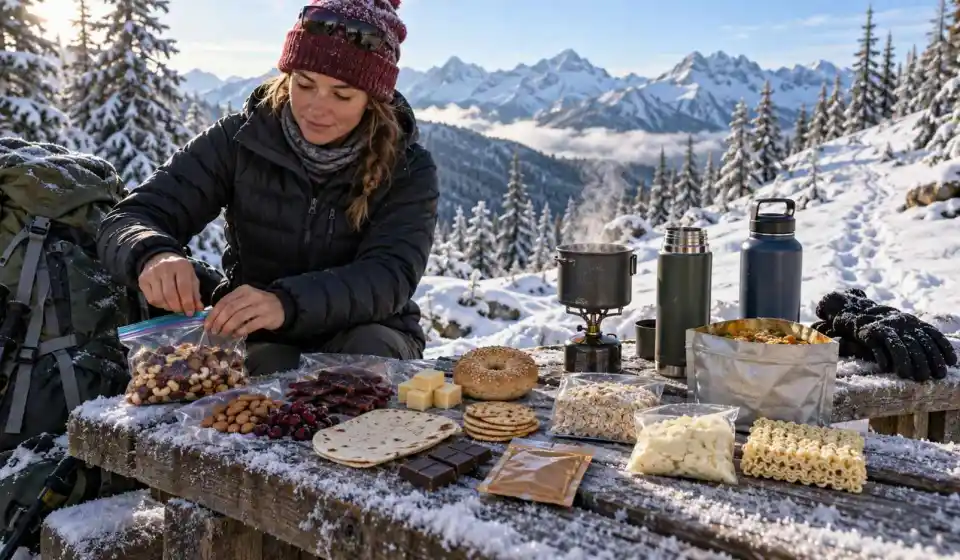
Access matters because opening tiny seals or cutting food with cold fingers may require removing gloves. Pre-portion snacks, choose easy-opening packages, and keep several hours of food somewhere reachable without unpacking your main bag. In very cold conditions, carrying a snack close to your body can also help keep it easier to bite.
25 Foods To Consider For Cold-Weather Hiking
A useful winter hiking food ideas list needs more than familiar trail snacks; it should include dry foods, savory choices, meal bases, and quick hot options. Approximate calories below are for comparison because brands, recipes, portion sizes, and moisture levels can change the numbers substantially. 🔥 Use the table as a screening tool, then check the label on the exact food you buy.
| Food | Typical serving | Approx. calories | Cold-weather use | Prep |
|---|---|---|---|---|
| 1. Almonds | 1 oz | 160–170 | Compact, low moisture | None |
| 2. Peanuts | 1 oz | 160–170 | Dense and easy to portion | None |
| 3. Trail mix | 1 oz | 130–170 | Practical; mixtures vary | None |
| 4. Raisins | 1 oz | 80–90 | Can become chewy | None |
| 5. Dried apricots | 1 oz | 65–75 | May firm in deep cold | None |
| 6. Jerky | 1 oz | 70–110 | Savory; can become tough | None |
| 7. Hard cheese | 1 oz | 100–120 | Firms as it gets colder | None |
| 8. Dry salami | 1 oz | 110–130 | Dense savory option | None |
| 9. Flour tortilla | 1 medium | 130–160 | Useful wrap; may stiffen | None |
| 10. Bagel | 1 medium | 240–300 | Bulky but convenient | None |
| 11. Crackers | 1 oz | 120–140 | Dry; protect from crushing | None |
| 12. Pretzels | 1 oz | 105–115 | Simple salty carbohydrate | None |
| 13. Peanut butter | 2 tbsp | 180–200 | Dense; thickens in cold | None |
| 14. Sunflower butter | 2 tbsp | 190–210 | Dense non-peanut spread | None |
| 15. Chocolate | 1 oz | 140–170 | Compact; becomes harder | None |
| 16. Granola | 1 oz | 120–150 | Dry and easy to portion | None |
| 17. Nut-based energy bar | 1 bar | 180–250 | Test for cold hardness | None |
| 18. Instant oatmeal | 1 packet | 140–180 | Simple warm breakfast | Hot water |
| 19. Potato flakes | 1 oz dry | About 100 | Lightweight savory base | Hot water |
| 20. Couscous | 2 oz dry | About 210 | Compact meal carbohydrate | Rehydrate |
| 21. Instant rice | 2 oz dry | About 200 | Flexible meal base | Hot water |
| 22. Instant ramen | 1 package | 350–400 | Compact comfort meal | Cook/soak |
| 23. Freeze-dried entrée | 1 pouch | 450–800 | Convenient; brands vary | Hot water |
| 24. Dehydrated chili | 1 serving | 300–600 | Savory full meal | Rehydrate |
| 25. Hot cocoa mix | 1 packet | 80–160 | Warm drink plus calories | Hot water |
No food wins every category, which is why a mountaineering food list should not simply rank foods from best to worst. Nuts and spreads excel in calorie density, bagels and tortillas work as meal carriers, and instant potatoes, ramen, couscous, and dehydrated meals become attractive when a stove is already part of the trip. 🥜 Combining sweet and savory choices also keeps the menu from depending on one texture or flavor.
Which Foods Become Hard Or Difficult To Eat When Frozen?
Chewy energy bars are a common problem because some formulations become surprisingly hard in deep cold. Chocolate firms, cheese hardens, dried fruit becomes tougher, and nut butter thickens, although the exact change depends on temperature and ingredients. 🧊 For snacks for subzero hiking, testing the specific brand beforehand is more reliable than assuming an entire food category behaves the same way.
Low-moisture foods such as nuts, pretzels, crackers, dry granola, and powdered meal ingredients usually create fewer freezing problems. Cutting bars, cheese, or jerky into smaller portions at home can reduce the amount of handling and biting needed outside. Keep several different snack types available so one unexpectedly hard food does not leave you with nothing convenient to eat.
Day Hikes Versus Overnight Climbs
For a winter day hike, ready-to-eat foods usually deserve priority because there is little reason to add cooking complexity unless you specifically want a hot meal. A bagel with nut butter, trail mix, jerky, cheese, raisins, chocolate, and pretzels can provide multiple textures with almost no trail preparation. 🥾 The quantities should match your trip length, effort, body size, appetite, and individual dietary needs rather than a universal calorie target.
Overnight winter hiking and mountaineering change the calculation because you may already carry cooking equipment, making dehydrated foods more useful. Instant potatoes, oatmeal, ramen, couscous, instant rice, chili, and freeze-dried meals let you carry ingredients dry and add water later. Keep some ready-to-eat food in reserve, however, so your entire plan does not depend on successful cooking in difficult weather.
How To Build A Better Cold-Weather Food System
Start with four questions: how many calories does the food provide for its weight, what happens when it freezes, how easily can you reach it, and does it require heat or water? A food with excellent calorie density is less useful if it becomes so unpleasantly hard that you avoid eating it. ⚖️ This is why cold weather backpacking food should balance weight efficiency with actual usability.
Packaging can improve that balance without changing the food itself, so remove unnecessary boxes, divide bulk foods into manageable portions, and separate moving-time snacks from camp meals. Protect crackers and similar foods from crushing, and avoid packages that demand fine finger movements when your hands are cold. The best winter setup is intentionally simple: open, eat, reseal, and continue moving.
A Sample Cold-Weather Trail Food Checklist
For a full winter day, a practical pattern is a substantial pre-hike meal, several accessible snacks, one savory lunch item, something sweet, and a small reserve. One combination might include a bagel with peanut butter, trail mix, jerky, raisins, cheese, chocolate, and pretzels, adjusted to your expected duration and effort. 🌨️ Food planning should also sit beside a realistic hydration strategy because cold weather does not eliminate the need to drink.
For an overnight trip, add a simple dinner such as instant potatoes, couscous, ramen, dehydrated chili, or a freeze-dried entrée, plus oatmeal or another quick breakfast. Carrying different flavors and textures helps prevent an efficient-looking menu from becoming unappealing after hours in the cold. Ultimately, the best food for cold weather hiking is a cold-tested system of accessible snacks, dense staples, and simple meals matched to your route, temperature, and trip length.