Can Monster Mash Become Backpacking Food? The Calories-Per-Ounce Test
Monster Mash sounds almost perfect for hungry hikers: rice, ground meat, sweet potato, broth, and seasoning packed into one substantial meal. 🍚 The problem appears when a recipe designed for meal-prep containers has to travel ten miles inside a backpack, because cooked rice, cooked potatoes, meat, and broth all bring water along for the ride. A meal can be extremely high in total calories while still being surprisingly poor in calories per ounce once its cooked weight is counted.
That makes Monster Mash an interesting trail-food experiment rather than an automatic yes or no. Instead of asking whether beef, rice, and sweet potato are “good hiking foods,” the more useful question is what happens when we remove the water, rebuild the meal in trail form, and calculate the carried calories per ounce. 🎒 Once viewed that way, Monster Mash starts looking less like ordinary meal prep and more like a possible dehydrated backpacking dinner.
What Monster Mash actually contains
The version behind this experiment uses 2 pounds of ground bison or roughly 90% lean beef, 2 cups of long-grain white rice, 1 pound of sweet potato, and broth, with seasonings and sometimes oil used during preparation. The original calculation provided for that batch comes to approximately 3,276 calories before broth, including roughly 1,528 calories from the meat, 1,360 from rice, and 388 from sweet potato. 🥩 Split into four portions, that is roughly 819 calories each; five portions are about 655 calories each.
Those totals are already large enough to resemble the dinner calorie ranges many backpackers might build into a full-day food plan, but total calories alone tell us almost nothing about backpacking efficiency. A five-pound meal containing 3,276 calories and a two-pound meal containing the same calories are nutritionally similar in energy but radically different things to carry. That distinction is why pack weight must become part of the recipe calculation.
Cooked calories and carried calories are different problems
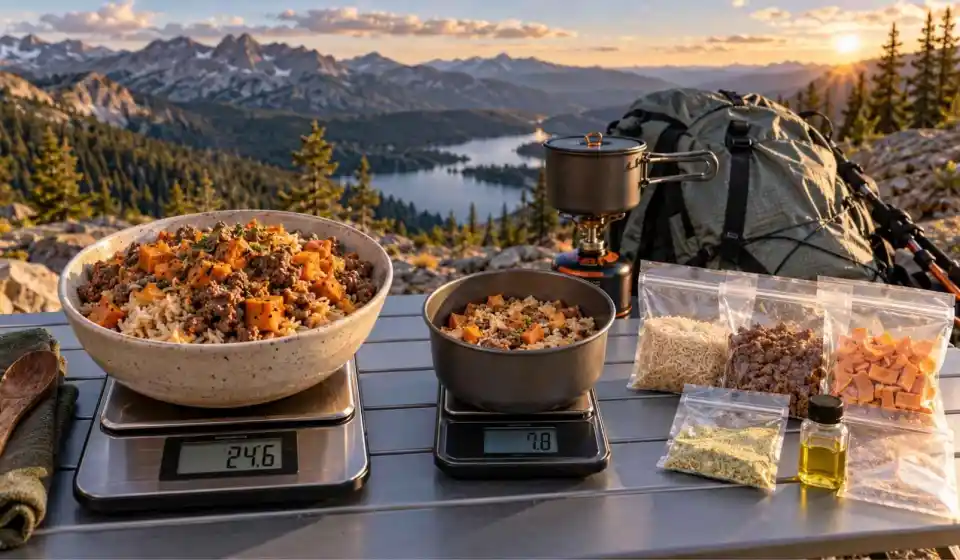
Cooking rice demonstrates the problem beautifully because dry rice absorbs a large amount of water while cooking, dramatically increasing its weight without adding meaningful calories. 💧 Sweet potatoes already contain substantial water before cooking, broth is overwhelmingly water, and cooked meat also retains moisture. When those ingredients are packed in normal meal-prep form, you are carrying not only dinner—you are carrying much of the water required to prepare dinner.
Backpacking reverses that logic whenever dependable water is available near camp: carry food dry and collect the water later. Dehydration does not magically create calories; it mostly removes water so the same energy occupies fewer carried ounces. This is exactly why instant rice, dehydrated beans, powdered potatoes, dried vegetables, and freeze-dried meats appear so frequently in backpacking meals even though their hydrated versions may be ordinary heavy foods.
Rebuilding Monster Mash for the trail
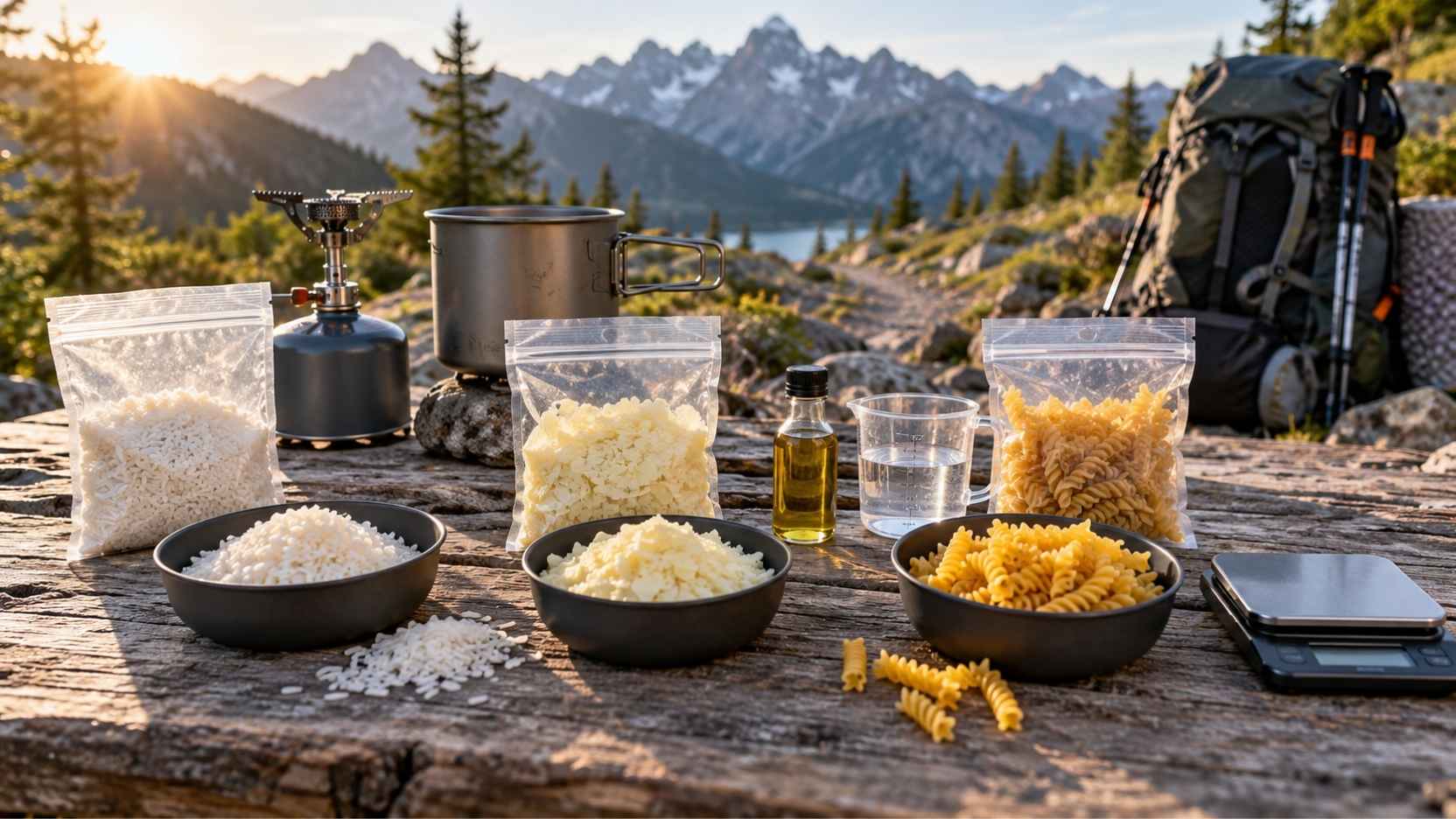
The trail version starts by replacing cooked rice with dry instant rice, which provides the rice component without requiring you to carry its cooking water. Instant rice also has a logistical advantage over uncooked conventional rice because it can rehydrate relatively quickly, reducing stove time and fuel requirements. 🔥 The calorie count remains dependent on the amount packed, so hikers should calculate from the nutrition label on the specific rice being used rather than relying on one universal number.
The ground meat can become commercially freeze-dried beef, safely prepared dehydrated lean ground meat, or another shelf-stable dried meat product, while the sweet potato can become dried pieces, flakes, or powder. Powdered broth and dry seasoning recreate much of the original meal’s flavor without carrying liquid broth through the day. The result is essentially Monster Mash with the water removed and added again at camp.
What happens to calories per ounce?
Here is where the experiment becomes interesting: dry rice commonly sits around the neighborhood of 100-plus calories per ounce, while properly dried meat can become significantly more calorie-dense than its cooked refrigerated form because much of its water has disappeared. Dried sweet potato also becomes much lighter than cooked sweet potato, although its calorie density remains lower than pure fats and many nut-based foods. 🧪 Your exact finished number will depend heavily on meat fat content, residual moisture, ingredient ratios, and the particular products purchased.
A reasonable working model for a rice-heavy Monster Mash assembled from dry ingredients can land around 120 to 125 calories per ounce before substantial added fat, but this should be treated as a planning estimate rather than a guaranteed recipe specification. The correct way to verify your own batch is simple: add the calories listed for every dry ingredient, weigh the entire dry meal, and divide total calories by total ounces. If 3,000 calories of dry ingredients weigh 25 ounces, for example, the result is 120 calories per ounce.
Can Monster Mash pass the 125 cal/oz test?
Camp Kitchen Lab’s 125 calories-per-ounce benchmark is useful because it gives backpackers a quick way to notice meals that are becoming unnecessarily heavy. 🎯 It is not a nutritional requirement and a meal does not suddenly become bad at 124 cal/oz, but consistently low-density food can add a surprising amount of weight across several days. A rebuilt Monster Mash hovering around 120–125 cal/oz therefore sits close enough to the target to be interesting rather than immediately disqualified.
The ingredient holding the meal back is not necessarily rice or meat—it is that the basic recipe contains relatively little highly concentrated fat compared with foods such as nuts, nut butter, olive oil, or fatty snack mixes. Fat provides roughly 9 calories per gram, compared with about 4 calories per gram for carbohydrate or protein, so a small amount can noticeably raise a meal’s overall calorie density. Adding fat therefore changes the arithmetic much faster than simply adding another ounce of rice or sweet potato.
What optional oil does to the math
Suppose your dry Monster Mash starts near 120 calories per ounce and you add a measured portion of olive oil shortly before eating. 🫒 Oil contributes roughly 240 calories per ounce, so it can pull the combined meal upward without requiring a large weight increase. The exact result still depends on your starting mixture, which is why the oil should be included in both the calorie total and the weight total rather than simply assuming the finished meal exceeds the benchmark.
There is also no requirement that every ingredient independently reach 125 calories per ounce. A lower-density sweet-potato component can remain in the recipe if denser ingredients bring the entire dinner’s weighted average into the range you want. Think of the benchmark like a backpack’s average load: one heavier item is manageable when everything else compensates for it, but several inefficient choices stacked together eventually become noticeable.
How heavy is a 600-calorie Monster Mash?
If a finished dry Monster Mash reaches 120 calories per ounce, a 600-calorie dinner requires approximately 5 ounces of dry food. At 125 calories per ounce, the same 600 calories require about 4.8 ounces, a difference small enough that taste, cost, portion size, and ingredient availability may matter more than chasing another fraction of an ounce. 🥣 After water is added at camp, the bowl becomes substantially heavier, but that water does not necessarily have to travel inside your food bag.
An 800-calorie dinner works out to roughly 6.7 ounces at 120 cal/oz or 6.4 ounces at 125 cal/oz. A 1,000-calorie dinner requires about 8.3 ounces at 120 cal/oz or exactly 8 ounces at 125 cal/oz. Those numbers make the concept easier to judge because hikers can compare Monster Mash directly with the weight allocated to other dinner options instead of relying on labels such as “high calorie.”
The meat choice matters more than it first appears
Ground beef or bison creates one complication when converting the original recipe because fat affects both calories and storage characteristics. Leaner meat is generally more suitable when meat is being dehydrated for storage, while freeze-dried commercial products can provide a simpler option for hikers who do not want to manage meat dehydration themselves. 🥩 Whatever method is used, safe handling and tested dehydration practices matter more than squeezing a few additional calories out of the ingredient.
That creates a useful backpacking tradeoff: lean dried meat may be convenient for shelf stability but contributes less fat, while separately packed oil can restore calorie density immediately before eating. This lets the hiker separate two jobs—the dried meat provides the meat component, while the oil supplies concentrated calories. It can be a more controllable system than trying to preserve a very fatty homemade meat mixture for an extended trip.
Why instant rice beats carrying cooked rice
Rice is actually one of the easiest parts of Monster Mash to convert because there is little reason to haul fully cooked rice when dry alternatives exist. 🍚 Traditional uncooked rice is lightweight, but it usually requires more sustained cooking, meaning the weight saved in food may partly reappear as additional stove fuel. Instant or precooked dried rice shifts that tradeoff by requiring much less cooking before it becomes edible.
That distinction illustrates another Camp Kitchen Lab principle: food weight cannot always be optimized separately from fuel, water, and preparation time. A meal that saves one ounce but requires considerably more fuel may not produce the system-level savings expected, especially on short trips. Backpacking efficiency therefore works best when the entire cooking system is considered rather than ranking ingredients solely by their dry calorie density.
Sweet potato survives the conversion better than expected
Fresh or cooked sweet potato is not especially attractive from a calorie-per-ounce perspective because much of its weight comes from water. 🍠 Dry it, however, and the situation changes because the carbohydrate remains while a large portion of that water disappears. Dried sweet potato therefore becomes easier to justify as a smaller component providing the familiar flavor and texture that makes Monster Mash different from plain beef and rice.
It still does not need to dominate the meal, and reducing its proportion is one easy way to raise overall calorie density if weight is a priority. A hiker could use rice as the main carbohydrate base, a smaller amount of dried sweet potato for variety, dried meat for the protein component, and measured oil for additional calories. That preserves the basic Monster Mash identity without pretending a home meal-prep recipe should be copied ounce-for-ounce into a backpack.
When backpacking Monster Mash actually makes sense
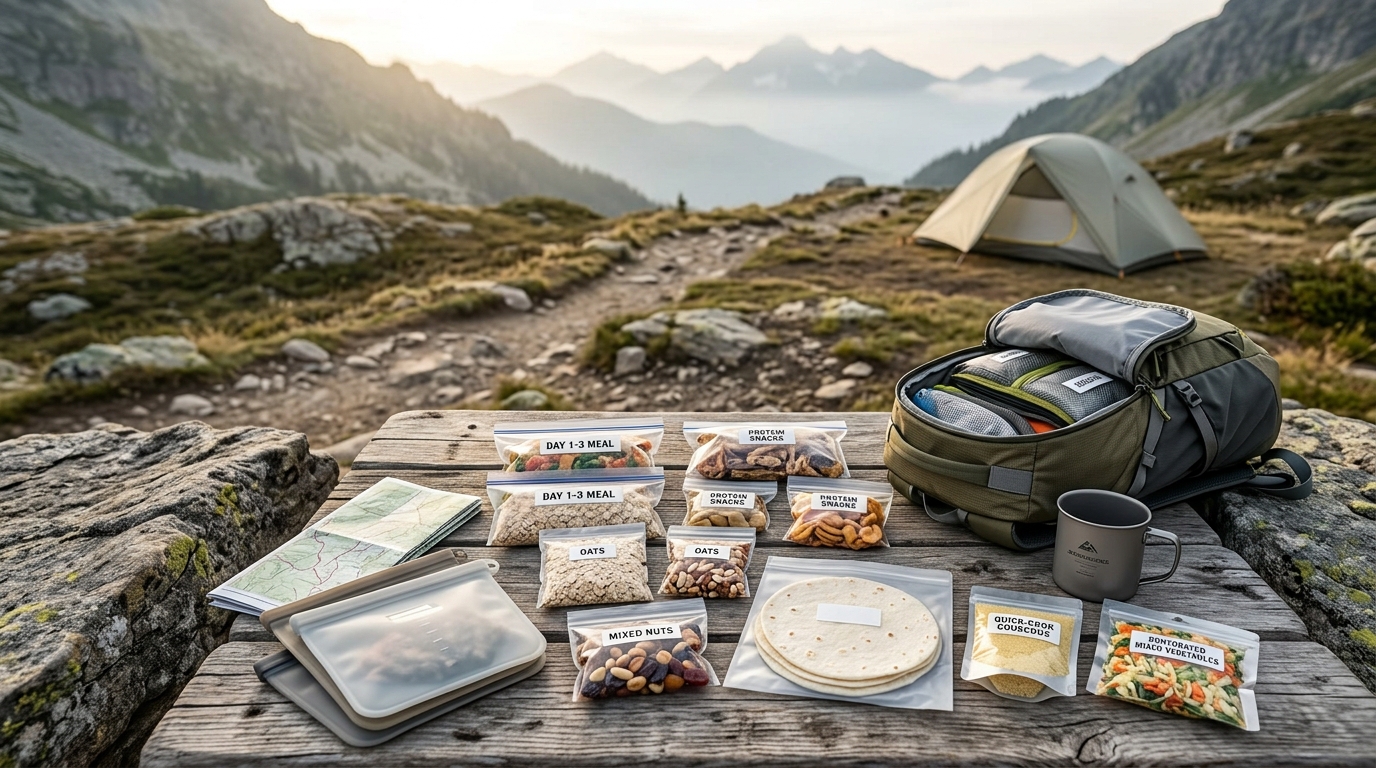
A dehydrated Monster Mash makes the most logistical sense for hikers who want a substantial savory dinner, have access to water near camp, and are willing to rehydrate a meal rather than eat exclusively ready-to-eat foods. 🏕️ It becomes particularly interesting when sweet bars, candy, dried fruit, and other snack foods dominate the daytime menu and dinner is expected to feel more like an ordinary meal. That is a food-variety benefit, not a claim that Monster Mash performs better than other backpacking dinners.
The recipe becomes less attractive when water is scarce and must already be carried, when no-cook simplicity is the priority, or when a hiker wants every food item pushed far above 125 calories per ounce. On longer trips, even small efficiency differences multiply across several breakfasts, lunches, dinners, and snacks, so calculating actual packaged weight becomes increasingly valuable. For an overnight trip, however, a few fractions of an ounce may matter far less than whether you actually want to eat your dinner.
The final calories-per-ounce verdict
Normal cooked Monster Mash is poorly suited to efficient backpacking because too much of its carried weight comes from water already absorbed by the rice, sweet potato, meat, and broth. Remove that water, switch to instant rice and dried ingredients, and the same basic idea can move into roughly the 120–125 cal/oz neighborhood, with optional added oil capable of moving the finished meal higher. 🎒 That puts trail Monster Mash close enough to Camp Kitchen Lab’s benchmark to deserve experimentation rather than dismissal.
The most important lesson is larger than this one recipe: a high-calorie home meal is not automatically a high-calorie-density backpacking meal. Backpackers have to ask how many calories remain for every ounce that actually leaves the trailhead, then consider cooking fuel, water availability, storage, appetite, and trip length alongside that number. Monster Mash can become backpacking food—but only after you stop packing it like meal prep and start designing it like trail food.