How to Build a 6-Day Backpacking Menu Without Carrying Too Much Food 🎒🥾
Introduction
Planning food for a six-day backpacking trip can feel like a balancing act. Pack too little, and you may struggle to keep up with demanding hiking days. Pack too much, and your food bag becomes unnecessarily heavy and bulky.
The solution is not simply to eat less. It is to choose foods that deliver enough energy for their weight, build meals around ingredients you will actually enjoy, and organize portions before leaving home.
A well-planned menu can provide variety, reduce food waste, and make camp cooking easier. Here is how to create a practical six-day food plan, estimate your total food weight, and reduce packaging without compromising food safety.
1. Start With Your Daily Energy Needs
Your calorie needs depend on body size, hiking pace, distance, elevation gain, weather, and how much weight you carry. A shorter, gentle trail may require considerably less energy than a steep, demanding route.
For planning purposes, some backpackers use approximately 2,500–3,500 calories per day as an initial estimate for a strenuous trip, but this is not a universal target. Your needs may fall outside that range.
Instead of relying on one number:
- Consider your usual appetite and activity level.
- Account for elevation gain, mileage, temperature, and pack weight.
- Include breakfast, lunch, dinner, and snacks rather than depending on three meals alone.
- Bring a modest reserve of food for delays or unexpectedly demanding days.
Do not assume that minimizing food weight is always the best strategy. Consistently eating too little can contribute to fatigue, poor recovery, and reduced performance.
2. Choose Foods With More Energy Per Gram
Food energy density helps you compare how much energy different foods provide relative to their weight.
| Food | Approximate energy per 100 g | Why it works |
|---|---|---|
| Peanut butter | 580–600 kcal | Compact and calorie-dense |
| Mixed nuts | 550–650 kcal | Convenient snacks with fats and some protein |
| Olive oil | About 880 kcal | Adds substantial energy in a small quantity |
| Oats | 370–400 kcal | Useful breakfast base |
| Trail mix | 400–550 kcal | Combines nuts, seeds, and dried fruit |
| Tortillas | 280–330 kcal | Convenient, ready-to-eat lunches |
| Couscous, dry | 350–380 kcal | Lightweight and quick to prepare |
| Dried fruit | 250–350 kcal | Easy-to-carry carbohydrate source |
These figures are approximate and vary by product. Use package labels for your actual calorie and weight calculations.
The practical rule: prioritize foods that are compact, nutritious, shelf-stable, and easy to prepare. You do not need to choose only the highest-calorie foods; variety and nutritional balance still matter.
3. Build a Repeatable Meal System
A six-day menu becomes easier to manage when you use a few reliable meal templates.
Breakfast: oats, powdered milk, dried fruit, and seeds.
Lunch: tortillas, peanut butter, cheese or a suitable shelf-stable protein, and trail mix.
Dinner: quick-cooking grains or noodles with dehydrated vegetables, protein, and a little oil.
Snacks: nuts, dried fruit, energy bars, crackers, or jerky.
Repeat ingredients where practical, but change flavors and textures to avoid eating exactly the same thing every day.
4. A Complete Six-Day Backpacking Menu
The following is a sample menu for one adult. Portions are illustrative, and the daily calorie totals are estimates rather than measured nutrition values. Adjust them to your needs and verify amounts using the labels on the foods you purchase.
| Day | Breakfast | Lunch | Dinner | Snacks |
|---|---|---|---|---|
| Day 1 | Oats, powdered milk, chia seeds, dried cranberries | Tortillas with peanut butter and honey | Couscous, dehydrated vegetables, olive oil, chicken pouch | Trail mix, energy bar |
| Day 2 | Oats, powdered milk, raisins, peanut butter | Tortillas with hard cheese and suitable shelf-stable protein | Instant mashed potatoes, jerky, dried vegetables, olive oil | Nuts, dried mango, crackers |
| Day 3 | Oats, powdered milk, banana chips, chia seeds | Peanut butter tortillas with dried fruit | Couscous, lentils, dehydrated vegetables, olive oil | Trail mix, chocolate |
| Day 4 | Oats, powdered milk, raisins, nuts | Tortillas with shelf-stable tuna pouch and seasonings | Instant rice, dehydrated vegetables, chicken pouch, olive oil | Energy bar, nuts, dried fruit |
| Day 5 | Oats, powdered milk, chia seeds, dried fruit | Peanut butter tortillas with crackers | Quick-cooking noodles, dehydrated vegetables, jerky, olive oil | Trail mix, chocolate |
| Day 6 | Oats, powdered milk, raisins, peanut butter | Remaining tortillas, nuts, and suitable shelf-stable protein | Couscous or instant rice with remaining vegetables and protein | Energy bar and remaining snacks |
Use only enough ingredients to match your planned portions. The table gives meal combinations, not permission to pack unlimited amounts of each listed food.
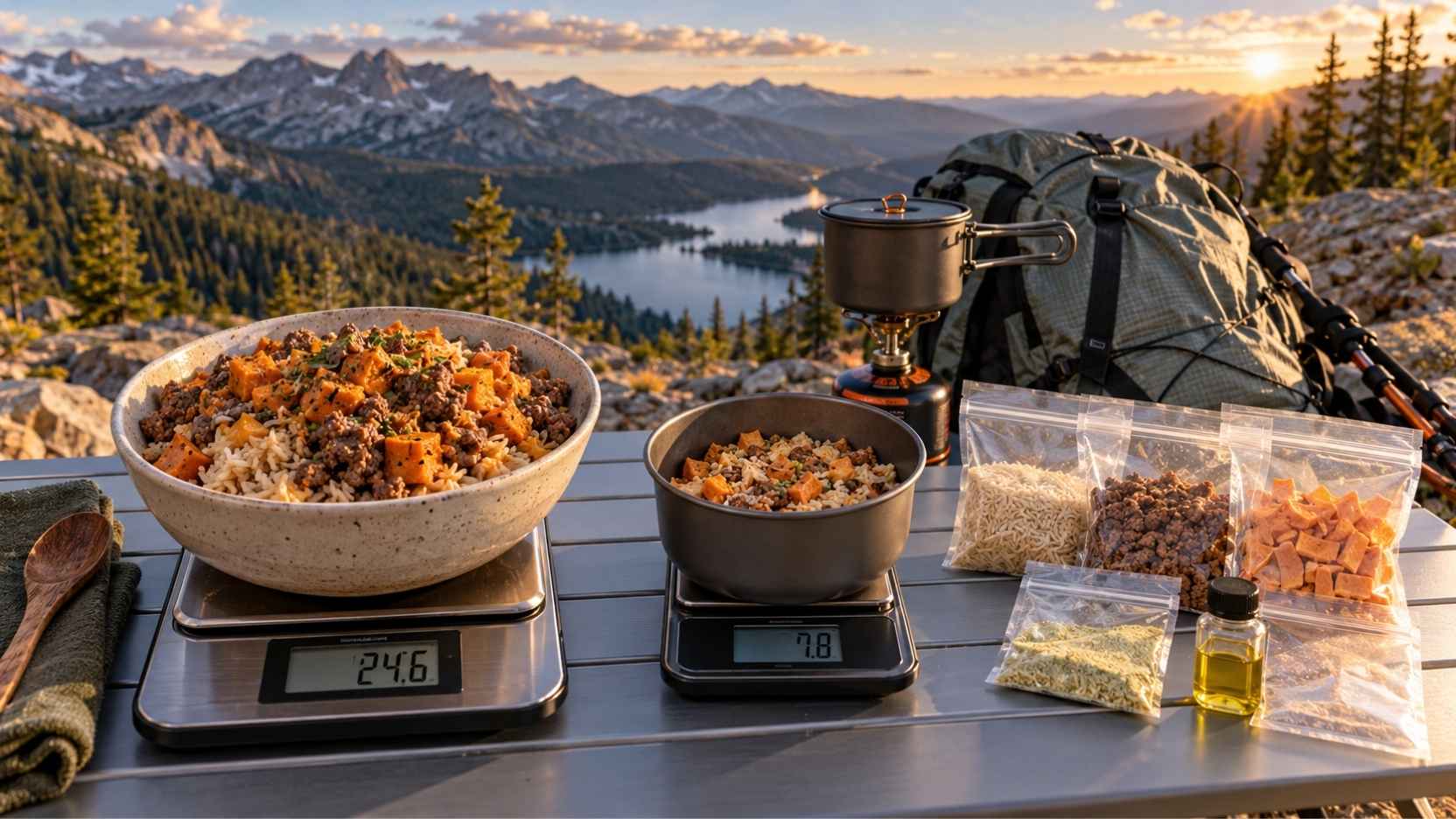
Portioning example for one hiking day
A sample day’s food might contain:
- Breakfast oats and toppings: 135 g
- Lunch tortillas and fillings: 170 g
- Dinner grain, vegetables, protein, and oil: 200 g
- Snacks: 180 g
Estimated total: 685 g of food for the day.
This is a planning example, not a guaranteed calorie target. Depending on the ingredients and portions, 685 g may provide substantially different amounts of energy. Check labels and calculate your own total before relying on the menu for a demanding trip.
5. Calculate the Total Food Weight
For six days, a daily food allowance of 650–750 g gives the following estimate:
| Planning measure | Amount |
|---|---|
| Food per day | 650–750 g |
| Trip duration | 6 days |
| Total food weight | 3.9–4.5 kg |
| Example at 685 g/day | 4.11 kg |
These totals refer to the food itself, not the container, stove, fuel, water, or storage system.
If your menu averages around 2,800 calories daily, six days would require approximately 16,800 calories. Whether that amount is adequate depends on your actual energy needs. If the planned food weight cannot provide enough energy for your trip, revise the menu rather than forcing the weight lower.
Also account for the food you will consume during the trip. Your pack should become lighter as you eat, but you still need enough food for each day and a sensible reserve.
6. Reduce Packaging Without Sacrificing Safety ♻️
Packaging can add unnecessary bulk, but reducing it should not create food-safety problems.
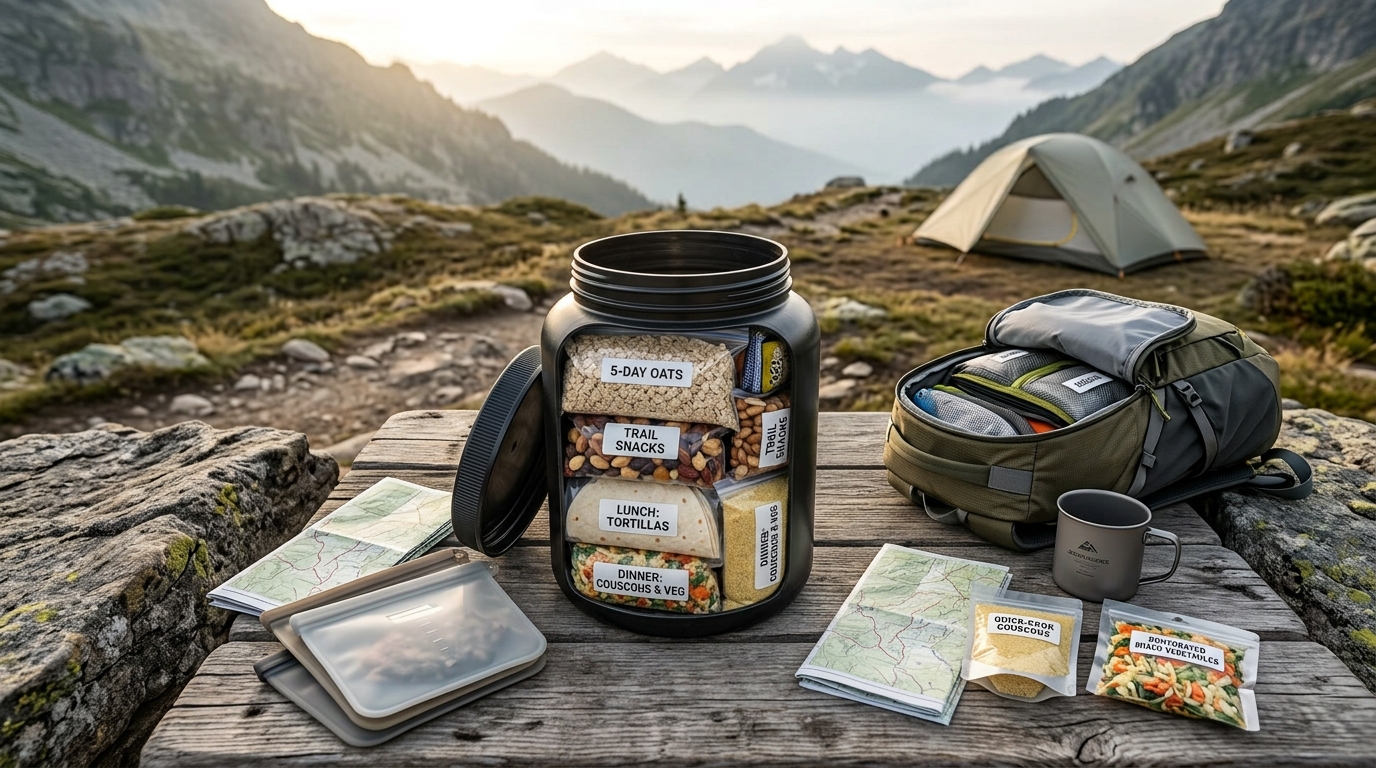
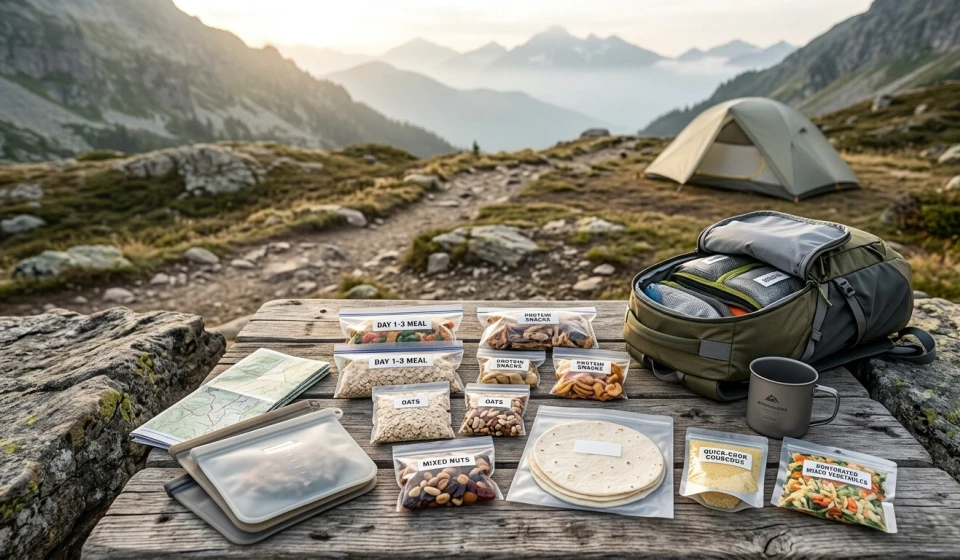
Repackage dry foods at home. Oats, dried fruit, nuts, powdered milk, and dehydrated vegetables can often be portioned into lightweight, food-safe bags or containers.
Label every portion. Write the food name, ingredients or allergens where relevant, quantity, and any cooking instructions. Mark the day if you organize food into daily bags.
Remove unnecessary outer boxes. Keep essential preparation instructions and any information you need, but discard bulky secondary packaging when appropriate.
Choose resealable containers carefully. Lightweight bags can work for dry ingredients, but liquids, oily foods, and sharp-edged items may need sturdier leak-resistant containers.
Do not compromise temperature control. Repackaging does not make perishable food shelf-stable. Follow product storage instructions, keep foods requiring refrigeration at safe temperatures, and use shelf-stable alternatives when you cannot maintain a cold chain. Discard food if its safety is uncertain.
Plan for waste. Carry out wrappers, used bags, and food scraps. Do not leave food scraps at campsites or assume they will biodegrade quickly.
Finally, follow local food-storage requirements. Where bears or other wildlife are a concern, use the required bear-resistant canister, locker, or approved storage method. A lightweight food bag is not automatically a safe wildlife-storage system.
7. Five Ways to Make Your Menu More Efficient
- Use overlapping ingredients. Oats, tortillas, couscous, nuts, and dried fruit can serve several meals without requiring a separate product for every recipe.
- Choose quick-cooking foods. Couscous and instant grains can reduce cooking time and fuel use.
- Measure oil and spreads. They add energy efficiently, but unmeasured quantities can leak and make food bags messy.
- Pack snacks where you can reach them. Easy access helps you eat throughout the day without unpacking your entire food bag.
- Test your meals before departure. Eat a sample breakfast or dinner at home to check portion size, taste, preparation time, and how satisfying it feels.
A little testing at home is more reliable than discovering on day three that you dislike your dinner or need more food than expected.
Final Thoughts 🌄
A successful six-day backpacking menu balances energy, food variety, convenience, and weight. Start by estimating your daily needs, select compact foods you enjoy, and calculate the weight of every portion before packing.
Use overlapping ingredients, prepare meals in advance, and remove unnecessary packaging while keeping food properly labeled and safely stored. Most importantly, do not sacrifice adequate nutrition just to reach an arbitrary food-weight target.
The best backpacking menu is light enough to carry, substantial enough to fuel your hike, and simple enough to enjoy after a long day on the trail.