Carrots vs Spinach vs Eggs: Which Vitamin A Foods Actually Make Sense in a Backpacking Food Bag?
Why Carrots Became the Famous “Vitamin A Food”
Carrots became synonymous with vitamin A because they are rich in beta-carotene, an orange plant pigment the body can convert into vitamin A, but that does not make carrots uniquely important or automatically superior to every other source. 🥕 Spinach, sweet potatoes, winter squash, eggs, dairy foods, some fish, fortified foods, and liver can also contribute vitamin A activity through either provitamin-A carotenoids or preformed vitamin A. For backpackers, the better question is not which food has the strongest health reputation, but which form delivers useful nutrition without unnecessary water weight, spoilage risk, or cooking trouble.
Vitamin A supports normal vision and other normal body functions, but this is not evidence that a particular trail food improves eyesight, reverses myopia, or prevents eye disease. Plant foods such as carrots and spinach mainly provide provitamin-A carotenoids, while animal foods such as eggs, dairy, fish, and organ meats can provide preformed vitamin A. 🥾 On the trail, that nutritional difference has to be considered alongside calories per ounce, serving weight, shelf stability, preparation, and whether the food will still be practical several days into a trip.
Vitamin A vs Provitamin-A Carotenoids in Simple Language
Nutrition science groups different vitamin A sources using retinol activity equivalents, or RAE, because the body does not use every source in exactly the same way. Preformed vitamin A comes mainly from animal-derived foods, while beta-carotene and several related provitamin-A carotenoids come from plant foods and must be converted by the body. 🧠 This is why a simple gram-for-gram argument about carrots versus eggs misses part of the picture: they provide different forms, and the usefulness of each food also depends on the rest of the meal.
For backpacking purposes, there is little reason to chase one “perfect” vitamin A food when a mixed menu can include several sources over breakfast, snacks, and dinners. Carotenoids are fat-soluble, so meals containing some dietary fat—perhaps from nut butter, olive oil, seeds, cheese, or egg—also make practical sense rather than eating dried vegetables completely by themselves. 🥜 The goal should be food variety and pack efficiency, not trying to engineer a medical result from a single ingredient.
Fresh Carrots and Spinach: Nutritious but Heavy for Their Calories
Raw carrots travel better than many fresh vegetables, need no cooking, offer crunch and fiber, and can be enjoyable on an overnight or short trip. The limitation is water: generic USDA composition data put raw carrots at about 88% water and roughly 41 calories per 100 grams, which is only about 12 calories per ounce. 🎒 A carrot can still earn its place as a first-day food, but carrying several days of them means carrying a large amount of water that contributes very little to the trip’s calorie target.
Spinach pushes the same problem further because raw leaves are about 91% water and provide only around 23 calories per 100 grams, or roughly 7 calories per ounce. 🥬 A handful in a first-night wrap may be pleasant, yet the leaves are bulky, fragile, and increasingly inconvenient as trip duration and warm temperatures increase. Neither vegetable is “bad” backpacking food; they simply perform poorly if the main packing metric is calories delivered for every ounce carried.
Dehydrated Carrots, Greens, and Sweet Potatoes Change the Math
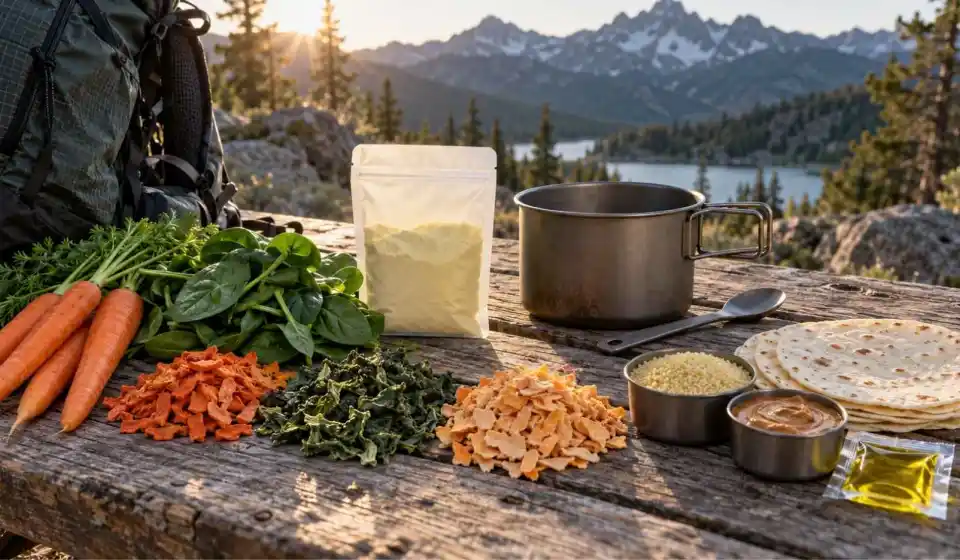
Drying vegetables removes the biggest backpacking disadvantage—the water—so dehydrated carrots, spinach, kale, sweet-potato pieces, and vegetable powders can fit into a lightweight food bag much more logically. 🔥 Small portions can be mixed with couscous, instant rice, ramen, potatoes, beans, or soup and rehydrated with the same water used to prepare the meal. Exact calories per ounce vary by product and drying method, so the nutrition label, serving size, ingredients, and rehydration instructions are more useful than pretending every dried vegetable has one universal value.
Sweet potato is especially useful as a comparison because it supplies orange carotenoids while also contributing more carbohydrate than leafy greens, though fresh sweet potatoes are still heavy and require cooking. Dehydrated flakes or pieces can turn that ingredient into a more packable meal component, while dried spinach works better as a lightweight addition than as a major calorie source. 🍲 A practical trail formula is calorie-dense base + protein or fat source + small dried-vegetable portion, which preserves energy efficiency without reducing every dinner to plain starch and oil.
Eggs: Fresh Shells vs Powdered Egg Products
A fresh whole egg is more calorie-dense than raw carrots or spinach, but ordinary U.S. store-bought shell eggs create a food-safety and handling problem on the trail. USDA guidance says refrigerated eggs should remain refrigerated and should not be left out for more than two hours, so they are a poor default backpacking choice unless reliable cold storage is maintained. 🥚 They are also fragile, bulky for the energy provided, and inconvenient once breakage, shells, cleanup, and cooking are included.
Dried whole egg changes the comparison because removing water concentrates both weight and calories; generic USDA data list dried whole egg at about 592 calories per 100 grams, or roughly 168 calories per ounce. 🍳 Pasteurized dried egg products can be shelf-stable while unopened and stored cool and dry, although hikers should follow the manufacturer’s directions after opening and after reconstitution. That makes powdered egg useful not merely as a “vitamin A food,” but as a compact breakfast ingredient providing protein, fat, calories, and preformed vitamin A in one trail-friendly format.
Calories Per Ounce and the Ultralight Trade-Off
Approximate generic values show the packing difference clearly: raw carrot is about 12 calories per ounce, raw spinach about 7, fresh whole egg about 41, and dried whole egg roughly 168, while dehydrated vegetable products vary enough that their own labels should be checked. ⚖️ Calories per ounce do not measure overall nutritional quality, but they explain why fresh produce rarely becomes the energy backbone of a backpacking menu. A separate Calories Per Ounce: 125+ Foods chart is useful here because it lets hikers compare these foods with nuts, oils, tortillas, oats, couscous, dried fruit, and other common trail staples.
| Food | Approx. calories per ounce | Main trail consideration |
|---|---|---|
| Raw carrot | 12 | High water weight |
| Raw spinach | 7 | Water, bulk, wilting |
| Fresh whole egg | 41 | Refrigeration and breakage |
| Dried whole egg | 168 | Follow product storage directions |
| Dehydrated vegetables | Varies | Check individual nutrition label |
Ultralight hikers can also make a mistake by optimizing only for energy density, because a bag built entirely around oils, candy, nut butter, bars, and dry starch may become repetitive and leave little room for vegetables, fiber-rich foods, or texture variety. 🏕️ A better compromise is to protect the calorie base first, then spend a modest “variety budget” on dried carrots, greens, mushrooms, peas, tomato powder, or sweet-potato flakes. This is also where Foods That Look Light But Aren’t, vegetable-dehydration guides, and a reusable Menu Template become practical internal links instead of treating one micronutrient as the whole planning problem.
What Makes Sense for 2-, 4-, and 7-Day Trips
For a two-day trip, one fresh carrot for the first day can be completely reasonable if you enjoy it, while a small packet of dried greens can improve dinner and powdered egg can give breakfast a different texture from oatmeal. 🥾 On a four-day trip, dried carrots, spinach, or sweet-potato flakes usually make more sense than carrying multiple fresh vegetables because the water-weight penalty compounds as food quantity rises. For seven days, portioning several dried vegetable types into individual meals can create more variety without forcing one bulky ingredient to do all the nutritional work.
The bottom line is that carrots do not “win” simply because they are famous for beta-carotene, spinach does not lose because it is low in calories, and eggs are not automatically practical just because they contain preformed vitamin A. 🌄 Choose foods according to their trail role: dense staples for energy, appropriate protein and fat sources, and modest amounts of dehydrated vegetables for variety and micronutrient density. If you have a diagnosed deficiency, medical condition, or individualized nutrition concern, consult a qualified healthcare professional rather than using a backpacking food plan as treatment.