Forest Trail vs. Paved Path: Can the Same Hiking Distance Burn Different Calories?
Introduction: Why Five Miles Isn’t Always the Same Five Miles
🌲 Imagine walking five miles along a smooth paved path, then covering the same distance through a forest filled with roots, loose stones, muddy sections, and steep hills. Both journeys register five miles on your GPS, yet the physical effort required can be noticeably different because your body must respond to more than distance alone. Understanding calories burned hiking on uneven terrain helps explain why two routes with identical mileage can produce different energy-expenditure estimates.
A paved walkway provides predictable footing that generally allows consistent strides, while rugged trails may require frequent adjustments in balance, speed, and body position. These adjustments can increase physical effort, especially when unstable ground combines with climbing, descending, or carrying a backpack. 🥾 However, a forest trail does not automatically burn more calories than a road, because terrain conditions, walking intensity, elevation, and total moving time must all be considered.
What Changes the Energy Cost of Walking?
🔥 Walking requires energy to move your body forward, support your weight, maintain balance, and overcome gravity when climbing. The main variables influencing hiking terrain energy expenditure include walking speed, gradient, surface stability, body mass, carried weight, and exercise duration. Two hikers traveling the same distance may therefore expend different amounts of energy even when following exactly the same route.
Walking speed deserves particular attention because moving faster usually increases energy expenditure per minute, although the relationship with calories per mile is more complicated. A steep trail can produce greater effort despite slower movement, while a heavy backpack adds work that ordinary walking estimates may not capture adequately. Consequently, reliable comparisons require looking at the entire activity rather than assuming that distance alone determines calorie burn.
Smooth Trails, Loose Gravel, Rocks, and Mud
🪨 Surface conditions influence walking mechanics because stable pavement supports relatively predictable foot placement, while loose or irregular ground can require additional muscular adjustments. A 2021 study examining ten healthy adults across outdoor surfaces found that walking energy expenditure varied significantly between sidewalks, dirt, gravel, grass, and woodchips. Under the study’s controlled conditions, walking on woodchips required approximately 27% more energy than walking on sidewalks, although that finding should not be applied as a universal percentage to every forest trail.
Mud introduces another challenge because slippery surfaces may demand shorter steps, slower movement, and greater attention to traction. Rocky ground can similarly interrupt normal walking rhythm, while compact dirt paths may feel almost as stable as pavement when they are relatively smooth and level. 🌳 This distinction matters because a forest setting describes the surroundings, not the actual difficulty of the walking surface.
Does Elevation Gain Matter More Than Trail Surface?
⛰️ Elevation gain can substantially change energy expenditure because uphill movement requires your body to perform additional work against gravity. Walking up a sustained incline generally demands more effort than walking at the same speed on level ground, even when the uphill surface is smooth. The difference becomes particularly noticeable on long climbs, although the exact calorie increase depends on gradient, pace, body weight, and other conditions.
Surface instability and elevation should nevertheless be treated as separate variables rather than competing explanations with one permanent winner. A moderately steep paved hill may require more energy than a flat forest path, while a highly unstable route can make even level walking demanding. Descending also requires muscular control and careful footing, but downhill travel does not necessarily use as much energy as climbing the equivalent slope.
How Hiking Calorie Calculators Account for Terrain
📊 Many activity calculators estimate energy expenditure using metabolic equivalents, commonly called METs, which represent activity intensity relative to a standardized resting metabolic rate. The 2024 Adult Compendium of Physical Activities assigns approximately 3.8 METs to moderate walking on a level, firm surface, 5.3 METs to normal-paced walking through fields and hillsides, and 7.0 METs to moderate-to-brisk hill climbing on a 6–10% gradient without a load. These classifications provide useful reference values but cannot describe every variation in trail conditions.
A commonly used estimation formula multiplies the MET value by 3.5, then by body weight in kilograms, divides by 200, and multiplies by activity duration in minutes. This produces an approximate gross calorie expenditure, meaning it includes the energy your body would have consumed at rest during the same period. Actual results vary because standardized MET values do not fully represent individual fitness, walking efficiency, temperature, terrain changes, or personal metabolic differences.
Illustrative Comparison: Three Different Five-Mile Routes
🥾 Consider a hypothetical hiker weighing 70 kilograms, approximately 154 pounds, completing three different five-mile routes without a backpack. Each example uses a different assumed pace and activity classification from the 2024 Adult Compendium, with the calorie calculations applying only to uninterrupted moving time. The resulting numbers illustrate how identical mileage can represent different workloads, rather than predicting what every hiker will burn.
| Route | Assumed Speed | MET Value | Moving Time | Estimated Calories |
|---|---|---|---|---|
| Smooth, level paved path | 3.0 mph | 3.8 | 100 minutes | 466 |
| Natural trail through fields and hillsides | 2.5 mph | 5.3 | 120 minutes | 779 |
| Sustained uphill route, 6–10% grade | 2.5 mph | 7.0 | 120 minutes | 1,029 |
<text color=”secondary” size=”xs”>Illustrative gross calorie estimates for a 70 kg adult, assuming a constant activity intensity, no load, no rest breaks, and the stated terrain conditions throughout.</text>
The uphill example has a particularly demanding assumption because maintaining a 6–10% climb across five miles creates substantial elevation gain. Similarly, the natural-trail category includes field and hillside walking, so its higher estimate cannot be attributed exclusively to rocks, roots, or softer ground. 📏 These examples demonstrate how pace, duration, and activity category affect calorie calculations, not an experimentally measured difference between three specific hiking routes.
Why Fitness Trackers May Report Different Results
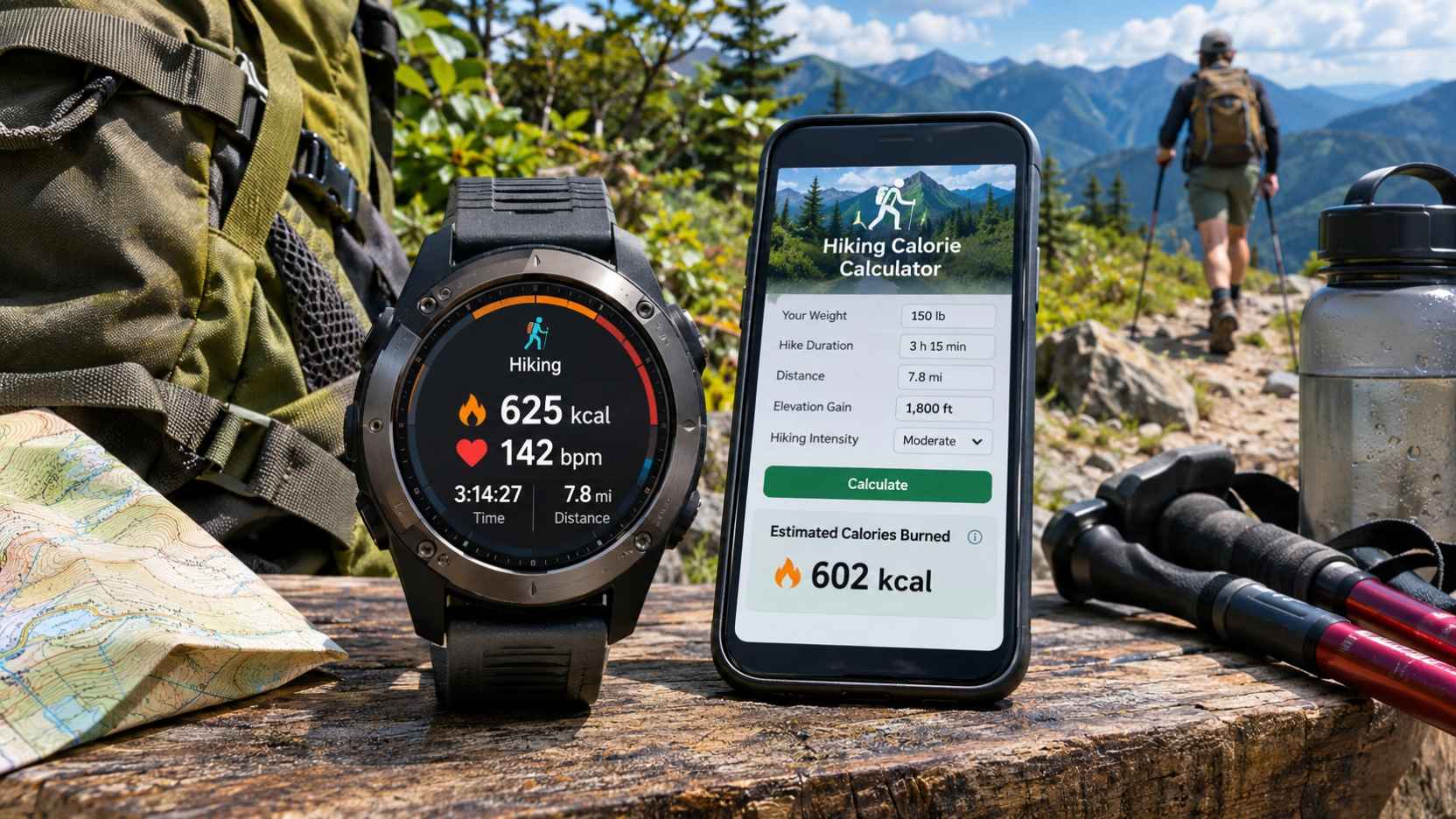
⌚ Smartwatches and hiking applications commonly estimate calories using combinations of movement data, heart rate, personal information, and sometimes elevation measurements. However, different manufacturers use different algorithms, and a device may not fully recognize whether difficult footing, steep terrain, or frequent interruptions are influencing the activity. Consequently, two devices can report different calorie totals for the same hiker even when their recorded distances are nearly identical.
GPS distance also does not reveal every challenge involved in traveling over uneven ground, while elevation measurements may contain errors caused by sensor limitations or environmental conditions. Heart rate provides potentially useful information about physiological effort, but stress, heat, hydration status, and other influences can affect heart rate independently of calorie expenditure. Rather than treating one number as exact, hikers should view calories burned hiking as an estimate that becomes more useful when considered alongside route difficulty and moving time.
What Different Calorie Burns Mean for Trail Nutrition
🥪 A physically demanding hiking route may increase the amount of energy a person expends, but that does not mean every estimated calorie must immediately be replaced with food. Short outings, long backpacking days, and repeated strenuous climbs involve different fueling considerations based on duration, intensity, available meals, and individual needs. For longer activities, accessible carbohydrate-rich foods can help hikers maintain an appropriate eating routine rather than relying entirely on appetite after becoming exhausted.
The distinction between gross and additional activity calories is especially important when planning food because standard MET estimates include resting energy expenditure. Eating precisely the number of calories shown on a watch may therefore be misleading, particularly when the device’s calculation method is unclear. 🎒 A practical hiking nutrition strategy should prioritize sufficient overall food, appropriate carbohydrates, hydration, and manageable meal timing instead of treating estimated calorie burn as an exact prescription.
How to Compare Your Own Hiking Routes More Accurately
🧭 Begin by recording distance, moving time, elevation gain, approximate backpack weight, and the actual walking conditions encountered during each outing. Comparing these details across similar hikes creates a more meaningful picture than comparing mileage alone, especially when one route involves uninterrupted pavement and another requires frequent technical footing. If you use a fitness tracker, maintain consistent personal settings and recording methods so that trends become easier to interpret.
You can also distinguish gentle woodland paths from demanding mountain trails by examining route profiles and terrain descriptions before choosing an activity category for calorie calculations. A five-mile forest walk with minimal climbing should not automatically receive the same intensity assumption as a five-mile mountain ascent. When uncertainty remains, using a reasonable estimate and acknowledging its limitations is more defensible than presenting an exact calorie figure.
Conclusion: Distance Matters, but Terrain Changes the Workload
🌲 The same hiking distance can produce different calorie expenditure because surface stability, elevation, speed, body weight, and duration all influence the physical work involved. Smooth paved paths are generally more predictable, while rugged or uphill routes can require additional effort that mileage alone fails to capture. However, forest trail vs. paved path calories should never be compared using scenery as the only measure of difficulty.
A better approach is to evaluate each hike according to its actual terrain, gradient, pace, and moving time while treating calculator results as approximations. 🥾 This perspective helps hikers understand differences between trail experiences, prepare more realistic food plans, and interpret fitness-tracker numbers without overconfidence. Ultimately, five miles will always measure the same distance, but it will not always represent the same physical workload.