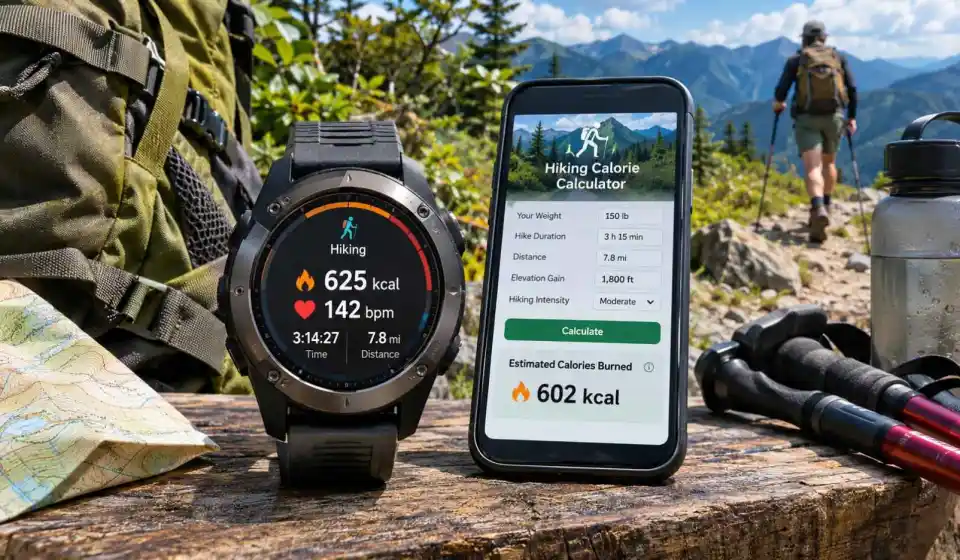
Garmin vs. Online Hiking Calorie Calculators: Which Numbers Can You Actually Trust?
Introduction: Why Hikers Disagree About Calorie Trackers
🥾 You finish a challenging mountain hike, check your Garmin watch, and discover that it reports substantially fewer calories than an online hiking calculator. Both numbers appear convincing, yet the difference raises an important question about Garmin hiking calories accuracy and whether either estimate reflects your actual energy expenditure. This disagreement is familiar in hiking communities, where some outdoor enthusiasts trust their sports watches while others prefer calculators based on distance, body weight, elevation, and hiking time.
The confusion begins because calorie trackers estimate energy expenditure rather than directly measuring how much energy your body uses. A smartwatch collects physiological and movement information, while an online calculator generally applies mathematical assumptions to the details you provide. 🔍 Understanding those differences helps hikers interpret estimates realistically instead of treating every displayed calorie as an exact measurement.
How Online Hiking Calorie Calculators Estimate Energy
Most online hiking calorie calculators begin with basic information, including body weight, hiking duration, and sometimes distance, speed, elevation gain, or backpack weight. These inputs feed mathematical models that estimate energy expenditure using average activity demands rather than measuring an individual’s metabolism. 📊 Consequently, two calculators can produce different answers even when they receive identical hiking information.
Many calculators use metabolic equivalents, commonly called METs, which describe the approximate energy cost of activities relative to resting metabolism. The 2024 Adult Compendium of Physical Activities assigns different MET values to slow hiking, ordinary hiking, backpacking, and hill climbing, reflecting how activity demands vary. However, choosing one general hiking category cannot fully represent constantly changing slopes, uneven surfaces, rest breaks, wind conditions, or individual walking efficiency.
How Garmin Hiking Smartwatches Estimate Calories
⌚ Garmin watches typically have access to more individual information than basic online calculators, including recorded movement, elapsed time, heart rate, and personal profile details. Depending on the model and available sensors, Garmin’s calorie calculations may incorporate heart-rate data through Firstbeat Analytics or rely on speed, distance, and user information. That richer dataset can help personalize an estimate, but it does not make the resulting number a direct measurement of calorie expenditure.
Wrist-based heart-rate measurements are themselves estimates from optical sensors, and accuracy can change with fit, movement, skin contact, and environmental conditions. GPS and elevation information also have limitations, especially around steep terrain, dense tree cover, or areas with weak satellite reception. 🏔️ A watch may therefore describe parts of the hike more individually while still producing an imperfect calculation of energy use.
Active Calories vs. Total Calories: The Important Garmin Difference
One major source of confusion is the difference between active, resting, activity, and total calories in Garmin’s terminology. Garmin describes active calories as energy associated with movement, while resting calories represent estimated energy used to maintain basic bodily functions and account for low-level daily activity. Its recorded activity calories include both active and resting expenditure during the activity, whereas daily total calories combine active and resting expenditure across the day.
For example, consider a hypothetical 70-kilogram hiker walking for two hours at an assumed 5.3 METs, a reference value for normal-paced hiking without a load. Using the simplified formula of METs multiplied by body weight and hours gives approximately 742 total calories, while subtracting the resting-equivalent portion produces about 602 additional active calories. 🔢 These are illustrative model calculations, not Garmin predictions, but they demonstrate why comparing an active-calorie figure against a total-calorie calculator can create an apparent disagreement of 140 calories.
Why Two Calorie Trackers Can Disagree On The Same Hike
Two hikers covering the same trail might have different energy requirements because of body size, movement efficiency, fitness, carried weight, and individual physiological responses. Even one person’s Garmin and online calculator may disagree because they use different activity categories, resting-energy assumptions, heart-rate information, and time measurements. ⚖️ Neither result should automatically be labeled incorrect simply because it differs from the other.
A calculator might assume three hours of continuous hiking, while a watch records two hours of movement alongside an additional hour of breaks and sightseeing. Another discrepancy can occur when a calculator accounts for a heavy backpack but the watch does not directly know the load being carried. These differences explain why verifying the inputs and comparing equivalent calorie categories matters more than selecting whichever number appears most impressive.
Garmin vs. Online Calculators: What Is Actually Measured?
📋 The most useful comparison separates information collected or entered directly from values inferred using mathematical models. A Garmin device may record timing and sensor signals, while an online calculator depends primarily on information supplied by its user. Both ultimately estimate energy expenditure rather than measuring calories burned through direct metabolic testing.
| Information | Garmin Hiking Watch | Online Hiking Calculator |
|---|---|---|
| Hiking duration | Recorded through activity timer | Usually manually entered |
| Heart rate | Estimated using sensors, if available | Usually not included |
| Distance | Estimated from GPS or movement sensors | Manually entered or route-derived |
| Elevation | Estimated by supported sensors | Entered or assumed |
| Backpack weight | Generally not directly measured | Included only in some calculators |
| Terrain difficulty | Partly represented by activity data | Based on selected assumptions |
| Calories burned | Algorithm-based estimate | Formula-based estimate |
The important distinction is that recording a heart-rate signal or GPS position does not equal directly measuring metabolic energy expenditure. Laboratory methods such as indirect calorimetry estimate energy use through respiratory gas measurements, which ordinary hiking watches do not perform. 🧪 Therefore, a detailed-looking dashboard may contain accurate-looking measurements and much less certain calculations presented together.
What Research Says About Wearable Calorie Accuracy
Scientific research supports caution when interpreting calorie estimates from Garmin, Fitbit, Apple Watch, and similar wearable devices. A 2020 systematic review examining 158 publications found substantial limitations in energy-expenditure accuracy across commercial wearable brands, even when some devices performed better at measuring steps or heart rate. 📚 The research suggests that tracking physical activity successfully is not equivalent to determining exactly how many calories someone burned.
A broader 2024 umbrella review also identified considerable variation in wearable measurement accuracy across studies, devices, activities, and testing methods. These findings should not be converted into a single universal error percentage for Garmin hiking, because individual models, conditions, and exercise types differ substantially. The practical conclusion is that a wearable calorie reading is useful contextual information, but not a laboratory-verified total.
Five Questions To Ask Before Trusting A Hiking Calorie Number
Before accepting a displayed result, hikers should examine whether the estimate represents the same activity period and calorie category they intend to compare. Checking profile information and recording quality can also reveal avoidable sources of error that make otherwise reasonable estimates misleading. ✅ These five questions provide a practical method for interpreting results without requiring advanced exercise-science knowledge.
| Question | Why It Matters |
|---|---|
| 1. Am I comparing active calories or total calories? | Resting expenditure can explain part of the difference. |
| 2. Is my body weight and personal profile current? | Incorrect personal information can affect calculations. |
| 3. Was my heart-rate information recorded properly? | Missing or unusual readings can influence watch estimates. |
| 4. Does the calculation use moving time or elapsed time? | Breaks and pauses can change the comparison. |
| 5. Were elevation, terrain, and backpack weight considered? | Physical conditions influence effort but may be omitted. |
If two estimates remain different after these checks, there may be no simple way to determine which one is closer to your actual expenditure. Comparing repeated hikes with similar routes, conditions, and recording settings can still help identify patterns and unusually inconsistent readings. 🔍 Consistency makes a tracking tool more useful for personal observation, although consistent readings do not guarantee accurate calorie totals.
8. Can A Smartwatch Replace A Proper Trail-Food Plan?
🍎 A sports watch can provide useful feedback about activity duration and estimated energy expenditure, but it should not determine your entire hiking nutrition strategy. Trail-food planning also needs to consider hiking intensity, total trip duration, meal timing, carbohydrate availability, food preferences, appetite, pack weight, and access to additional supplies. A single calorie number cannot capture all these practical requirements, particularly during demanding or multi-day adventures.
For example, a four-hour day hike may require a different food arrangement from a multi-day backpacking trip, even when daily calorie estimates look similar. Hikers should plan adequate meals and portable snacks in advance, adjusting what they carry to expected conditions, personal experience, and the consequences of running short. 🎒 Garmin results can inform later adjustments, but treating an estimated expenditure as an exact eating target may lead to unnecessary restriction or excessive confidence in the device.
Final Verdict: Which Hiking Calorie Number Should You Trust?
Neither Garmin nor an online hiking calculator deserves automatic trust simply because its result looks more scientific or personalized. Garmin may offer an advantage in recording individual activity information, while a carefully configured calculator can make useful assumptions about backpack weight, terrain, and expected hiking duration. 🏔️ The more meaningful comparison is whether the estimate uses appropriate inputs, represents the same calorie category, and remains reasonably consistent with the hike being evaluated.
For practical purposes, use both tools as approximate planning references rather than competing sources of absolute truth. Check active versus total calories, keep your personal information updated, examine recording errors, and prioritize realistic food planning over matching an exact number on your screen. Ultimately, Garmin hiking calorie accuracy matters most when you understand what the device estimates, what it cannot measure, and how those limitations affect decisions on the trail.