Freeze-Dried vs. Dehydrated Food: What Actually Happens During Each Process
Freeze-dried and dehydrated foods may look similar on a store shelf, but they are made using two very different preservation technologies. Both methods remove water to make food lighter and more shelf-stable, yet the way they remove that water determines the food’s final texture, appearance, rehydration ability, and some aspects of its nutritional quality.
Understanding the difference starts with one simple question: What happens to the water inside the food?
In dehydration, water is generally removed through heat and airflow. In freeze-drying, food is first frozen, and the ice is then converted directly into water vapor inside a vacuum chamber. This process is called sublimation.
Those different physical processes explain why a dehydrated apple becomes chewy while a freeze-dried apple can remain crisp and retain much of its original shape.
What Is Dehydration?
Dehydration is one of the oldest methods of preserving food.
The basic principle is straightforward: remove enough moisture to slow or prevent the growth of microorganisms and reduce chemical and enzymatic reactions that contribute to spoilage.
Modern food dehydrators use controlled heat and airflow. The food is exposed to warm air, which encourages liquid water inside the food to evaporate. The moving air then carries that moisture away.
USDA describes artificial drying as a process in which food is placed in a warm oven or food dehydrator, with temperature and processing conditions depending on the food being dried.
Think about a slice of apple in a dehydrator. As warm air circulates around it, moisture moves from inside the apple toward its surface. Water at the surface evaporates into the surrounding air. More internal moisture then moves toward the surface, and the cycle continues.
Over time, the apple becomes smaller, denser, and much less moist.
Why Dehydrated Food Shrinks
One of the most noticeable characteristics of dehydration is shrinkage.
Fresh fruits and vegetables contain a large amount of water. As that water leaves, the structure of the food changes.
Cells lose volume, and the food becomes denser. Depending on the ingredient and drying conditions, the final product may become chewy, leathery, crisp, or brittle.
This is why dried apricots look dramatically different from fresh apricots, while a piece of beef can become dense and chewy when turned into jerky.
The heat and loss of water change the physical structure of the food.
How Freeze-Drying Starts Differently
Freeze-drying begins with a completely different first step: freezing.
Instead of immediately heating the food to evaporate its moisture, the food is frozen until the water inside it becomes ice.
University of Minnesota Extension explains that freeze-drying involves freezing food and then vaporizing the ice crystals. The technique is also known as lyophilization.
The frozen food is then placed inside specialized equipment that creates a vacuum.
This vacuum is essential.
The Science of Sublimation
Under normal conditions, ice melts when it is heated.
But under the low-pressure conditions used in freeze-drying, frozen water can transition directly from a solid to a gas.
That means the ice does not have to become liquid first.
This direct transition from ice to vapor is called sublimation.
Utah State University Extension describes freeze-drying as a three-stage process involving initial freezing, primary drying through sublimation, and secondary drying that removes additional moisture.
During primary drying, controlled heat is introduced while the pressure remains low. Ice inside the food turns into water vapor, and the vacuum system removes that vapor from the chamber.
This is the key scientific difference between freeze-drying and conventional dehydration.
What Happens During Secondary Drying?
Freeze-drying does not necessarily end when the obvious ice has disappeared.
Some moisture can remain more tightly associated with the food.
During secondary drying, conditions are adjusted to remove additional moisture. This helps produce the very low final moisture levels associated with properly freeze-dried foods.
The result is a dry, lightweight product with a porous structure.
That porous structure is extremely important when the food is rehydrated.
Why Freeze-Dried Food Keeps Its Shape
Imagine a strawberry.
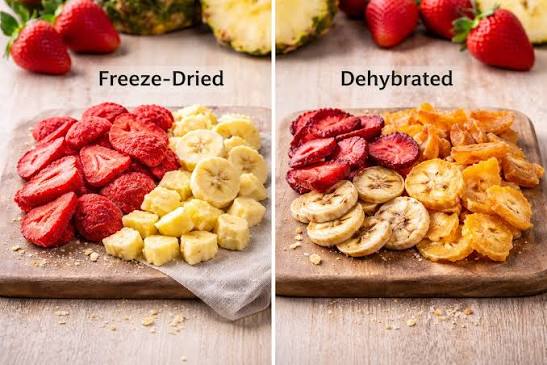
When a strawberry is dehydrated using heat, its cells lose water and the structure contracts. The strawberry becomes smaller and denser.
When a strawberry is freeze-dried, much of its physical structure can be maintained because the ice is removed through sublimation rather than allowing the food to go through a conventional liquid-water evaporation process.
Utah State University notes that freeze-drying can retain much of the original texture, flavor, and nutrition when the product is rehydrated.
This is why freeze-dried fruit can remain recognizable and often has a light, crispy texture.
Rehydration Reveals the Difference
The difference becomes especially obvious when water is added.
Freeze-dried food is generally highly porous. When water enters that structure, it can move through the dried food relatively efficiently.
As a result, freeze-dried ingredients can often return relatively close to their original form.
Dehydrated food behaves differently.
Because heat and moisture loss cause more structural changes, a dehydrated ingredient may soften after soaking but usually does not return completely to its original fresh texture.
This distinction is particularly useful for backpacking meals.
A freeze-dried pasta meal, vegetable mix, or meat-based entrée is designed to absorb water after preparation. The goal is to transform the dry ingredients back into an edible cooked meal.
Does Freeze-Drying Use Heat?
Yes—but the role of heat is different.
A common misconception is that freeze-drying means the food never encounters heat.
During primary drying, controlled heat is introduced to provide the energy needed for sublimation. However, the food remains under vacuum and the process is fundamentally different from conventional hot-air dehydration.
University of Minnesota Extension specifically notes that freeze-drying uses mild heat during the sublimation stage rather than a conventional heat treatment designed to kill microorganisms.
That distinction is important for food safety.
Freeze-drying itself should not be treated as a sterilization process.
What About Nutrition?
The two processes can affect nutrients differently.
Freeze-drying operates at relatively low product temperatures and is designed to minimize structural damage. This is one reason it is widely used when preservation of food quality is important.
However, it would be inaccurate to say that freeze-drying preserves every nutrient perfectly.
Heat-sensitive vitamins can still undergo losses depending on the food, processing conditions, storage, and exposure to oxygen.
Dehydration exposes food to heat for a longer period, which can increase the potential for heat-related changes in some nutrients.
At the same time, nutrition depends heavily on the original ingredient and the overall recipe. A dehydrated vegetable can still be highly nutritious, while a freeze-dried meal can contain large amounts of sodium or added ingredients.
The preservation method is only one part of the nutritional picture.
Shelf Stability Depends on More Than Drying
Removing water helps make food shelf-stable, but packaging is also critical.
USDA notes that freeze-dried foods need moisture-proof, hermetically sealed packaging for shelf stability.
Why?
Because dried food can absorb moisture from the surrounding environment.
Once enough moisture returns, the food can become vulnerable to quality deterioration and microbial growth.
That is why commercial freeze-dried meals often come in high-barrier pouches or other protective packaging.
Which Process Is More Complicated?
Dehydration is generally simpler.
A food dehydrator uses heat and airflow, and the equipment can be relatively straightforward.
Freeze-drying requires much more specialized equipment because the process depends on freezing, vacuum conditions, sublimation, vapor removal, and controlled drying.
University of Minnesota Extension notes that commercial freeze-drying involves equipment and food-safety processes that differ substantially from home processing.
The additional technology is one reason freeze-dried products are often more expensive.
The Bottom Line
Freeze-drying and dehydration both preserve food by removing moisture, but they do it through different physical mechanisms.
Dehydration: warm air + evaporation + moisture removal.
Freeze-drying: freezing + vacuum + sublimation + secondary drying.
Dehydrated food generally becomes smaller, denser, and chewier or crispier. Freeze-dried food tends to remain lightweight and porous and can rehydrate more effectively.
Neither process automatically makes a food “better.” Each method has advantages for different ingredients, recipes, budgets, and storage goals.
The most important distinction is not what the food looks like after processing. It is what happened to the water inside it.
Once you understand evaporation versus sublimation, the difference between dehydrated and freeze-dried food becomes much easier to understand.