From Heat to Vacuum: The Real Manufacturing Difference Between Dehydrated and Freeze-Dried Food
Walk through a grocery store or outdoor retailer and you will find plenty of foods labeled dried, dehydrated, or freeze-dried. They may all be lightweight and convenient, but the manufacturing processes behind them can be dramatically different.
A dehydrated meal and a freeze-dried meal both began with food containing water. The difference is what happens next.
Dehydration relies primarily on heat and airflow to evaporate water. Freeze-drying uses freezing and a vacuum to remove water through sublimation.
That distinction affects almost everything about the finished product—from its shape and texture to how it behaves when water is added back.
Stage One: Preparing the Food
Both processes begin with food preparation.
Raw ingredients may be washed, trimmed, sliced, chopped, cooked, seasoned, or mixed depending on the product.
For a simple dehydrated snack, the ingredient might be sliced fruit.
For a backpacking meal, the manufacturer may prepare an entire recipe containing pasta, vegetables, meat, sauce, and seasonings.
The initial quality of the food matters in both systems.
Drying does not transform low-quality ingredients into high-quality ingredients. The final product can only be as good as the recipe and ingredients entering the process.
Stage Two: Dehydration Uses Warm Air
In conventional dehydration, the prepared food is placed into a dehydrator or another controlled drying environment.
Warm air circulates around the food.
The heat gives water molecules enough energy to escape from the food as vapor. Air movement carries that moisture away.
The process continues until the desired moisture level is reached.
USDA describes artificial drying as using a warm oven or food dehydrator to remove moisture. It also emphasizes that safe processing conditions are particularly important when drying meat and poultry.
The important point is that dehydration removes liquid water through evaporation.
Why Temperature Matters in Dehydration
Heat makes dehydration possible, but too much heat can damage food quality.
Different foods require different temperatures and drying times.
Fruit, vegetables, herbs, and meat do not behave exactly the same way.
Food thickness also matters. A thick piece of food takes longer for moisture to travel from the interior to the surface.
Airflow matters as well.
If humid air surrounds the food, evaporation becomes less efficient. A good dehydrator therefore combines controlled temperature with airflow to continuously move moisture away from the product.
This makes dehydration relatively simple in concept, but proper processing still requires attention to food safety and product characteristics.
Freeze-Drying Takes a Different Route
Freeze-drying starts by moving in the opposite direction.
Instead of using heat to remove liquid water, the food is frozen.
The water inside the food becomes ice.
The frozen product is then placed into a vacuum chamber.
The pressure is lowered dramatically, creating the conditions necessary for sublimation.
This means the food’s ice can change directly into water vapor rather than first becoming liquid water.
University of Minnesota Extension describes this as the defining principle of freeze-drying: ice is vaporized directly after freezing, with sublimation serving as the mechanism for moisture removal.
Why the Vacuum Matters
The vacuum is not simply an accessory.
It is fundamental to the process.
At ordinary atmospheric pressure, frozen water generally melts before it can evaporate. Under sufficiently low pressure, however, ice can transition directly into vapor.
This allows manufacturers to remove moisture while keeping the product in a frozen state during the primary drying stage.
Utah State University Extension identifies freezing, primary drying through sublimation, and secondary drying as the three major stages of freeze-drying.
That is why a freeze dryer is much more complex than a conventional food dehydrator.
The Food’s Internal Structure Matters
One of the biggest differences between the two processes occurs inside the food.
During conventional dehydration, water leaves the food as liquid water evaporates. As the food loses moisture, its physical structure can collapse or contract.
That is why dried fruits often become wrinkled.
Freeze-drying takes a different path.
When food is frozen, the water becomes ice crystals. During sublimation, those ice crystals leave behind tiny spaces within the food.
The resulting product can have a porous structure.
This structure is one reason freeze-dried food can absorb water relatively quickly during rehydration.
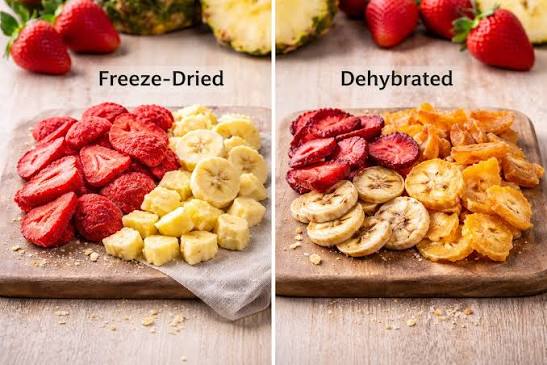
A Simple Example: Strawberries
Consider two strawberries.
The first goes into a dehydrator.
Warm air removes moisture. The strawberry gradually becomes smaller, darker, denser, and chewy.
The second strawberry is frozen and then freeze-dried.
Its water is removed through sublimation. The resulting strawberry can remain recognizable in shape and become light and crispy.
Add water to both.
The dehydrated strawberry will soften, but it generally will not return to the same texture as the fresh fruit.
The freeze-dried strawberry can absorb water into its porous structure and move much closer to its original condition.
That difference is one of the most visible demonstrations of how processing technology affects food.
Freeze-Drying Has a Secondary Drying Stage
Removing visible ice is not necessarily the end.
After primary drying removes much of the frozen water, the process can move into secondary drying.
During this stage, remaining moisture that is more tightly associated with the food is removed.
This allows manufacturers to reach the low moisture levels required for a stable finished product.
The exact time and conditions depend on the product.
A thin layer of fruit does not behave exactly like a thick meat-based entrée, and a sauce does not behave exactly like a dry vegetable.
Freeze-drying is therefore not a single standardized cycle for every food.
Why Freeze-Dried Meals Can Be So Lightweight
Water makes food heavy.
Fresh fruits and vegetables can contain a large percentage of water. Meat, cooked grains, and complete meals also contain significant moisture.
Remove most of that water, and the remaining ingredients become dramatically lighter.
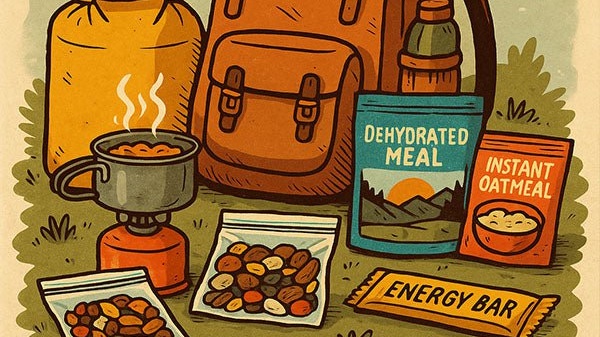
This is especially useful for backpacking.
A hiker needs calories and nutrients but also has to carry everything needed for several days.
Reducing the weight of food can make a meaningful difference.
Both dehydration and freeze-drying reduce weight, but freeze-drying can remove a very large proportion of the food’s water while maintaining a porous structure that makes rehydration practical.
Rehydration Is the Reverse Part of the Experience
The manufacturing process removes water.
The consumer puts it back.
For freeze-dried meals, water can penetrate the porous food structure and restore much of the food’s volume and softness.
This is why freeze-dried meals are popular for camping and backpacking.
Instead of carrying fresh meat, cooked vegetables, sauce, and rice separately, a backpacker can carry the finished dry meal in a lightweight pouch.
At camp, adding water reverses much of the physical transformation.
Food Safety Is Different From Preservation
One important misconception is that removing water automatically makes food sterile.
It does not.
University of Minnesota Extension notes that freeze-drying does not include a heat treatment step that kills illness-causing microorganisms. If microorganisms are present before processing, they can remain in the product and potentially become active again if moisture is added.
This is why proper food handling before and during processing matters.
The preservation effect comes largely from reducing water activity, not from sterilizing the food.
USDA also emphasizes that drying meat safely requires appropriate cooking and drying procedures because pathogens can survive improperly performed dehydration.
Packaging Finishes the Process
The drying machine is only part of the preservation system.
Once food has been dried, it must be protected from moisture.
A dehydrated or freeze-dried product exposed to humid air can absorb water again.
For commercial freeze-dried foods, packaging is therefore critical. USDA specifically states that freeze-dried foods should be kept in moisture-proof, hermetically sealed containers for shelf stability.
This explains why outdoor meals often come in specialized sealed pouches rather than ordinary paper bags.
Why the Two Methods Cost Different Amounts
Dehydration generally requires simpler equipment.
A food dehydrator needs controlled heat and airflow.
Freeze-drying requires a freezing system, vacuum chamber, refrigeration capability, vapor collection, and carefully controlled pressure and temperature.
The process also tends to take longer.
Utah State University Extension notes that freeze-drying requires greater initial investment, takes longer, and uses more energy than conventional dehydration.
Those additional technical requirements help explain the price difference between many dehydrated and freeze-dried products.
Which Process Should You Choose?
The answer depends on the food and the purpose.
Dehydration can be practical for fruit snacks, vegetables, herbs, jerky, and many homemade trail foods.
Freeze-drying is particularly useful when preserving shape, texture, and rehydration performance is important.
For backpacking meals, freeze-drying can provide a convenient combination of low weight and relatively easy rehydration.
For everyday snacks, however, a chewy dehydrated fruit or vegetable may be exactly what someone wants.
The two methods should therefore not be treated as competing versions of exactly the same technology.
They solve the moisture problem in different ways.
The Key Difference in One Sentence
If you remember only one thing, remember this:
Dehydration removes water by evaporation, while freeze-drying removes frozen water through sublimation.
Dehydration starts with heat and airflow.
Freeze-drying starts with freezing and ends with vacuum-driven sublimation.
That difference explains why dehydrated foods often shrink and become chewy, while freeze-dried foods can remain light, porous, and easier to rehydrate.
Once you understand what happens to the water inside the food, the entire freeze-dried-versus-dehydrated debate becomes much easier to understand.