How Much Water Should You Carry? The Trail Math Behind Bottle, Belt And Vest Capacity
A 500 mL bottle can be perfectly adequate on one four-hour hike and dangerously inadequate on another, which is why asking “How much water do I need for four hours?” does not have a useful universal answer. 💧 Distance matters, but so do hiking speed, temperature, sun exposure, elevation gain, humidity, personal sweat losses, and whether the next reliable refill is twenty minutes away or three hours away. The better approach is to stop treating hydration capacity as a mileage rule and start treating it as a route-planning equation.
For Camp Kitchen Lab, that distinction turns an ordinary bottle-versus-vest question into practical trail mathematics: determine the longest period you expect to travel without dependable water, estimate the amount you realistically expect to consume during that section, and then add capacity for uncertainty. A hiker who passes treated water every hour has a completely different carrying problem from someone crossing a long exposed ridge with no water until the next valley. 🎒 Your ideal container is therefore not necessarily the largest or lightest option—it is the one that can safely carry the required volume between dependable refill opportunities.
Why Mileage Alone Can’t Tell You How Much Water To Carry
“Water per mile” sounds convenient because mileage is easy to measure, but hiking miles are not equal units of effort or time. Three miles on a shaded, nearly level trail may pass quickly, while three steep miles in exposed terrain can take substantially longer and place you outside in hotter conditions for more time. ⛰️ Since you consume water over time and conditions, rather than because your GPS counter reaches another mile, mileage by itself is a weak capacity-planning tool.
This also explains why two hikers covering the same ten-mile trail may reasonably carry different amounts of water. One might complete the route quickly in cool weather with several dependable refill points, while another moves slowly, takes longer breaks, experiences warmer afternoon temperatures, or prefers a larger contingency margin. The practical planning question becomes “How long until my next dependable water source?”, not simply “How many miles am I hiking?”
Start With Four Variables
The first variable is expected time, meaning the realistic time between the start and your next refill rather than your optimistic moving-time estimate. Include climbing, navigation, photography, food stops, slower companions, rough terrain, and other delays that could extend a supposedly short section. ⏱️ If a four-mile dry stretch normally takes you two hours instead of one, its water-capacity requirement should be planned around those two hours.
The remaining variables are refill interval, environmental conditions, and planned consumption, with the final number being an individual planning estimate rather than a universal recommendation. Heat, direct sun, strenuous climbing, altitude, and other conditions can affect fluid losses, while cool or shaded conditions can create a very different situation. Your planned consumption input should therefore come from sensible preparation, experience on comparable outings, and professional guidance when appropriate—not from blindly copying another hiker’s exact number.
Calculate The Longest Dry Section First
A useful capacity equation is: planned consumption × expected hours without reliable water = base carrying requirement for that section. For example, imagine—not as a drinking recommendation—that a hiker has learned from similar outings that they typically plan around 500 mL per hour, and the route contains a two-hour section without dependable water. 🧮 The simple planning calculation gives 500 mL × 2 hours = 1,000 mL of base capacity before adding any contingency.
This method immediately exposes why a single 500 mL belt flask could be fine on one route but insufficient on another. If dependable fountains or treated-water taps appear every forty-five minutes, a small container may repeatedly return to full capacity; if the next dependable source is three hours away, the same bottle creates a much tighter constraint. The longest dry interval, not total trip duration alone, often determines the minimum container capacity you need to investigate.
Add Capacity For Uncertainty
Trail plans rarely happen exactly as written, so the calculated base volume should not automatically equal your absolute maximum carrying capacity. A water source could be dry, seasonal, contaminated, difficult to access, temporarily shut off, or simply farther away than expected, while an injury, navigation error, slower pace, or unexpected heat could extend the interval. ⚠️ A practical system therefore includes a contingency margin based on how serious a failed refill would be.
That margin does not have to be an identical percentage for every trail because the consequences of uncertainty vary dramatically. A popular park trail with frequent verified taps, road crossings, and easy bailout options presents a different planning problem from a remote ridge where the next stream is several hours away and there is no simple shortcut back. Think of spare water like a financial emergency fund: the appropriate reserve depends partly on how expensive being wrong would become.
500 mL Bottle Vs Two Bottles Vs Hydration Vest
A single 500 mL bottle or soft flask shines when refill points are frequent, the outing is short, and the hiker values simplicity, easy monitoring, and low carrying weight. 🥤 Its biggest weakness is not the bottle itself but its fixed ceiling: once the route requires more than 500 mL between safe refills, no amount of packing efficiency can create additional capacity. It can therefore be an excellent solution to a small-capacity problem and a poor solution to a long dry-section problem.
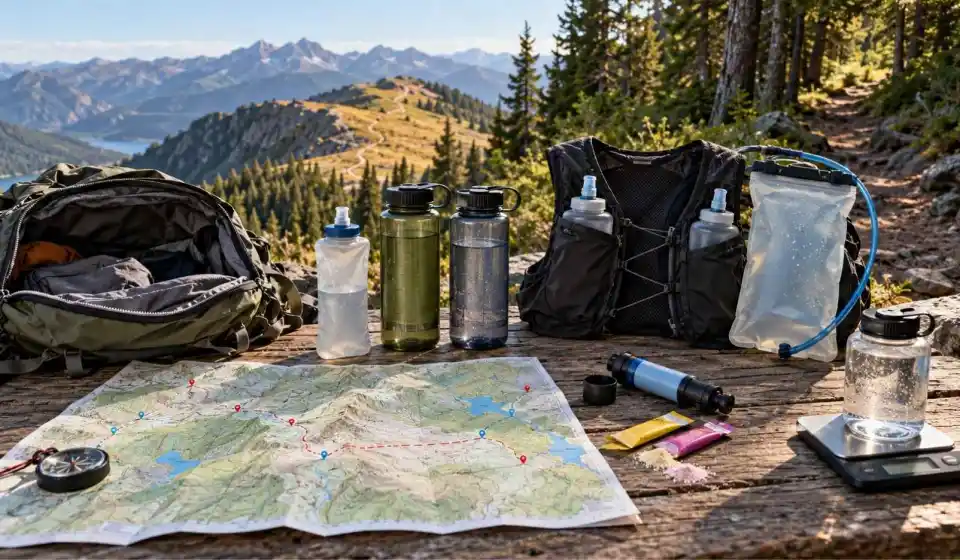
Two bottles add flexibility because one can remain plain water while the other holds a drink mix, and losing or contaminating one container does not necessarily eliminate your entire supply. A vest or larger reservoir becomes attractive when the required capacity rises, although more available volume can add weight and may make it harder to see exactly how much remains unless you deliberately monitor it. 🎒 Choose capacity after calculating the route, rather than buying a vest first and assuming its size determines how much water you should consume.
How Drink Mix Changes Water Logistics
Drink mix introduces another planning question because every milliliter committed to a flavored or electrolyte drink is no longer plain water unless you have another container. If your only 500 mL bottle contains a concentrated mix, for example, you lose the flexibility to sip plain water, dilute the drink, rinse food, or use that same water for another trail purpose. 🧂 Separating plain water and mixed drink capacity can therefore make sense when both are part of your plan.
Concentration also matters because powder instructions are usually designed around a particular volume of water, and simply adding extra powder to save bottle space changes the mixture you eventually consume. Refills complicate things further: a fountain makes remixing easy if you carried premeasured powder, while a backcountry stream may first require filtration or another appropriate treatment method before it becomes drinking water. For pack-out purposes, drink mix should therefore be treated as part of a water system, not merely as another snack tossed into the food bag.
Three Worked Trail Examples
Imagine a four-hour hike with dependable potable water roughly every hour, moderate weather, and several easy exit points; if a hiker’s personal planning assumptions fit comfortably inside a 500 mL interval, repeatedly refilling one lightweight bottle could make far more sense than carrying several liters from the trailhead. 🚰 The important number is not the four-hour total because that water does not all need to be carried simultaneously. Frequent dependable refilling reduces maximum required carrying capacity even though total water consumed across the outing may be much greater than one bottle.
Now imagine a route with a three-hour dry section after the final dependable source, or a hot exposed climb where travel time could increase unexpectedly; the capacity calculation must cover that entire interval plus whatever contingency the route justifies. A hiker whose hypothetical planning estimate were 500 mL per hour would already calculate 1.5 liters for a three-hour stretch before considering uncertainty, immediately ruling out a lone 500 mL flask as the complete system. ☀️ The point is not that everyone needs 1.5 liters for three hours—the point is that container capacity follows your planning assumptions and route constraints.
Water Weight Belongs In Your Pack Math
Water is heavy enough to materially affect backpack weight: one liter of water weighs approximately one kilogram, or about 2.2 pounds, before counting the bottle or reservoir. 💦 Carrying three liters therefore adds roughly 3 kilograms or 6.6 pounds, which explains why experienced hikers pay so much attention to reliable refill points rather than automatically starting every outing with the largest possible water load. Reducing unnecessary carried water can meaningfully lower pack weight, but only when the route actually provides safe opportunities to replace it.
This creates the same optimization problem seen throughout Camp Kitchen Lab: lighter is useful only when the system still works. Carrying an extra liter across a route with constant dependable water may be unnecessary, while saving that same kilogram before entering a long dry canyon could remove capacity you genuinely need. Water planning is therefore less about carrying “as little as possible” and more about carrying as little as reasonably necessary for the next section plus uncertainty.
Verify The Refill, Don’t Just Mark The Stream
A blue line on a map is not automatically a dependable drinking-water source. Seasonal creeks can dry up, water systems can be shut down, springs can have low flow, and natural surface water may require appropriate treatment before drinking. 🗺️ Route research should therefore distinguish between potable taps, reliable natural sources, seasonal sources, uncertain water, and no water instead of treating every water symbol equally.
This becomes especially important when your capacity calculation depends on one specific refill point. If skipping that source would turn a ninety-minute interval into a four-hour dry section, the reliability of the source is one of the most important facts in your entire pack-out plan. A conservative hiker may reasonably carry more capacity where refill failure has serious consequences, even if the extra water makes the pack temporarily heavier.
When Individual Hydration Needs Require Professional Guidance
Capacity mathematics can help organize your bottles, but it cannot calculate every person’s medical hydration needs. People vary in sweat rate and health circumstances, and medications or conditions affecting fluid or electrolyte balance can make generalized trail advice inappropriate. 🩺 Anyone with relevant medical concerns, a history of heat illness or exercise-associated problems, or uncertainty about hydration during prolonged strenuous activity should seek individualized guidance from a qualified healthcare professional.
It is also important not to turn “carry enough water” into “drink as much as possible,” because too little and excessive fluid intake can both create problems during prolonged activity. Your water system should support sensible drinking and route safety rather than encourage you to finish a reservoir merely because you packed it. Camp Kitchen Lab’s role is to help you calculate capacity and logistics, not prescribe a universal medical intake schedule.
The Better Question Is How Much Capacity You Need Between Refills
The most useful hydration question is therefore not “Should I buy a bottle, belt, or vest?” but “What is the maximum volume my route may require me to carry at one time?” Start with the longest dry interval, combine it with a realistic personal planning assumption, examine heat and route difficulty, evaluate the reliability of your refill point, and then add an appropriate margin for uncertainty. 🎯 Once that number exists, choosing between a 500 mL flask, two bottles, a vest, or a larger reservoir becomes much easier.
This approach also scales naturally from trail running to day hiking and backpacking because the equation stays the same even when the equipment changes. A short loop with fountains may reward minimal capacity, while a dry overnight route can make several liters and water-treatment equipment essential parts of the pack-out. The lesson is simple: do the trail math first, then choose the container—not the other way around.