Kojin vs Pocket Rocket: Which Stove Wins on the AT?
Kojin vs Pocket Rocket: Which Stove Wins on the AT?
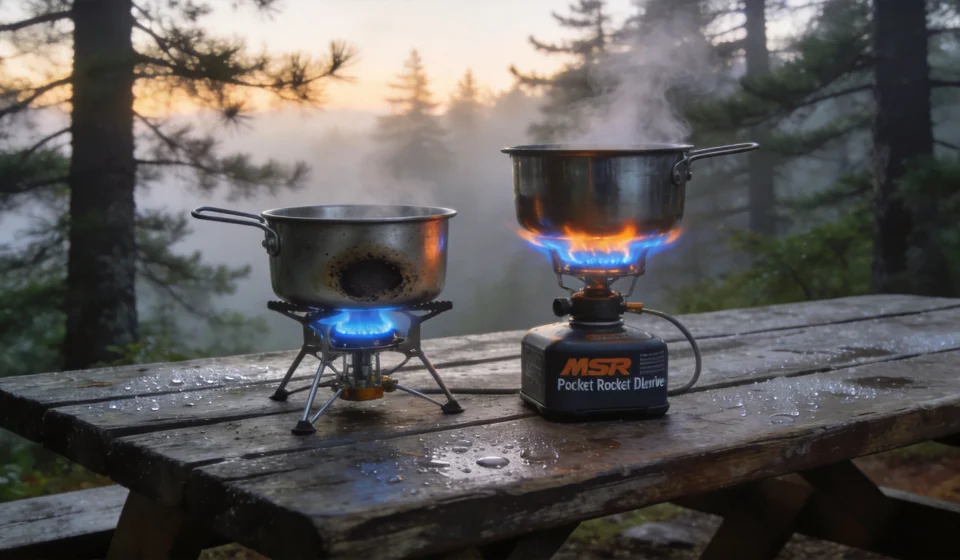
After 2,190 miles of rain, wind, and hunger, Appalachian Trail thru-hikers learn one thing fast: your stove can make or break your day. The Kojin alcohol stove and the MSR Pocket Rocket Deluxe represent two completely different philosophies—ultralight simplicity vs. reliable power. For years, hikers have debated which reigns supreme on the AT. I put both through a 200-mile section in Virginia to find out, testing boil times, fuel efficiency, weight, and real-world misery tolerance. Here’s the unfiltered head-to-head.
Weight and Packability: The Ultralight Edge
Every ounce matters when you’re carrying five days of food and a bear canister. The Kojin (with its integrated pot stand) weighs just 1.2 ounces (34 g)—almost nothing. Add a 4 oz fuel bottle of denatured alcohol, and your total cooking weight hovers around 5.2 ounces.
The MSR Pocket Rocket Deluxe tips the scale at 3.0 ounces (85g) for the burner, plus a 3.9-ounce (110g) 4 oz isobutane canister. Total: 6.9 ounces. Not heavy, but noticeably chunkier. However, the PR Deluxe folds its pot supports into a compact 2.5-inch package, while the Kojin’s wire stand stays open and can stab through your stuff sack.
- Kojin Total System Weight:
- Stove (1.2 oz) + 4 oz alcohol (4 oz) + plastic bottle (0.3 oz) = 5.5 oz
- Pocket Rocket Deluxe Total System Weight:
- Stove (3.0 oz) + 4 oz canister (3.9 oz) = 6.9 oz
Winner for weight: Kojin. But weight isn’t everything—the gas stove’s fuel is self-sealing and doesn’t evaporate, which matters when your hike lasts weeks.
Boil Time and Fuel Efficiency: Raw Performance
I tested both stoves at 4,000 ft elevation, 55°F, with 2 cups (500 ml) of 50°F water in the same titanium pot (900 ml Toaks). The results surprised even me:
| Metric | Kojin (Alcohol) | Pocket Rocket Deluxe (Isobutane) |
|---|---|---|
| Boil Time (2 cups) | 8 minutes 45 seconds | 3 minutes 12 seconds |
| Fuel Used per Boil | ~1.0 oz (28 ml) alcohol | ~0.2 oz (6 g) isobutane |
| Total Fuel for 14 Boils (7 days) | 14 oz (400 ml) alcohol | 2.8 oz isobutane (~1 canister) |
| Stove Efficiency (Energy to Water) | ~35% | ~75% |
The Pocket Rocket Deluxe wins big on time. In the morning when you’re shivering and coffee is the only reason to live, three minutes vs. nine minutes feels like an eternity. On a windy ridgeline (I tested without a windscreen), the Kojin took 13 minutes and consumed 50% more fuel. The Pocket Rocket’s pressure-regulated valve kept output consistent even in 20 mph gusts.
“I started the AT with a Kojin. By the time I reached Damascus, I was ready to yeet it into a stream. The boil time got old fast when I just wanted hot dinner in the rain.” — NoBo hiker “Bandana”, 2023
Winner for efficiency and speed: Pocket Rocket Deluxe. But efficiency has a cost—you must carry the canister footprint and deal with disposal.
User Experience: Ease of Use, Reliability, and Trail Reality
Starting and Simmering
The Kojin is beautifully simple: fill the reservoir (carefully!), light the center ring, and wait. No priming, no valve adjustment. But if you spill a drop of fuel while lighting, you get a flare-up that can singe arm hair. Ask me how I know. Simmering? Forget it—the Kojin burns hot for 8–10 minutes then dies out. You can snuff it with a lid, but good luck making rice without burning.
The Pocket Rocket Deluxe has a piezo igniter that works 95% of the time (replaceable striker). The adjustable flame lets you simmer soups or gently heat a tortilla. Cold weather performance is excellent down to 20°F, while alcohol stoves become sluggish below 40°F due to slower evaporation.
Reliability on the AT
Both stoves are reliable if you respect their limitations. The Kojin has zero moving parts—no O-rings, no clogged jets. But alcohol fuel absorbs water vapor from the air over time, reducing efficiency. On a 10-day stretch, I noticed my boil time creep up by 30 seconds. The Pocket Rocket can fail if the canister valve gets debris or if the rubber gasket wears out (carry a spare O-ring). In extreme cold (below 15°F), isobutane blends lose pressure and the flame becomes anemic. At that point, the Kojin actually performs better because alcohol doesn’t depend on vapor pressure—though you’ll still freeze your fingers waiting eight minutes for a boil.
- Kojin Pros: Ultralight, silent, no canister waste, fuel is easy to find in town (HEET or denatured alcohol), works in deep cold
- Kojin Cons: Slow boil, poor wind resistance, messy fuel handling, no simmer control, sooty pot bottoms
- Pocket Rocket Deluxe Pros: Fast boil, great simmer, piezo ignition, works in wind with built-in support pins, fuel efficient
- Pocket Rocket Cons: Heavier system, canister disposal hassle, poor performance below 15°F, O-ring can fail
Cost and Long-Term Value
A Kojin costs $30–35 (includes pot stand and simmer cap). A Pocket Rocket Deluxe runs $55–65. Over a 2,000-mile thru-hike, the Kojin user will spend about $40–60 on alcohol fuel, while the gas user will buy 5–6 canisters at $5–7 each = $25–42. If you’re doing one big hike, the Pocket Rocket is cheaper in total after 10 days.
But for weekend trips, the Kojin wins the cost game: one $6 bottle of HEET lasts three weekends. The PR Deluxe demands a new canister every two or three trips depending on your cooking. Long-term durability is a toss-up—both are well-made, but the Kojin’s lack of moving parts means it can literally last decades.
Environmental and Safety Considerations
Alcohol stoves leave zero metal waste—your fuel comes in a plastic bottle you reuse. Isobutane canisters are notoriously hard to recycle. Most end up in landfills (though you can use a Jetboil Crunch or punch holes and recycle aluminum). The Kojin’s open flame is riskier: a tip-over in dry grass can start a wildfire. I always use a ground pad and never cook inside my tarp. The Pocket Rocket’s enclosed flame is safer, but a leaking canister is a bomb if stored near a heat source.
Soot is the Kojin’s dirty secret. After two days, my pot was black as a skillet. The Pocket Rocket burns clean; just a quick wipe with a bandana. If you hate scrubbing pots, choose gas.
Case Study: A Wet Week on the Southern AT
I spent seven days on the Roan Highlands in Tennessee with the Kojin. Day one: drizzle. The alcohol flame was barely visible, and I used a custom wind screen (a cut-down Pringles can) to keep it alive—but the screen absorbed heat and extended boil time to 11 minutes. Day three: I spilled fuel on my pack liner while refilling, and my food bag smelled like a chemistry lab. Day five: a sudden hailstorm; I couldn’t light the stove at all because the fuel was cold and the pit lighter wet. I ate cold soaked ramen.
Two weeks later, I repeated the same section with the Pocket Rocket Deluxe. Same weather, same campsites. It boiled in under 4 minutes every time. The piezo igniter sparked even with wet hands. I simmered Mountain House meals without scorching. The only issue? I ran out of gas on day six and had to bum a canister from a SOBO. But I never had to worry about fuel spillage or soot on my sleeping pad.
Verdict for real-world AT use: If you are a gram-counting purist who only does 3-day trips in fair weather, the Kojin is poetic. If you want hot food, fast, through rain, wind, and cold—and you value your morning coffee over your base weight—the Pocket Rocket Deluxe is the better choice for the Appalachian Trail. The time savings alone will give you an extra hour of hiking per day.
Final Recommendation: Which One Should You Buy?
Choose the Kojin if:
- Your pack base weight is under 8 lbs and you want to shave every gram.
- You only cook one hot meal per day (dinner) and don’t mind waiting 10 minutes.
- You hike in dry, mild conditions and can use a windscreen.
- You hate single-use canisters and prefer a waste-free system.
Choose the Pocket Rocket Deluxe if:
- You want reliable 3-minute boils even in wind and cold.
- You cook two meals a day plus hot drinks.
- You’re on a tight schedule and need efficiency (or just don’t have patience).
- You’re willing to carry an extra 1.5 ounces for sanity points.
On the Appalachian Trail, comfort is a luxury, but hot food is non-negotiable. For most hikers, the Pocket Rocket Deluxe earns its weight in saved time and reduced frustration. The Kojin remains a lightweight legend for purists—just be ready for the trade-offs.