Oatmeal vs Bagels for Backpacking Breakfast: Which Gives You More Calories per Ounce?
Why Bagels Suddenly Feel Heavy In A Backpack
A bagel looks like ideal trail food because it is familiar, ready to eat, and easy to pair with peanut butter, but several bagels can become surprisingly bulky once they enter a backpack. Part of the problem is moisture: a standard plain bagel contains substantially more water by weight than dry oats, so some of what you carry contributes weight without contributing calories. 🥯 That difference matters when breakfast is repeated for several days.
Dry oatmeal approaches the problem differently because most of its water is added when you prepare it rather than carried inside the food from the trailhead. If reliable water is available where you eat breakfast, you can carry the dry ingredient and add water later, which improves the energy-to-weight relationship of the food in your pack. 🥣 This does not make oatmeal universally better, but it gives it a meaningful starting advantage.
Calories Per Ounce: The Number That Changes The Comparison
Calories per ounce tells you how much food energy you are carrying for each ounce of food weight, making it one of the most useful numbers for lightweight menu planning. The formula is simple: calories ÷ food weight in ounces = calories per ounce, so a 400-calorie breakfast weighing 4 ounces provides 100 calories per ounce. 🎒 Higher numbers generally mean more energy for less carried food weight.
This metric should not replace every other consideration because breakfast still needs to fit your appetite, digestion, preparation style, water access, and overall menu. Carbohydrate, protein, fat, fiber, packed volume, and cooking requirements can all change whether a mathematically efficient meal is actually practical. The best use of calorie density is therefore as a screening tool rather than a rule that every meal must maximize.
Oatmeal Vs Bagel: The Base-Food Test
Standard nutrition reference data list dry regular or quick oats at about 379 calories per 100 grams, with roughly 67.7 grams of carbohydrate, 13.2 grams of protein, 6.5 grams of fat, and 10.1 grams of fiber. A plain enriched bagel provides about 264 calories, 52.4 grams of carbohydrate, 10.6 grams of protein, 1.3 grams of fat, and 1.6 grams of fiber per 100 grams. 📊 Converted to trail units, that is about 107 calories per ounce for dry oats versus roughly 75 for the bagel.
| Food | Calories per 100 g | Calories per ounce | Carbs | Protein | Fat | Fiber |
|---|---|---|---|---|---|---|
| Dry oats | 379 kcal | ~107 kcal/oz | 67.7 g | 13.2 g | 6.5 g | 10.1 g |
| Plain bagel | 264 kcal | ~75 kcal/oz | 52.4 g | 10.6 g | 1.3 g | 1.6 g |
The moisture difference helps explain the result: the dry-oat reference contains roughly 11% water, while the plain bagel reference is about 34% water. 💧 Water is essential, but it contains no calories, so foods that already contain more moisture tend to look less impressive in a calories-per-ounce comparison. Brand, recipe, serving size, and fortification vary, so your actual package label should always be the final source for trip calculations.
What Happens When You Upgrade Both Breakfasts
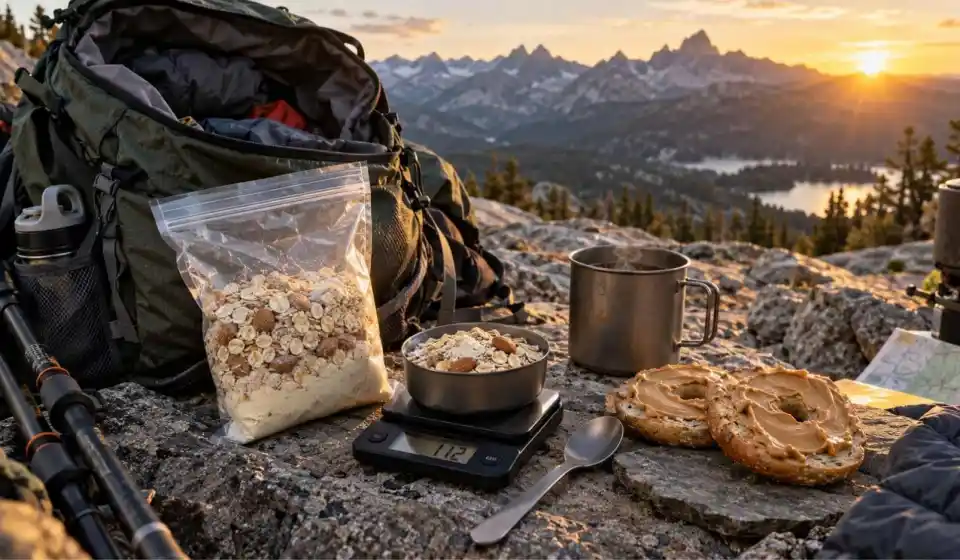
Plain foods are not the most realistic comparison because backpackers often add ingredients specifically to raise calories, flavor, and protein. One example bowl using 80 grams of oats, 25 grams of nonfat dry milk powder, and 30 grams of almonds works out to about 567 calories in 135 grams, or approximately 119 calories per ounce using standard reference values. 🥜 It also supplies roughly 74 grams of carbohydrate, 26 grams of protein, 20 grams of fat, and nearly 12 grams of fiber.
A 100-gram plain bagel paired with 32 grams of smooth peanut butter comes to roughly 455 calories in 132 grams, or about 98 calories per ounce. That is a substantial improvement over the bagel alone because peanut butter is highly energy dense, yet the sample oatmeal mixture still provides more calories for almost the same total carried weight. The important lesson is to calculate the finished breakfast, not just compare the base foods.
Why Higher-Fat Additions Change The Math
Fat provides about 9 calories per gram, while carbohydrate and protein each provide about 4 calories per gram, which is why nuts, nut butters, seeds, and oils can raise calorie density quickly. ⚡ Adding almonds to oatmeal or peanut butter to a bagel therefore changes more than flavor; it changes how many calories you can carry in a fixed amount of food weight. This is basic energy math, not a claim that the highest-fat breakfast is automatically the best breakfast.
Carbohydrates remain a major component of both oats and bagels, while protein and fiber can be adjusted through the ingredients you add. A hiker who wants more protein might use powdered milk or another shelf-stable protein source, while someone prioritizing simplicity might accept a lower-density breakfast that requires no mixing or cooking. Your preferred macro balance should support the rest of your menu rather than be judged from breakfast alone.
Packed Volume And Cooking Matter Too
Calories per ounce does not measure the space a food occupies, and this is where bagels often feel more expensive than their weight suggests. Bagels hold their shape and trap air, while dry oats settle into flexible packaging and can fit around other food more efficiently inside a food bag or bear canister. 📦 There is no universal volume figure because bagel dimensions, packaging, compression, and oatmeal add-ins vary too much for one honest number.
Bagels regain ground through convenience because they can be eaten immediately, require no cooking water, and eliminate stove time, fuel use, and pot cleanup. Oatmeal usually requires hot water or a cold-soak routine, although the equipment penalty may be small if you already carry a stove for dinner. 🔥 A no-cook morning can easily be worth a few extra ounces to hikers who want to break camp quickly or eat while moving.
The Better Question Is Not Oatmeal Or Bagel
Instead of asking which breakfast is universally better, start with the number of calories you want and work backward to the food weight required to deliver them. If you want roughly 500 calories, compare complete recipes at that calorie target rather than comparing one arbitrary bagel with one arbitrary scoop of oats. 🧮 Then check preparation time, water availability, packed volume, fuel needs, taste, and whether you realistically want to eat the same meal repeatedly.
A practical decision framework is: calories needed → target food weight → preparation time → water requirement → packed volume → breakfast choice. This approach may lead one hiker toward enriched oatmeal because it delivers more energy per ounce, while another chooses bagels because zero cooking and fast eating matter more than absolute weight efficiency. Backpacking food works best when the math supports the way you actually hike.
So Which Gives You More Calories Per Ounce?
On the base-food comparison, dry oatmeal provides substantially more calories per ounce than the plain bagel used here, about 107 versus 75 calories per ounce. When calorie-dense toppings are added, both improve, but the example oats-plus-powdered-milk-and-almond breakfast reaches about 119 calories per ounce compared with about 98 for the bagel-plus-peanut-butter combination. 🥾 For a hiker primarily trying to reduce food weight, oatmeal is the stronger starting platform in this test.
Bagels are still useful backpacking food because they are familiar, ready immediately, easy to portion, and compatible with high-calorie spreads. The larger lesson is that breakfast should be evaluated as a complete system involving calories, ounces, macros, moisture, volume, water, and preparation instead of being judged by reputation alone. Once you calculate those pieces, you can choose the meal that fits your trip rather than relying on a generic list of “best backpacking breakfasts.”