Are Tortillas Actually Good Backpacking Food? The Calories-Per-Ounce Test
Tortillas seem almost perfectly designed for backpacking: they are flat, flexible, relatively durable, require no cooking, and can turn peanut butter, cheese, beans, tuna, or leftovers into something resembling a real meal. 🥾 That convenience explains why tortillas appear so often in trail-food lists, but popularity does not automatically make a food efficient when every ounce inside a backpack matters. The better question is not simply “Are tortillas good for backpacking?” but “How many calories am I carrying for every ounce of tortilla weight?”
That is where the calories-per-ounce test becomes useful because it separates convenient trail foods from genuinely calorie-dense ones. Tortillas can perform reasonably well, but their numbers depend heavily on tortilla size, recipe, moisture content, and—most importantly—what you put inside them. 🌯 Camp Kitchen Lab therefore treats the tortilla less like a standalone food and more like an edible packaging system whose value changes with the meal built around it.
Why Tortillas Became A Backpacking Staple
A tortilla solves several practical problems at once without requiring special equipment. It packs flatter than bread, normally resists crushing better than crackers, does not require a bowl, and can be eaten directly from its package while sitting beside a trail or walking during a short break. 🎒 That makes tortillas particularly attractive for cold lunches when unpacking a stove would create more work than the meal deserves.
They are also unusually flexible from a menu-design perspective because the same package can support sweet and savory meals. Peanut butter and dried fruit can become breakfast, cheese and cured meat can become lunch, while beans, dehydrated fillings, or packaged proteins can create dinner. Instead of carrying a separate bread product for every meal, backpackers can use one tortilla as both a carbohydrate source and edible container.
The tradeoff is water weight. Most tortillas are soft because they contain more moisture than extremely dry trail foods such as crackers, chips, powdered meals, or some dehydrated foods, meaning part of the weight you carry contributes no calories. That does not make tortillas bad food, but it explains why their calorie density can look less impressive once the package is measured rather than judged by convenience alone.
The Number That Matters: Calories Per Ounce
Calories per ounce is calculated with a simple formula: calories ÷ food weight in ounces = calories per ounce. 🔢 If a tortilla weighs approximately 1.5 ounces and provides 140 calories, for example, its calorie density is about 93 calories per ounce. A 200-calorie tortilla weighing 2.5 ounces would deliver only about 80 calories per ounce, despite containing more total calories.
This distinction matters because backpackers do not carry calories in isolation—they carry the physical food that contains those calories. Two foods might each provide 200 calories, but if one weighs 1.5 ounces and another weighs 3 ounces, the first provides twice as much energy for the same carried weight. For long trips where several days of food must fit inside one pack, those differences accumulate quickly.
There is no universal calorie-per-ounce number for tortillas because flour tortillas, whole-wheat tortillas, high-fiber wraps, low-carb wraps, and oversized burrito tortillas can have very different nutrition labels. The most reliable trail calculation is therefore surprisingly simple: read the package serving weight and calories instead of assuming all tortillas perform similarly. 🧮 One minute with the label can tell you more about backpacking efficiency than the words “large,” “whole wheat,” or “high fiber” printed on the front.
Small Vs Medium Vs Burrito Tortillas
Small tortillas may appear less useful because one tortilla contains fewer calories, but portion size alone does not determine trail efficiency. Imagine a smaller tortilla containing roughly 100 calories at about one ounce: that would produce approximately 100 kcal/oz, while a much larger tortilla containing 200 calories but weighing 2.5 ounces would provide approximately 80 kcal/oz. The larger tortilla delivers more energy per piece but requires carrying more weight for each calorie.
Larger tortillas also occupy more package space and encourage backpackers to carry fewer but heavier wraps. 🌯 That can be useful when a large tortilla replaces multiple smaller ones and prevents fillings from falling out, but unnecessary diameter becomes wasted pack weight if half the tortilla contains almost nothing. A backpacking meal should therefore be sized around the filling rather than around the largest tortilla available.
Small tortillas have their own disadvantage because creating a substantial lunch might require two or three of them. That increases handling, packaging exposure, and potentially the number of tortillas that dry out or remain unused near the end of a trip. Medium tortillas often provide a practical compromise because they hold calorie-dense fillings without creating an oversized carbohydrate wrapper around a relatively small meal.
Why The Filling Changes The Equation
A plain tortilla is rarely the entire backpacking meal, and this is where tortilla mathematics becomes much more favorable. 🥜 Adding a calorie-dense filling such as peanut butter increases total meal calories substantially without adding the same proportional amount of weight. A tortilla that looks mediocre at roughly 80–100 kcal/oz can become part of a much denser meal once fats, nuts, cheese, or other concentrated ingredients are added.
Consider a hypothetical 150-calorie tortilla weighing 1.7 ounces combined with 190 calories of peanut butter weighing roughly 1.1 ounces. The complete wrap provides about 340 calories at 2.8 ounces, or roughly 121 calories per ounce. The tortilla itself has not changed, but the meal has become more weight-efficient because peanut butter contributes a large amount of energy within relatively little additional mass.
Cheese can produce a similar effect, while beans and lean packaged meats usually change the calculation differently because they may contain more water relative to calories. 🧀 That does not mean lower-calorie-density fillings should be avoided; carbohydrates, protein, fiber, taste, texture, and meal satisfaction all matter on the trail. The important lesson is that tortillas should be evaluated as part of the complete wrap, not judged solely by the tortilla label.
Tortillas Compared With Other Trail Carbohydrates
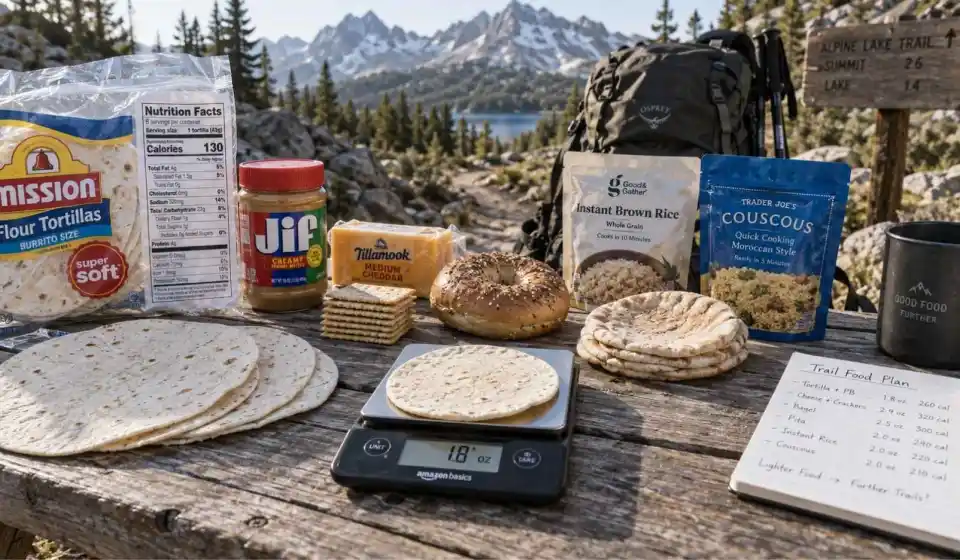
Crackers can outperform soft tortillas in calorie density because they generally contain less water, but they create another problem: fragility. A sleeve of crackers compressed beneath a cook pot can quickly become crumbs, while tortillas usually remain usable after being squeezed into an awkward food bag. 🥨 Calorie density therefore represents only one dimension of trail-food efficiency.
Bagels can provide substantial calories but are bulky and relatively dense physically, while pita bread offers a convenient pocket but can crack after being compressed. Naan can be richer and more calorie-dense depending on its recipe, although it may also be heavier per piece. Tortillas occupy an unusual middle ground where they are not necessarily the lightest carbohydrate source, yet they provide strong packability, durability, versatility, and zero-cook convenience.
Dry foods such as instant rice and couscous can look much stronger when compared strictly by calories per ounce because almost all their water has already been removed. 🍚 Their disadvantage is preparation: they normally require water, soaking, or cooking before becoming a meal. Tortillas require none of those steps, which makes comparing them purely through calorie density somewhat like comparing a tent with a tarp while ignoring setup time.
When Tortillas Make Mathematical Sense
Tortillas make the strongest case when they eliminate cooking and carry calorie-dense ingredients efficiently. A lunchtime tortilla filled with peanut butter, cheese, nut spreads, or another concentrated filling can provide substantial energy while requiring no fuel, cookware, cleanup, or water beyond what the backpacker was already carrying. ⛺ For hikers covering long days, that convenience may be worth accepting slightly lower calorie density than extremely dry foods.
Crush resistance also has real value when food must survive several days inside a tightly packed bag. A theoretically lighter cracker provides little practical advantage if it becomes powder before lunch, while a flexible tortilla can wrap around other food and tolerate compression. Trail-food efficiency therefore includes not only weight efficiency but usable-food efficiency.
Tortillas also work particularly well when one ingredient serves multiple meals. Carrying the same tortillas for breakfast wraps, lunch wraps, and dinner tacos simplifies planning and reduces the number of separate bread products in the food bag. That flexibility can be especially useful in menu templates where several ingredients are intentionally reused to reduce leftovers.
When Tortillas Become Dead Weight
The biggest tortilla mistake is carrying more tortilla than the meal requires. Oversized burrito tortillas can quietly add several ounces across a trip, especially when they surround low-calorie fillings such as small portions of vegetables or lightly filled wraps. ⚖️ What looks like a substantial meal can therefore have disappointing calorie density despite occupying considerable food-bag weight.
Unused tortillas are even worse mathematically because their calories never become hiking fuel. Packing ten tortillas for a trip where only six are realistically needed means carrying four pieces of unnecessary food from trailhead to campsite and potentially back home again. Accurate meal planning often improves backpack weight more effectively than obsessing over tiny differences between similar foods.
The same principle applies to fillings. A tortilla combined with a very wet, low-calorie filling may create a satisfying lunch but will usually produce fewer calories per ounce than a wrap containing calorie-dense fats and carbohydrates. The correct conclusion is not that one meal is universally better, but that backpackers should understand exactly what tradeoff they are making.
Trail Tortilla Quick-Reference Table
| Trail factor | Tortilla performance | What it means |
|---|---|---|
| Calories per ounce | Moderate, recipe dependent | Check individual nutrition labels |
| Carbohydrates | Usually significant | Useful meal-energy component |
| Fat | Varies widely | Higher-fat recipes may raise calorie density |
| Protein | Usually modest | Filling often supplies more protein |
| Fiber | Highly variable | Whole-grain/high-fiber versions can differ considerably |
| Physical volume | Low and flat | Easy to stack inside food bags |
| Crush resistance | Very good | Major advantage over crackers |
| Preparation | None | Excellent for zero-cook meals |
| Meal flexibility | Excellent | Works with sweet or savory fillings |
| Leftover risk | Moderate | Pack according to actual planned meals |
The Camp Kitchen Lab verdict is therefore more nuanced than “tortillas are great backpacking food.” 🥾 They are extremely practical backpacking food, but their calorie-per-ounce performance ranges from reasonable to unimpressive depending on the tortilla and the meal. Their strongest advantage comes from combining moderate calorie density with exceptional packability, durability, and meal versatility.
For your own trip, calculate the calories per ounce directly from the tortilla package, then repeat the calculation after adding the filling. That second number is the one that reveals whether your wrap is genuinely efficient trail fuel or simply convenient food carrying unnecessary weight. From there, the logical next step is comparing the result with your Calories Per Ounce Table, estimating Food Weight Per Day, and placing the winning combinations into realistic Menu Templates.