Olive Oil vs Nuts vs Peanut Butter: Which Fat Adds the Most Trail Calories for the Weight?
When backpackers start chasing higher calories per ounce, fat quickly becomes attractive because it can add hundreds of calories without adding the same weight as bulky, water-rich foods. 🥾 Olive oil, peanut butter, almond butter, walnuts, almonds, sunflower seeds, cheese, and fatty fish can all contribute fat, but they are definitely not equally calorie-dense by weight. For a hiker deciding what deserves space in a food bag, the useful question is not whether one fat is healthier than another—it is how many useful trail calories each ounce actually buys.
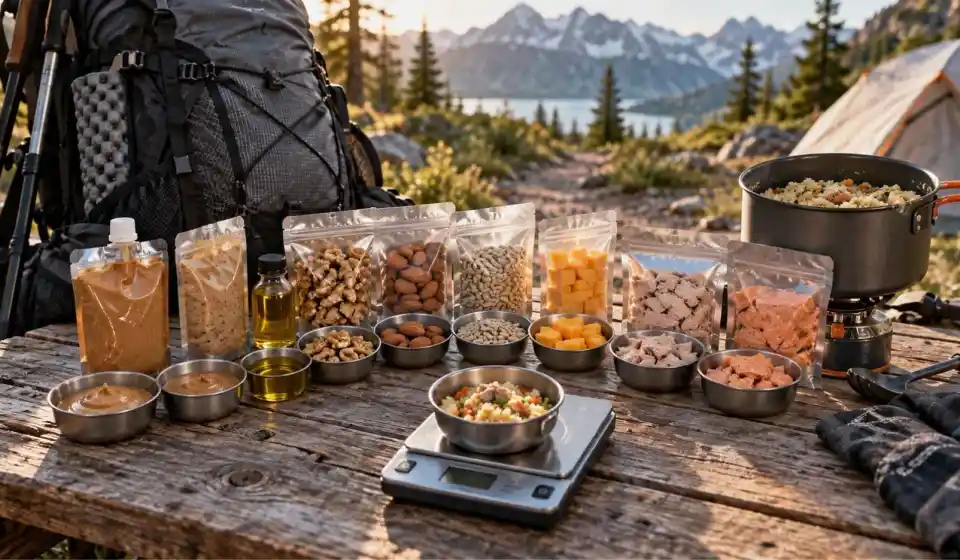
The mathematical winner is straightforward: pure olive oil provides roughly 251 calories per ounce, considerably more than walnuts at about 185, almond butter around 174, peanut butter around 170, sunflower seeds around 166, and almonds around 164 calories per ounce. Those differences become meaningful over several days, especially when a backpacker is trying to raise a menu from something like 100–120 calories per ounce toward a more weight-efficient target. 📊 However, calorie density alone cannot tell you whether you would actually enjoy eating the food or whether it completes the meal you are building.
Why 9 Calories Per Gram Changes Trail Food Math
Dietary fat is commonly assigned approximately 9 calories per gram, while protein and carbohydrate are generally calculated at roughly 4 calories per gram under the Atwater system. That means replacing some food weight dominated by carbohydrate with food weight dominated by fat can dramatically increase the calories carried in the same backpack space. 🔥 USDA documentation still uses the general 4-9-4 factors for many energy calculations, although individual foods may use more specific factors and actual foods contain combinations of nutrients, water, fiber, and other components.
This also explains why saying “nuts contain fat, so they should provide nine calories per gram” produces the wrong answer, because an almond is not a tiny container of pure fat. Almonds also contain protein, carbohydrate, fiber, minerals, and a small amount of water, while peanut butter and almond butter contain similarly mixed compositions. 🌰 Pure oil gets unusually close to the theoretical maximum because essentially the entire edible weight is fat, whereas every additional gram of protein, carbohydrate, fiber, or water reduces the food’s calories per ounce.
The Trail Calorie-Density Comparison
The following figures are useful reference values rather than promises about every brand, because commercial peanut butter, cheese, roasted nuts, flavored seeds, and fish packets can have different formulations and serving sizes. The table converts representative USDA-style values to approximately one ounce so backpackers can compare foods using the same unit instead of comparing tablespoons with handfuls and pouches. Always use the Nutrition Facts panel on the actual product when building a precise resupply spreadsheet. 🧮
| Food | Approx. kcal/oz | Fat/oz | Protein/oz | Carbs/oz | Packaging & mess | Trail practicality |
|---|---|---|---|---|---|---|
| Olive oil | 251 | 28.3 g | 0 g | 0 g | Leak risk | Excellent density |
| Walnuts | 185 | 18.5 g | 4.3 g | 3.9 g | Very low mess | Excellent snack/add-in |
| Almond butter | 174 | 15.7 g | 6.0 g | 5.3 g | Sticky | Excellent meal add-in |
| Peanut butter | 170 | 14.6 g | 6.3 g | ~6.3 g | Sticky | Excellent versatility |
| Sunflower seeds | 166 | 14.6 g | 5.9 g | 5.7 g | Low mess | Easy topping/snack |
| Almonds | 164 | 14.2 g | 6.0 g | 6.1 g | Very low mess | Excellent snack |
| Cheddar cheese | 114 | 9.4 g | 7.1 g | 0.4 g | Low mess | More temperature-sensitive |
| Tuna in oil, drained | 53 | 2.3 g | 7.5 g | 0 g | Pouch/can waste | Protein-focused |
| Canned pink salmon | 39 | 1.4 g | 6.5 g | 0 g | Pouch/can waste | Protein-focused |
Walnuts provide about 654 calories per 100 grams, almonds about 579, dried sunflower kernels about 584, and plain almond butter about 614, explaining why these foods cluster well below pure oil but remain highly weight-efficient choices. Cheese and fish demonstrate the other side of the calculation: cheddar contains substantial fat but also protein and some moisture, while tuna and salmon contain considerable water, making them much less calorie-dense despite being useful protein foods. 🐟 In other words, a high-fat food and a high-calorie-per-ounce food are related concepts, but they are not automatically the same thing.
Olive Oil vs Peanut Butter vs Almond Butter
If your only goal is maximizing energy while minimizing edible food weight, olive oil wins decisively, because an ounce contributes around 250 calories without carrying protein, carbohydrate, or meaningful water weight. Two ounces mixed across meals can therefore contribute roughly 500 additional calories for only two ounces of food, which is difficult for ordinary mixed foods to match. 🫒 The disadvantages are equally practical: straight oil is unpleasant for many people, too much can make a meal greasy, and a leaking bottle can turn calorie efficiency into a food-bag disaster.
Peanut and almond butter sacrifice some density but give the backpacker something olive oil cannot provide: a ready-to-eat combination of fat, protein, carbohydrate, texture, and flavor. 🥜 Peanut butter can go onto tortillas, oatmeal, crackers, bars, or desserts, while almond butter works similarly and representative USDA values put it slightly higher in calories per ounce than standard peanut butter. That versatility means a nut butter may be the smarter food even when oil wins the spreadsheet, because the best trail calorie is still one you can comfortably eat day after day.
Nuts, Seeds, Cheese, And Fish Solve Different Problems
Walnuts are particularly impressive for weight-conscious menus at roughly 185 calories per ounce, while almonds and sunflower kernels remain around the mid-160s and bring a crunchy format that requires almost no meal preparation. 🌻 They can be eaten directly, added to oatmeal, mixed into trail mix, sprinkled onto couscous, or combined with dried fruit when a meal needs more calories without becoming much larger. Their packaging is also forgiving: a lightweight bag is easier to manage than a liquid-oil bottle and produces little cleanup.
Cheese and fish should be judged differently because their strongest contribution may be meal structure and protein rather than maximum calorie density. 🧀 Representative cheddar provides roughly 114 calories and 7 grams of protein per ounce, whereas canned or pouch-style tuna and salmon can be much lower in calorie density because a large portion of their weight is water even when the package feels substantial. For longer or warmer trips, follow the storage instructions of the specific cheese or fish product rather than assuming that every product can safely remain unrefrigerated after opening.
What About Cost Per 1,000 Trail Calories?
Price changes too much by store, package size, country, brand, and sale cycle to pretend there is one permanent cost-per-1,000-calorie ranking, so the useful solution is to calculate the number from what you can actually buy. 💰 Take the package price, divide it by the total calories in the package, and multiply by 1,000; for example, a hypothetical $5 food containing 5,000 calories costs $1 per 1,000 calories, while a $5 food containing only 1,250 calories costs $4 per 1,000. This metric prevents a tiny inexpensive-looking pouch from appearing economical when you really need several of them to supply meaningful energy.
In ordinary grocery shopping, large containers of oil, peanut butter, seeds, and some nuts can often compete strongly because you are purchasing dense food with relatively little packaging, while individually packaged convenience products may cost more per calorie. However, the cheapest 1,000 calories are not automatically the best 1,000 trail calories, because palatability, preparation, protein contribution, portion control, and the amount you will realistically eat all matter. A useful Camp Kitchen Lab spreadsheet should therefore track calories per ounce and cost per 1,000 calories side by side rather than optimizing either number alone.
Three Ways To Add 300–500 Calories To Trail Dinner
For an instant-rice, couscous, mashed-potato, or ramen dinner, roughly 1.5 ounces of olive oil approaches 375 calories, creating an extremely weight-efficient calorie boost when the flavor and texture work with the meal. 🍚 A second strategy is adding roughly two ounces of peanut or almond butter, contributing approximately 340–350 calories while also supplying some protein and carbohydrate. A third approach is mixing approximately two ounces of walnuts with another calorie-dense ingredient, producing around 370 calories from the walnuts alone while maintaining a solid-food texture.
You can also combine smaller quantities instead of forcing one ingredient to perform the entire job—for example, oil in the cooked meal plus nuts afterward or peanut butter inside a dessert tortilla. This layered-fat strategy makes a 300–500 calorie increase easier to eat and gives the backpacker multiple textures instead of turning dinner into an oil-heavy bowl. 🏕️ It can also spread packaging risk, since losing or spilling one calorie source does not eliminate every high-density component in the menu.
When More Fat Stops Improving The Menu
Calorie density is a tool, not the entire nutrition plan, and maximizing fat indefinitely can push other useful foods out of the menu. Carbohydrate-rich foods remain practical trail fuels, while protein-containing foods contribute something that a bottle of olive oil cannot, so replacing every ounce of rice, tortillas, oats, dried fruit, beans, or protein foods simply to increase calories per ounce misses the point. ⚖️ The better question is whether adding fat raises menu density without making the overall menu harder to eat, poorly balanced, or mismatched with your hiking demands.
A simple approach is to build meals around the foods you already want for carbohydrate and protein, then use oil, nut butter, nuts, seeds, or cheese as calorie-density knobs that can be turned upward when the menu weighs too much. Your ideal amount will depend on total energy requirements, trip duration, hiking intensity, appetite, food tolerance, climate, and personal preferences rather than one universal macro percentage. Individual nutrition needs vary, so hikers with medical conditions or specific dietary requirements should discuss major dietary changes with an appropriate qualified professional.
The Bottom Line: Oil Wins The Math, Mixed Foods Often Win The Meal
For the narrow question “Which fat adds the most trail calories for the weight?”, olive oil is the clear mathematical answer at roughly 251 calories per ounce, followed by especially dense foods such as walnuts, almond butter, peanut butter, sunflower seeds, and almonds. 🏆 But olive oil contributes essentially nothing besides fat and calories, whereas nuts, seeds, nut butters, cheese, and fish can simultaneously contribute protein, carbohydrate, texture, flavor, and greater meal variety. That is why the highest-calorie food on the table should not automatically become the largest component of the food bag.
Think of olive oil as the pure calorie-density lever, nut butters as versatile calorie boosters, nuts and seeds as highly packable solid calories, cheese as a calorie-plus-protein ingredient, and fish packets primarily as protein foods rather than ultralight calorie sources. Used together, those categories make it easier to build a food bag that is both weight-efficient and realistically enjoyable over several days instead of chasing one impressive calories-per-ounce number. 🎒 For Camp Kitchen Lab menu design, the winning strategy is therefore not “carry the fattiest food possible,” but use concentrated fat strategically while leaving enough room for the carbohydrates, protein, flavor, and variety that make the full trail menu work.