Oxygen Absorbers vs. Vacuum Sealing: Which Is Better for Storing Trail Food?
If you prepare your own backpacking food, you have probably encountered two popular storage methods: oxygen absorbers and vacuum sealing.
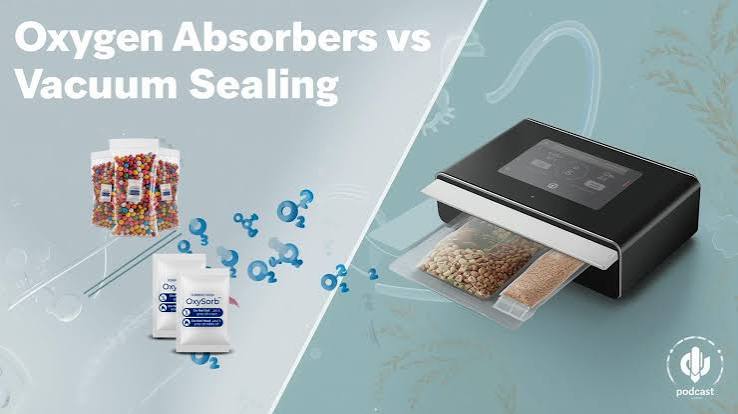
Both are designed to reduce exposure to oxygen, but they work in different ways. One removes air mechanically before sealing, while the other uses a chemical process to absorb residual oxygen inside a sealed package.
So which method is better for trail food?
The answer depends on what you are storing, how long you want to keep it, and whether the food is genuinely shelf stable. Neither method is a universal solution, and neither should be confused with a substitute for proper food-safety practices.
Understanding the differences can help you choose the right packaging system for everything from homemade dehydrated vegetables to jerky and long-term freeze-dried meals.
What Does Oxygen Actually Do to Food?
Oxygen is one of the major causes of food-quality deterioration.
When oxygen interacts with certain components of food, it can contribute to oxidation. Fats are particularly important because oxidation can eventually produce rancid flavors and odors.
Oxygen can also contribute to changes in color, flavor, and nutrient quality.
This is why long-term food packaging often focuses on limiting both oxygen and moisture.
However, removing oxygen does not stop every type of deterioration. Temperature, humidity, light, ingredients, and packaging quality all continue to matter.
How Vacuum Sealing Works
Vacuum sealing uses a machine to remove much of the air from a package before sealing it.
The result is a tightly compressed package with less air surrounding the food.
This can be especially useful for backpacking because vacuum-sealed food takes up less space and is often easier to organize.
For example, you might vacuum seal portions of dehydrated vegetables, dry pasta, or properly prepared jerky.
The major advantage is mechanical air removal.
The major limitation is that vacuum sealing does not necessarily remove every bit of oxygen.
Some air remains in the package, including air trapped between pieces of food.
How Oxygen Absorbers Work
An oxygen absorber works differently.
Instead of removing air mechanically, it contains materials that react with oxygen and reduce the oxygen concentration inside a properly sealed package.
This makes oxygen absorbers particularly useful when you want to reduce residual oxygen after packaging.
They are commonly associated with long-term storage of dry foods.
However, the food itself needs to be appropriate for this type of storage.
An oxygen absorber is not a food preservative that makes moist or perishable food safe.
Vacuum Sealing vs. Oxygen Absorbers
The basic difference can be summarized like this:
| Feature | Vacuum Sealing | Oxygen Absorber |
|---|---|---|
| Removes air mechanically | Yes | No |
| Reduces residual oxygen | Partially | Yes |
| Compresses food | Yes | No |
| Useful for portion control | Excellent | Good |
| Requires airtight packaging | Yes | Yes |
| Good for dry foods | Yes | Yes |
| Makes perishable food shelf stable | No | No |
| Helps long-term dry-food storage | Yes | Yes |
Neither method automatically wins.
They solve slightly different packaging problems.
Vacuum Sealing Is Excellent for Backpack Organization
One major advantage of vacuum sealing is physical efficiency.
Backpackers care about volume almost as much as weight.
A bulky bag of snacks can take up valuable space.
Vacuum sealing can compress certain foods, allowing you to create compact portions.
It can also protect food from spills and external moisture when the seal remains intact.
For a three-day trip, individually sealed meal portions can make food organization much easier.
You know exactly how much food you have, and unused portions remain sealed.
Oxygen Absorbers Are More Interesting for Long-Term Storage
If your goal is to store dry food for months or years, oxygen absorbers become more relevant.
A properly selected oxygen absorber can reduce the amount of oxygen remaining inside a sealed package.
This can help slow oxidation in appropriate dry foods.
That can be useful for long-term storage of certain dehydrated or freeze-dried ingredients.
But packaging quality is critical.
If the container is not sufficiently airtight, oxygen from outside the package can continue entering.
In that situation, the absorber may become exhausted while the food remains exposed to oxygen.
Moisture Is Just as Important
One of the biggest mistakes in trail-food storage is focusing on oxygen while ignoring moisture.
Removing oxygen does not compensate for poorly dried food.
If homemade vegetables or fruit retain too much moisture, long-term storage becomes much more complicated.
For dehydrated food, proper drying must happen before packaging.
The packaging method comes afterward.
Think of preservation as a chain:
Safe preparation → adequate drying → appropriate packaging → suitable storage conditions.
Breaking the chain at the beginning cannot be fixed simply by adding an oxygen absorber.
What About Jerky?
Jerky is a special case.
Commercial jerky is specifically manufactured to be shelf stable.
Homemade jerky requires more attention to preparation, drying, and storage.
USDA recommends heating meat to 160°F and poultry to 165°F before dehydrating as part of safe jerky preparation.
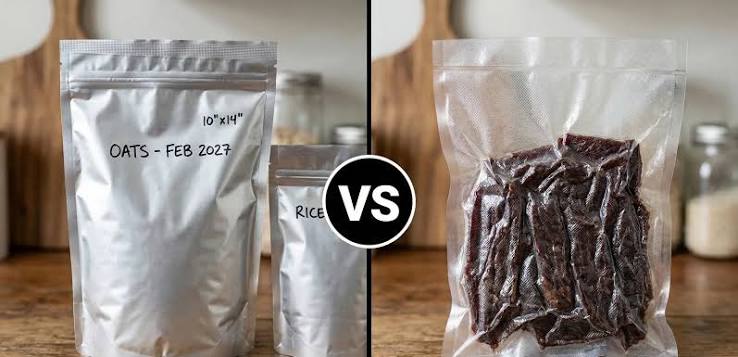
Vacuum sealing can be useful for portioning properly prepared jerky.
However, vacuum sealing does not turn improperly prepared or inadequately dried meat into safe shelf-stable food.
Oxygen absorbers should likewise not be viewed as a safety solution for homemade meat products.
Trail Mix and Nuts
Trail mix presents a different challenge.
Nuts and seeds contain fats, and those fats can oxidize over time.
Reducing oxygen can therefore help preserve quality.
Vacuum sealing may be useful for short- or medium-term storage and for creating individual hiking portions.
For longer storage of appropriate dry products, oxygen absorbers can further reduce residual oxygen inside suitable packaging.
But temperature remains important.
A sealed bag of nuts stored in a hot garage can still experience accelerated quality deterioration.
Reducing oxygen does not eliminate the effects of heat.
Freeze-Dried Meals
Commercial freeze-dried meals are already packaged specifically for long-term storage.
If the manufacturer provides a long shelf-life claim, it is usually better to leave the original package intact rather than repackage it unnecessarily.
The original packaging is part of the product’s preservation system.
For homemade freeze-dried or dehydrated ingredients, packaging decisions become more important.
You need a container that provides an appropriate barrier against moisture and oxygen.
When Vacuum Sealing Is the Better Choice
Vacuum sealing is particularly useful when:
- You are preparing food for an upcoming trip.
- You want compact portions.
- You want to reduce bulk.
- You are storing properly dried foods for relatively short periods.
- You want individually packaged meals or snacks.
- You want protection from external moisture and air.
For many backpackers, these practical advantages are enough.
When Oxygen Absorbers Make More Sense
Oxygen absorbers are more useful when:
- The food is appropriately dry.
- You are planning longer-term storage.
- Oxidation is a major concern.
- The packaging is designed to be airtight.
- You want to reduce residual oxygen after sealing.
- You are building a larger emergency food supply.
The key word is appropriate.
Not every food belongs in an oxygen-depleted package.
Can You Use Both?
In some dry-food storage applications, vacuum sealing and oxygen absorbers can complement each other.
Vacuum sealing removes much of the air.
An oxygen absorber can address residual oxygen inside a properly sealed package.
But combining methods does not automatically create a better system for every food.
For backpackers, it can also be unnecessary complexity.
If you are preparing snacks for a weekend trip, vacuum-sealed portions may be all you need.
For long-term storage, the packaging system should be selected according to the food and intended storage period.
Storage Temperature Still Matters
Regardless of the packaging method, storage conditions remain important.
A cool, dry, temperature-stable environment is generally preferable for long-term dry-food storage.
Heat can accelerate oxidation and other chemical reactions.
Humidity can damage dried foods and packaging.
Light can also affect certain foods over time.
Therefore, don’t interpret oxygen control as permission to store food in an attic, hot car, or unconditioned garage.
A Common Myth: Vacuum Sealed Means Shelf Stable
This is one of the most dangerous misconceptions.
Vacuum sealing does not make fresh meat safe to store at room temperature.
USDA warns that vacuum packaging does not eliminate the need for refrigeration of perishable meat and poultry.
The reduced-oxygen environment can actually create specific food-safety considerations for some foods.
The safest approach is to determine whether the food is shelf stable before choosing a packaging technique.
Packaging cannot replace appropriate temperature control.
A Practical Backpacker’s Decision Tree
Ask yourself three questions.
Question one: Is the food properly shelf stable?
If not, stop. Neither method replaces refrigeration.
Question two: How long will I store it?
For a short trip, simple airtight packaging or vacuum sealing may be sufficient.
For long-term dry-food storage, oxygen control becomes more important.
Question three: Does the food contain significant fat or remain sensitive to moisture?
If yes, packaging and temperature deserve additional attention.
Final Thoughts
Oxygen absorbers and vacuum sealing are not competing technologies so much as different tools.
Vacuum sealing removes much of the air and creates compact, convenient packages.
Oxygen absorbers reduce residual oxygen inside appropriately sealed packages and can be valuable for longer-term storage of suitable dry foods.
For backpackers, the best choice depends on the food and the purpose.
Use vacuum sealing when compact portions and convenience are priorities.
Consider oxygen absorbers when you are storing suitable dry foods for longer periods.
And remember the most important rule: neither method makes unsafe or perishable food safe at room temperature.
Proper preparation, adequate drying, suitable packaging, and appropriate storage conditions all have to work together.
The goal isn’t to remove as much oxygen as possible.
The goal is to create a storage system that matches the food you’re actually trying to preserve.