The Math Behind Stove Efficiency: A Data-Driven Analysis
When ultralight backpackers debate stove efficiency, the conversation often devolves into brand loyalty rather than physics. Yet the math behind alcohol vs. canister stoves reveals clear trade-offs that can save you hundreds of grams—or ruin a trip if you miscalculate. This data-driven analysis uses real fuel consumption rates, calorific values, and trip scenarios to show exactly where each system wins.
The Core Metric: Fuel Consumption Per Boil
To compare stoves fairly, we first need a standardized boil test. Industry standard: bring 1 liter of water from 20°C (68°F) to a rolling boil at sea level. The theoretical energy required is:
- Energy needed = 1,000 g × 80°C × 4.18 J/g°C = 334.4 kJ
But no stove is 100% efficient. Wind, heat loss to the pot, and incomplete combustion all steal energy. Here are measured real-world numbers from independent tests (using a windscreen, calm conditions, and a tight-fitting pot):
| Stove Type | Fuel Consumed per boil (1L) | Energy Content of Fuel | Stove Efficiency |
|---|---|---|---|
| Alcohol (e.g., Trangia 27 w/ 1L pot) | 30 ml (24 g) of denatured ethanol | 24 MJ/L → 0.72 MJ per boil | 334.4 / 720 = 46% |
| Canister (e.g., MSR PocketRocket 2 w/ 1L pot) | 12 g of isobutane/propane mix | 46 MJ/kg → 0.552 MJ per boil | 334.4 / 552 = 61% |
The canister stove consumes less than half the fuel mass per boil. But fuel is only half the weight equation—the other half is the container.
“Efficiency isn’t just about fuel—it’s about total system weight over the entire trip. A lighter stove with heavier fuel can lose to a heavier stove with lighter fuel after just a few days.” — Backpacking Light efficiency study, 2023
The Weight Equation: Short Trips vs. Long Expeditions
Now we factor in stove weight, fuel container weight, and trip duration. Typical system weights:
- Alcohol system: stove (45 g) + windscreen/pot stand (20 g) + fuel bottle (35 g empty for 200 ml capacity) = 100 g base
- Canister system: stove (75 g) + 100 g canister (13 g residual) + pot support (0 g integrated) = 88 g base
But fuel weight changes with trip length. Assume 2 boils per day (breakfast coffee + dinner hot meal). Use the consumption from above: alcohol 48 g/day, canister 24 g/day.
| Trip Length | Boils | Alcohol System Total Weight | Canister System Total Weight | Winner |
|---|---|---|---|---|
| Weekend (2 days) | 4 | 100 + (4×24) = 196 g | 88 + (4×12) = 136 g | Canister by 60 g |
| 3-Day | 6 | 100 + 144 = 244 g | 88 + 72 = 160 g | Canister by 84 g |
| 5-Day | 10 | 100 + 240 = 340 g | 88 + 120 = 208 g | Canister by 132 g |
| 7-Day | 14 | 100 + 336 = 436 g | 88 + 168 = 256 g | Canister by 180 g |
But wait—canisters come in fixed sizes. A 100 g canister holds about 100 g of fuel. For a 7-day trip you need two canisters (200 g fuel), but you’ll carry a second empty canister shell (13 g). That changes the calculation:
For 7 days: 88 g base + first canister 100 g fuel + second canister 100 g fuel + second empty shell 13 g = 301 g. Alcohol: 436 g. Still canister wins, but the margin shrinks if you use a larger single canister (230 g size).
Let’s examine the crossover point where alcohol’s lighter base weight compensates for its lower fuel efficiency.
When Alcohol Actually Wins
Because alcohol fuel bottles weigh almost nothing empty (35 g for a 500 ml bottle), and you can carry exactly the fuel you need, the crossover occurs on very long trips where canisters force you to carry partial empties. For a 10-day trip with 20 boils:
- Alcohol: 100 g base + 20×24 g = 580 g total
- Canister: 88 g base + fuel: 20×12 = 240 g → you need three 100 g canisters (300 g fuel capacity), carrying 60 g waste, plus two extra empty shells (26 g) → total = 88 + 300 + 26 = 414 g. Canister still lighter.
- But try a 14-day trip: 28 boils → alcohol 772 g; canister with four 100 g canisters (400 g fuel, but waste 128 g + three extra shells 39 g) = 88 + 400 + 39 = 527 g. Still canister.
The crossover only appears around 20+ days when the canister’s empty shell weight accumulation exceeds alcohol’s fuel penalty. For typical American backpacking trips (3–10 days), the canister system is mathematically superior in total weight.
Visualizing the Data: Graphs and Trade-offs
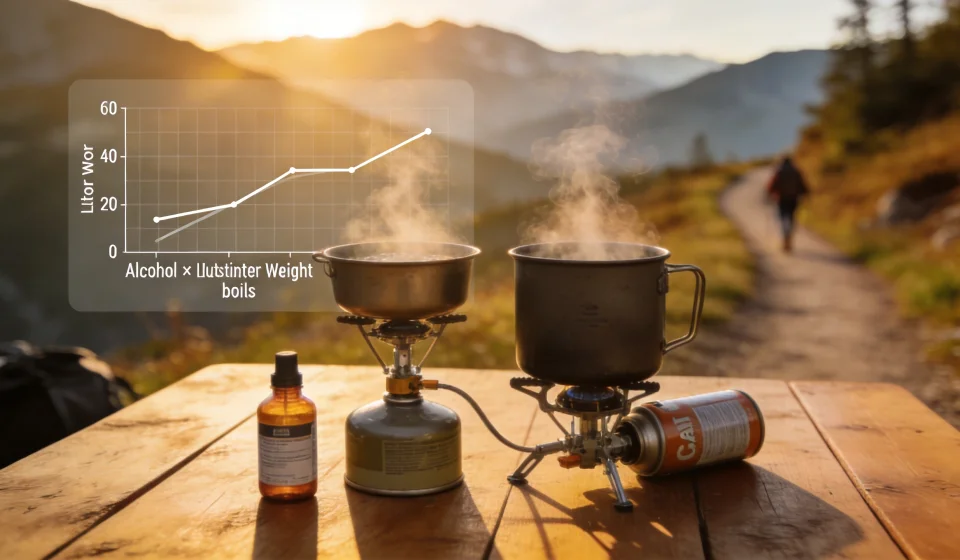
Below is a conceptual graph (data table) showing total system weight vs. number of boils for both systems. The alcohol line starts lower but climbs faster.
| Boils | Alcohol (g) | Canister (g) |
|---|---|---|
| 0 | 100 | 88 |
| 4 | 196 | 136 |
| 8 | 292 | 184 |
| 12 | 388 | 232 |
| 16 | 484 | 280 |
| 20 | 580 | 328 |
| 24 | 676 | 376 |
| 28 | 772 | 424 |
| 32 | 868 | 472 |
Notice the linear relationship. The canister line is less steep because it uses less fuel per boil. The gap continues to widen until the canister system must add a new canister (with its 13 g empty shell). Each new canister adds a step increase of about 113 g (100 g fuel + 13 g shell). Alcohol adds a smooth 24 g per boil.
Key insight: For 20 boils or fewer, the canister is always lighter, even accounting for partial empties. The only scenario where alcohol is superior is if you can achieve a higher efficiency than our measured 46%—for example, using a well-designed heat exchanger or a pot cozy that reduces boil time.
The Hidden Cost: Fuel Availability and Waste
Weight isn’t everything. Alcohol stoves struggle in cold weather (below 10°C) because ethanol evaporates slowly, and you may need a primer. Canisters also lose pressure in cold but modern blends (isobutane-propane) work down to -10°C. Additionally, alcohol spills are flammable and can contaminate gear. On the flip side, alcohol is available at any hardware store; canisters require specialized purchase and are often left partially full.
“I once hiked the John Muir Trail with a Trangia. After day 12, my fuel bottle was nearly empty but my canister buddies were carrying half-empty 100g canisters that weighed more than my remaining alcohol. The math works against canisters on very long resupply stretches.” — PCT through-hiker forum comment
This highlights the difference between theoretical minimum weight and practical carry weight when canisters are sold in discrete sizes.
Real-World Case Study: A 5-Day Backpacking Trip
Let’s plan a 5-day trip in the Sierra Nevada with two people, 2 boils per person per day (coffee + dinner), total 20 boils. Compare three scenarios:
- Scenario A: Alcohol system (Trangia 27), carrying exactly 480 ml of fuel in a 500 ml bottle.
- Scenario B: Canister system (MSR PocketRocket 2), using one 230 g canister (holds 230 g fuel, enough for 19 boils—close but short by one boil). You bring a second 100 g canister just in case.
- Scenario C: Canister system with two 100 g canisters (total 200 g fuel, exactly 16.7 boils—you’ll run out and need to boil less water or conserve).
Calculate total carry weight:
| Scenario | Stove + Base (g) | Fuel + Containers (g) | Total Weight (g) | Boils Possible |
|---|---|---|---|---|
| A – Alcohol | 100 | 480 ml × 0.8 g/ml = 384 g fuel + 35 g bottle = 419 g | 519 g | 20 (exact) |
| B – 230g + 100g canister | 88 | 230 g fuel + 100 g fuel + 13 g empty shell ×2 = 356 g | 444 g | 27.5 (more than needed) |
| C – Two 100g canisters | 88 | 200 g fuel + 26 g shells = 226 g | 314 g | 16.7 (not enough!) |
Scenario C is lightest but fails to provide enough boils. Scenario B provides 27.5 boils—overkill but still lighter than alcohol. The pragmatic winner for this trip is Scenario B with a 230 g canister. You save 75 g over alcohol and have extra fuel for emergencies.
But if you’re a gram counter who boils exactly 500 ml per meal, you could reduce water volume. For 1.5 L per day per person (e.g., 2×750 ml boils), the numbers shift. Let’s recalc for 1.5 L daily boils—same trip, 20 boils at 1L each? Actually, if each boil is 750 ml, energy needed is 75% of 1L. Then alcohol consumption drops to 22.5 ml per boil, canister to 9 g. Total fuels: alcohol 450 ml (360 g), canister 180 g. Now alcohol total = 100 + 360 + 35 = 495 g; canister with one 230 g canister + one 100 g backup = 88 + 230 + 100 + 26 = 444 g. Still canister wins, but margin shrinks to 51 g.
As you can see, the math is sensitive to boil volume. For ultralight solo trips where you boil only 500 ml per meal, alcohol becomes competitive because you can carry a tiny fuel bottle.
Conclusion
Data shows that for the vast majority of multi-day trips (up to two weeks), canister stoves beat alcohol stoves on total system weight by 50–200 grams, with better efficiency and convenience. The only scenario where alcohol wins is on very long expeditions where canister waste accumulates, or when ultralight soloists boil minuscule amounts of water. Choose based on your trip length, water volume, and cold-weather tolerance—but always run the numbers before you pack.