Cooked vs Dry Weight: The Backpacking Food Measurement Mistake That Changes Everything
A cup of cooked rice and a cup of dry rice are not remotely the same amount of food, yet nutrition discussions often compare them as though they were interchangeable. 🍚 For backpackers, that confusion can completely distort calorie-per-ounce calculations because water can double or triple a food’s weight without supplying meaningful calories. If you are building a trail menu based on the weight actually carried in your backpack, the preparation state of every ingredient matters.
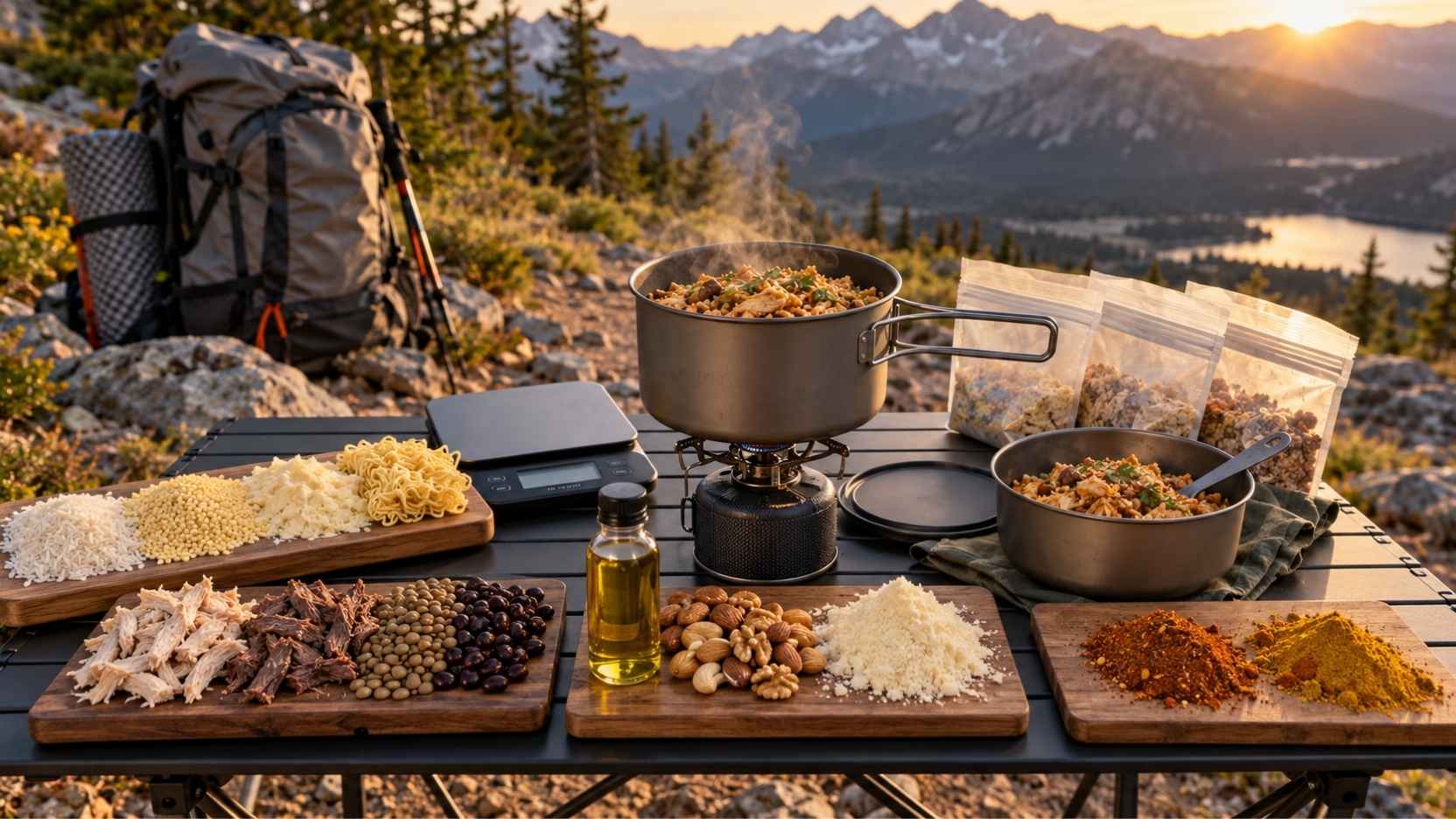
That leads to one of the most useful rules for Camp Kitchen Lab: calculate trail calorie density from the dry or packaged food you actually carry, not from the hydrated food sitting in your bowl at camp. A dry ingredient may look mediocre in a nutrition database if you accidentally select the cooked entry, even though it becomes substantially more calorie-dense when measured before water is added. 🎒 Understanding this distinction makes comparisons among rice, oats, pasta, couscous, potatoes, and dehydrated beans much more meaningful.
The Trail Calorie-Density Equation Backpackers Need
For basic menu planning, the calculation is straightforward: trail calorie density = total calories ÷ dry packed ounces of food. If a dry meal weighs 4 ounces and supplies 500 calories, its food calorie density is 125 calories per ounce, even if adding water eventually turns it into 10 or 12 ounces of prepared dinner. 💧 Water collected at camp changes the final bowl weight, but it was not part of those 4 ounces carried from the trailhead.
This distinction becomes especially important when comparing home foods with backpacking foods because most nutrition databases contain multiple entries for the same ingredient. Rice may appear as dry, cooked, enriched, unenriched, long-grain, instant, or prepared with other ingredients, and each entry can show a dramatically different number per 100 grams. The calories are not mysteriously appearing or disappearing; you are often comparing different amounts of actual dry food because their water content differs.
Why Cooking Changes Weight More Than Calories
Many dry carbohydrates absorb substantial amounts of water as they cook, causing their weight and volume to increase considerably. A 100-gram dry portion might become roughly 250 to 300 grams after preparation depending on the ingredient, cooking method, and how much water remains in the finished food. 🔬 The same original portion still contains approximately the energy it started with unless calories were added through oil, sugar, sauce, broth solids, or another ingredient, or meaningful solids were discarded during preparation.
Imagine pouring water into a backpacking meal pouch: you have increased the total weight of the meal, but you have not created carbohydrate, fat, or protein merely by adding plain water. Consequently, dividing the same calories by a much larger prepared weight produces a lower calories-per-ounce figure. That lower number accurately describes the hydrated meal in your bowl, but it does not accurately describe the dry food weight you carried down the trail.
Rice: The Classic Dry Vs Cooked Calorie Confusion
Dry white rice commonly provides roughly 350 to 370 calories per 100 grams, although the exact figure varies by rice type and manufacturer. After cooking with water, 100 grams of cooked rice may contain only roughly 120 to 140 calories because much of that cooked weight is now water. 🍚 It does not mean cooking destroyed more than half the calories from the original portion; it means 100 grams of cooked rice contains considerably less dry rice than 100 grams measured before cooking.
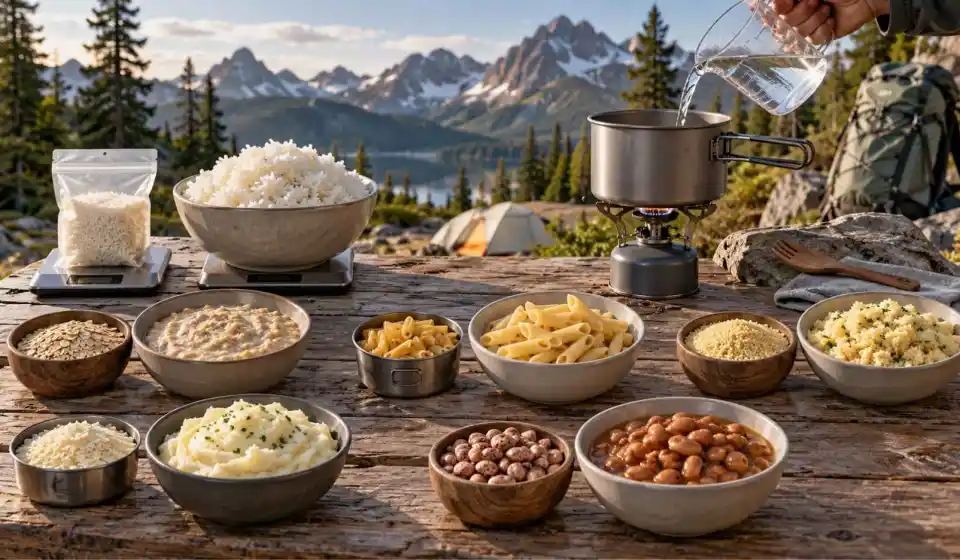
Suppose you pack 100 grams of dry rice containing around 360 calories and then cook it until the finished batch weighs about 280 grams. You still began with approximately 360 calories from that rice, but those calories are now distributed across roughly 280 grams of prepared food instead of 100 grams of dry food. For backpacking calculations, the 100 grams you carried is the relevant starting weight, while the final cooked weight matters more for portion size and how much food ends up in your bowl.
Oatmeal Shows The Same Water-Weight Effect
Dry oats are another easy place to make this mistake because cooked oatmeal looks much heavier and larger than the dry portion used to make it. Plain dry rolled oats are typically around the upper-300-calorie range per 100 grams, while oatmeal prepared with water can fall dramatically lower on a per-100-gram basis because the finished bowl contains so much added water. 🥣 Comparing those two database entries without checking preparation state can make the oats appear to lose most of their energy during cooking.
For a backpacker portioning breakfast at home, weighing 60 grams of dry oats is therefore more informative than weighing the finished oatmeal after hydration. Add hot water on the trail and the meal becomes heavier, but that additional water may have been collected only minutes before eating. If you add powdered milk, nuts, seeds, sugar, or nut butter, however, those ingredients contribute both additional calories and additional carried dry weight and should be included separately.
Pasta And Couscous Can Create The Same Trap
Dry pasta is generally several times more calorie-dense by weight than its cooked form appears to be because cooked noodles contain a large amount of absorbed water. Typical dry pasta is often around 350 to 380 calories per 100 grams, whereas cooked pasta commonly lands much lower per 100 grams after hydration. 🍝 That makes dry pasta far more sensible in a backpacking calorie-density calculation than a database value describing noodles that have already been boiled.
Couscous demonstrates the same principle and is particularly useful for explaining why preparation logistics belong beside nutrition numbers. Dry couscous is compact and calorie-dense compared with its hydrated form, and it can absorb hot water directly rather than requiring the longer boiling time associated with many conventional pastas. For trail planning, you should therefore compare dry couscous weight with dry pasta weight, then separately evaluate water requirements, fuel use, cooking time, and cleanup.
Instant Mashed Potatoes Make The Difference Obvious
Instant potato flakes provide one of the clearest demonstrations of why dehydration matters for backpackers. 🥔 Dry flakes commonly provide roughly 350 calories per 100 grams, while prepared mashed potatoes contain far fewer calories per 100 grams because water has been returned to the food. The ingredient did not suddenly become low-energy after rehydration; its calories simply became diluted across a heavier finished portion.
That difference explains why dehydrated potatoes can be practical even though fresh boiled potatoes are relatively heavy for the calories they provide. With flakes, the backpacker carries mostly the dry potato solids and can add water when preparing the meal rather than transporting that water for miles. Additions such as powdered cheese, olive oil, milk powder, or seasoning can change both calorie density and sodium, so the complete recipe should be calculated rather than treating every mashed-potato meal as identical.
Beans And Dehydrated Beans Need Clear Labels
Beans can become especially confusing because nutrition information may refer to dry beans, soaked beans, cooked beans, canned beans, or commercially dehydrated and precooked beans. 🫘 Dry uncooked beans frequently contain roughly 330 to 350 calories per 100 grams, while cooked beans may show numbers closer to roughly 110 to 150 calories per 100 grams depending on the variety and preparation. Much of that difference again comes from the water absorbed during soaking and cooking rather than from some dramatic disappearance of food energy.
For backpackers, commercially dehydrated precooked beans are a different logistical product from ordinary uncooked dry beans even when the ingredient name looks similar. Traditional dried beans may require long soaking and cooking, while dehydrated precooked beans are designed to rehydrate much faster, making cooking time and stove fuel part of the comparison. 🔥 A useful backpacking database should therefore identify not only dry versus cooked, but also whether an ingredient is raw-dry, instant, dehydrated after cooking, or ready to eat.
The Calories-Per-Ounce Trap
Consider a hypothetical food containing 400 calories in a 4-ounce dry portion: that equals 100 calories per dry ounce. After adding 8 ounces of water, the prepared food weighs 12 ounces, so dividing 400 calories by the finished weight produces only about 33 calories per prepared ounce. 📉 Both calculations can be mathematically correct, but they answer completely different questions.
The 33-calorie figure tells you how energy-dense the food is while sitting hydrated in your bowl, whereas the 100-calorie figure tells you how efficiently the dry food used space and weight in your food bag. Backpackers deciding what to carry generally need the second number because water obtained during the trip was never part of the packed food weight. Confusing these measurements can make dehydrated ingredients look unnecessarily inefficient and can distort comparisons across an entire multi-day menu.
Water You Carry Still Counts
There is one important exception to the idea that hydration water can be ignored: sometimes you actually must carry that water. If a dry camp or long waterless section requires you to leave the previous source with enough water for both drinking and dinner, the water added to your meal becomes part of your temporary pack weight. 🚰 The food itself may still be 120 calories per dry ounce, but your full carried system is heavier because you are transporting the water required to prepare it.
This is why calorie density should not be treated as the only metric in backpacking food planning. Water availability, stove fuel, cooking time, appetite, food volume, packaging, cleanup, cost, and preparation convenience can all affect which food makes sense for a particular route. A dehydrated meal may be extraordinarily efficient where water is abundant but less attractive when every ounce of cooking water must also be hauled uphill.
The Camp Kitchen Lab Measurement Standard
To prevent these mistakes, Camp Kitchen Lab can use one consistent methodology across future food comparisons: measure grams first, record the dry or packaged state, identify preparation status clearly, obtain calorie information from the manufacturer or authoritative food-composition data, and convert the result into calories per dry ounce. ⚖️ Gram measurements reduce the ambiguity created by phrases such as “half a cup,” since half a cup of dry rice and half a cup of cooked rice represent radically different quantities of food. Volume can still be shown for convenience, but weight should be the foundation of the calculation.
Every future food table should therefore label entries with terms such as dry, cooked, dehydrated, instant, ready-to-eat, or prepared, rather than displaying a calorie number without context. When comparing packaged foods, the label on the exact product should take priority because formulations can vary, and added oils, sugars, milk powders, or seasonings can materially change the result. This creates a measurement system that can connect naturally to a 125+ calorie-per-ounce food database, trail menu builder, dehydration guides, and daily calorie calculations.
The Bigger Lesson: Measure What Goes Into The Backpack
The question “Does rice have more calories uncooked than cooked?” has a surprisingly simple answer once the measurement problem is removed. The dry rice does not gain some special calorie advantage merely because it has not been cooked; 100 grams of dry rice simply contains far more rice solids and far less water than 100 grams of cooked rice. 🍚 Compare equal original portions rather than equal post-cooking weights and the apparent contradiction largely disappears.
For backpackers, that lesson changes how nearly every dehydrated staple should be evaluated, from oats and pasta to couscous, potatoes, quinoa, beans, and complete trail meals. Start with the food in the state that actually enters your pack, calculate calories from that dry weight, and treat water added later as a separate logistics question. 🎒 Once that standard becomes automatic, calorie-density calculations become considerably more consistent—and building a lighter, more accurately measured trail menu becomes much easier.