The One-Pot Trail Meal Formula: How to Build a Complete Backpacking Dinner Without a Recipe
Backpacking dinner does not need to mean carefully following a recipe while measuring five ingredients beside a tiny stove after hiking all day. 🥾 A much simpler approach is to build every dinner from the same four pieces: carbohydrate base + protein component + calorie booster + flavor system. Once you understand that formula, rice can become couscous, chicken can become beans, olive oil can become nuts, and taco seasoning can become curry without rebuilding your entire menu.
The advantage is flexibility rather than culinary perfection, because the formula lets you estimate calories, food weight, and macronutrients before leaving home. A meal can be designed around 500, 700, or 900 calories simply by changing portions instead of learning a completely different recipe. 🎒 Those numbers are examples for meal-planning arithmetic, not individualized calorie recommendations, since total energy needs vary substantially with body size, mileage, terrain, pace, conditions, and the rest of the day’s food.
Why Complicated Backpacking Recipes Fail In The Real World
A beautiful camping recipe may look easy in a kitchen but become frustrating when your equipment consists of one pot, one spoon, a small stove, and a limited amount of fuel. Ingredients that require separate cooking times, draining, frying, chopping, or constant attention add work precisely when many hikers would rather eat and rest. 🔥 Every extra preparation step can also mean more fuel, dirty cookware, measuring, packaging, and ingredients to remember.
This is why a backpacking meal formula can be more useful than collecting dozens of unrelated recipes. You measure the ingredients at home, combine compatible dry ingredients in a meal bag, and perform as little decision-making as possible at camp. The goal is not to create restaurant food in the wilderness; it is to create a dinner that provides useful energy and macronutrients while remaining practical to carry, cook, and clean up.
The Four-Part Trail Meal Formula
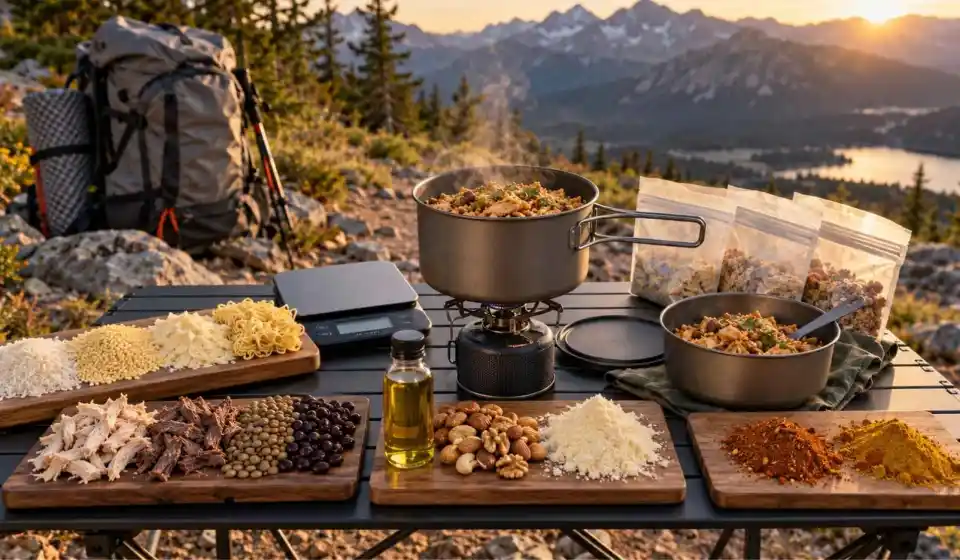
Start with the carbohydrate base, which usually provides the largest physical portion of the dinner and much of its carbohydrate: instant rice, couscous, instant potatoes, noodles, or another quick-cooking grain can fill this role. Next comes a protein component, such as dehydrated meat, dried beans, lentils, chicken, tuna, textured vegetable protein, or another shelf-stable option appropriate for your trip. 🍚 These first two components create the structure of the meal, but they do not necessarily make it calorie-dense enough for weight-conscious backpacking.
That is where the calorie booster becomes important, with possibilities including olive oil, nuts, seeds, cheese, nut butter, or another compact ingredient that works with the meal. Finally, the flavor system—taco seasoning, curry powder, bouillon, dried herbs, powdered cheese, chili flakes, soy-sauce powder, or similar ingredients—prevents the meal from tasting like four unrelated ingredients stirred into hot water. 🌶️ Think of the formula as interchangeable building blocks rather than fixed recipes.
How Many Calories Should Each Component Contribute?
Instead of beginning with exact percentages, begin with a desired meal total and work backward using nutrition labels. For an illustrative 500-calorie dinner, you might combine roughly 200 to 250 calories of carbohydrate base, 100 to 150 calories of protein food, and another 100 to 150 calories from oil, nuts, cheese, or other additions. 🧮 Seasonings may contribute very few calories or considerably more depending on whether the flavor system includes ingredients such as powdered cheese, coconut milk powder, or peanut powder.
The same arithmetic scales upward: a roughly 700-calorie meal might contain around 300 calories from a grain or potato base, 150 to 200 from the protein component, and 200 or more from calorie-dense additions. A 900-calorie version can simply use larger portions or more calorie-dense ingredients rather than requiring an entirely different recipe. These examples are useful planning templates, but the important habit is adding the actual calories printed on your ingredients rather than assuming every rice, noodle, meat, or cheese product has the same nutrition profile.
Rice Vs Couscous Vs Instant Potatoes Vs Noodles
Instant rice is predictable, mild, widely available, and easy to combine with almost any seasoning, although it still requires enough water and heat to rehydrate properly. Couscous is especially convenient because its tiny granules generally hydrate quickly, making it attractive when conserving stove fuel or minimizing cooking time matters. 🍜 Instant potato flakes are another quick option and can create a thick, satisfying base without carrying the water found in fresh cooked potatoes.
Noodles vary more because some are simply dried wheat products while instant ramen-style noodles may contain substantially more fat and therefore more calories per ounce. Dry carbohydrate bases commonly land around roughly 90 to 130 calories per ounce, but the exact number depends on the product and should be checked from its label. The best base is therefore not automatically whichever has the highest number; water requirements, cooking time, package size, texture, and the other ingredients in your meal also matter.
Protein Options That Actually Work In A Backpack
Dehydrated meat can be especially weight-efficient because much of its original water has already been removed, although cost and availability may be greater than ordinary grocery-store foods. Tuna and chicken pouches are extremely convenient because they require no rehydration, but the moisture inside them means you are carrying additional water weight compared with properly dried ingredients. 🥩 Beans, lentils, textured vegetable protein, and certain powdered or dehydrated foods can provide additional options for hikers who want inexpensive, vegetarian, or shelf-stable components.
The important distinction is protein grams versus total food weight, because two foods containing similar amounts of protein may have very different pack weights once moisture is considered. A wet chicken pouch can still be perfectly reasonable for an overnight trip even if dehydrated chicken is lighter, just as a fresh potato can make sense on a day hike despite poor calorie density. Trail-food efficiency always depends on how long you are carrying the food and how heavily you prioritize pack weight.
Why Fat Dramatically Changes Meal Weight
Carbohydrate and protein each supply about 4 calories per gram, while fat supplies about 9 calories per gram, which is why relatively small quantities of high-fat ingredients can change a backpacking meal’s calorie density dramatically. 🫒 Pure fat theoretically provides approximately 255 calories per ounce, although foods containing fat also contain protein, carbohydrate, water, and other components. An ounce of nuts or cheese therefore contains fewer calories than an ounce of pure oil but can still provide substantially more energy per ounce than many hydrated foods.
Imagine adding about half an ounce of olive oil to dinner: it can contribute roughly 120 calories while adding very little weight or volume. Adding the same weight of a low-calorie vegetable would change the meal’s total calories far less, although it could provide other qualities such as flavor, texture, or variety. This is why understanding calories per ounce matters—you can manipulate meal weight deliberately instead of simply making portions larger.
Five One-Pot Backpacking Meal Formulas You Can Customize
1. Taco Rice Bowl 🌮: Combine instant rice + dehydrated beef or beans + olive oil or powdered cheese + taco seasoning, then adjust portions to match your planned meal total. The rice provides the carbohydrate foundation, the beef or beans contribute protein, the added fat raises calorie density, and the seasoning creates a recognizable flavor without requiring several sauces. Dried corn, peppers, or tomato powder can also be included when you are willing to carry the additional ingredients.
2. Curry Couscous Bowl 🍛: Build it from couscous + dehydrated chicken or chickpeas + cashews or coconut milk powder + curry seasoning. Couscous works particularly well in minimalist cooking systems because it hydrates quickly, while nuts can supply both texture and additional calories. Measure everything at home so camp preparation becomes little more than adding the appropriate amount of water and allowing the mixture to hydrate.
3. Cheesy Potato And Beef Bowl 🥔: Use instant potato flakes + dehydrated beef + powdered cheese + pepper, garlic, or another dry seasoning combination. This configuration demonstrates how a relatively lean carbohydrate base can become substantially more energy-dense once cheese or another calorie booster is included. The ingredients also share a soft rehydrated texture, reducing the need to cook separate components.
4. Sesame-Style Noodle Bowl 🍜: Combine quick-cooking noodles + dried chicken or textured vegetable protein + peanut powder, nuts, or a measured oil portion + soy-style seasoning and chili flakes. Choosing a higher-fat noodle can increase the meal’s starting calorie density, while leaner noodles give you more control over how much fat you add separately. Oil can be packed in a leak-resistant container instead of mixing it with dry ingredients before the trip.
5. Savory Lentil Couscous 🌿: Mix quick-cooking or dehydrated lentils + couscous + nuts or olive oil + bouillon, herbs, and spices. Lentils add protein and carbohydrate, while couscous keeps preparation simpler than meals built around ingredients requiring prolonged simmering. The key is choosing precooked or genuinely quick-rehydrating lentils, because ordinary dry lentils can require considerably more cooking time and stove fuel.
How To Calculate Your Finished Meal’s Calories Per Ounce
The basic equation is simple: total meal calories ÷ total carried food weight in ounces = calories per ounce. 📊 If a dry meal contains 700 calories and weighs 6 ounces before adding trail water, its packed calorie density is about 117 calories per ounce. If another 700-calorie dinner weighs 8 ounces because it contains moisture-heavy ingredients, its density drops to about 88 calories per ounce even though both dinners provide the same total energy.
Use the weight you actually carry, including wet food when applicable, but normally do not count water collected later on the trail as part of the packed food weight. Weighing completed meal bags at home can expose ingredients that quietly make a supposedly lightweight dinner much heavier than expected. This calculation also connects directly with broader Camp Kitchen Lab concepts such as the 125-calorie-per-ounce rule, calorie-density tables, high-fat trail foods, dehydration, and full backpacking menu templates.
Build A System, Not A Collection Of Recipes
The strongest reason to learn this formula is not that every dinner should contain rice, meat, and olive oil; it is that understanding the structure lets you substitute ingredients without starting over. 🔄 Run out of rice and you can use couscous, dislike beef and you can use chicken or lentils, need more calories and you can increase nuts or oil, or want different flavors and you can change the seasoning system. The framework survives even when individual ingredients change.
For practical meal planning, remember the sequence: pick a quick carbohydrate base, add a practical protein source, adjust calorie density with a compact booster, then make it enjoyable with seasoning. Calculate the total calories and packed ounces at home, write the required water amount on the meal bag, and test unfamiliar combinations before depending on them in the backcountry. A good one-pot backpacking dinner is therefore less about memorizing recipes and more about understanding enough food arithmetic to build your own.