Soy Curls for Backpacking: Protein, Calories, Rehydration Time & Pack Weight Explained
Dry plant proteins look almost perfect for backpacking: they are lightweight before preparation, easy to portion, and can add meaningful protein without carrying cans, refrigerated foods, or water-heavy ingredients. 🌱 Soy curls for backpacking are especially interesting because their larger pieces create a substantial, chewy meal texture that feels very different from powdered protein or tiny TVP granules. The question is whether that texture remains worthwhile after calories per ounce, protein per ounce, rehydration water, cooking time, and total meal weight enter the calculation.
Soy curls are not automatically the best vegan backpacking protein simply because they start dry, and they are not automatically inefficient because they require soaking. A fair test has to distinguish dry pack weight from hydrated eating weight, because water added at camp does not necessarily travel on your back for the entire day. 🎒 Once that distinction is made, soy curls become an interesting middle ground between lightweight meal ingredients and ready-to-eat protein snacks.
What Soy Curls Actually Are
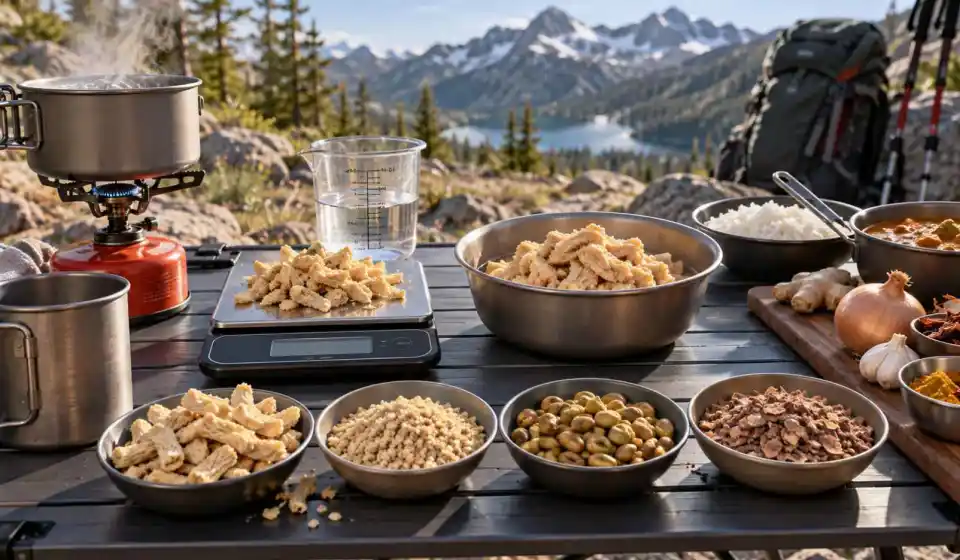
Soy curls are dried pieces made from whole soybeans rather than a protein powder shaped into strips, which helps explain their combination of protein, carbohydrate, fiber, and fat. A current Butler Soy Curls label lists approximately 120 calories, 11 grams of protein, 8 grams of carbohydrate, and 5 grams of fat per 30-gram dry serving. Those numbers describe the dry ingredient before water is added, which is the number backpackers should use when calculating food-bag weight.
Because soy curls contain soy, they are unsuitable for anyone with a soy allergy, and they should be treated as an ingredient rather than a universal hiking recommendation. The manufacturer also recommends keeping unused dry Soy Curls refrigerated or frozen for freshness at home, an important detail if someone plans to buy large quantities for future trips. ❄️ For an actual backpacking menu, portioning only what the trip requires avoids carrying unnecessary packaging and keeps meal calculations much easier.
Protein Per Ounce And Calories Per Ounce
Converting that 30-gram serving into trail-friendly numbers gives roughly 113 calories and 10.4 grams of protein per dry ounce of soy curls. That is a respectable protein-to-weight ratio, although 113 calories per ounce is not exceptionally high compared with calorie-dense backpacking foods rich in fat. 🧮 Soy curls therefore work better as a protein component inside a meal than as the ingredient responsible for maximizing the meal’s total calories per ounce.
This matters because hikers sometimes treat protein density and calorie density as if they were the same calculation, but they answer different questions. Nuts or oils may provide far more calories for the same carried weight, while an ingredient such as TVP can provide more protein relative to its dry weight. A balanced backpacking dinner can therefore combine soy curls with rice, couscous, noodles, coconut milk powder, peanuts, oil, or another calorie source instead of expecting one ingredient to solve every nutrition target.
Dry Weight Versus Hydrated Weight
A 30-gram portion of soy curls still weighs only 30 grams inside your food bag when you leave the trailhead, regardless of how heavy it becomes after soaking. 💧 The added water increases the weight and volume of the food you eventually eat, but it contributes no additional calories or protein. If that water comes from a reliable source near camp, its eventual hydrated weight is much less important than the dry weight you actually carried between resupplies.
The calculation changes when a route requires hikers to carry all of their cooking water, because the water used to rehydrate dinner is then part of total pack weight until it is consumed. This is why a dry meal can be extremely efficient on a water-rich mountain route yet provide a smaller practical weight advantage across a dry desert section. Backpacking food comparisons should therefore separate food weight, required preparation water, and water that must physically be carried rather than combining them into one vague number.
How Long Soy Curls Take To Rehydrate
Butler’s preparation instructions call for covering Soy Curls with warm water and soaking them for approximately 8 to 10 minutes, followed by draining excess water before further cooking. ⏱️ On trail, however, hikers often adapt ingredients into one-pot meals where the curls absorb seasoned liquid alongside rice, noodles, vegetables, or sauce rather than being soaked and drained separately. Actual meal time therefore depends on water temperature, piece size, altitude, cooking method, other ingredients, and the texture the hiker considers acceptable.
This also explains why comments about dried soy pieces taking much longer than minced soy products can be directionally useful without creating a universal rule. Large pieces generally have farther for water to penetrate than tiny granules, but product instructions show that the difference is not always enormous: common TVP directions often specify around 5 to 10 minutes, while Soy Curls specify roughly 8 to 10. 🔥 The practical concern is less “Will this take forever?” and more whether your chosen meal can rehydrate everything efficiently with one heating cycle.
Soy Curls Vs TVP For Backpacking
TVP is one of the strongest direct competitors because it is also dry, soy-based, versatile, and commonly used as a ground-meat substitute in chili, pasta, burrito bowls, and other trail meals. Using one current TVP label, a 23-gram serving supplies about 80 calories and 12 grams of protein, equivalent to roughly 99 calories and nearly 15 grams of protein per ounce. That gives TVP a notable protein-per-ounce advantage over the Soy Curls example, although it provides fewer calories per ounce.
Texture creates the bigger practical distinction: TVP becomes small crumbles, while soy curls remain larger, chewier pieces that can feel more substantial in curries, stir-fry-style dinners, wraps, and noodle dishes. 🍜 Neither texture is objectively better, because a hiker adding protein invisibly to chili may prefer TVP while someone building a meal around recognizable pieces may prefer curls. TVP is therefore the stronger pure protein-density tool, while soy curls offer a different eating experience for a modest weight cost.
Soy Curls Vs Dry-Roasted Edamame
Dry-roasted edamame approaches the problem from the opposite direction because it can be eaten immediately without stove fuel, soaking water, or waiting for rehydration. A representative sea-salt product provides around 130 calories and 13 grams of protein per 30 grams, which works out to approximately 123 calories and 12.3 grams of protein per ounce. 🌿 On simple pack-weight mathematics, that makes roasted edamame both more calorie-dense and slightly more protein-dense than the Soy Curls example.
But roasted edamame is primarily a crunchy snack, whereas hydrated soy curls can become the protein structure of a hot dinner, so the two ingredients do not always compete for the same job. Someone wanting a no-cook protein addition for lunch may logically choose edamame, while someone planning curry and rice may find soy curls much easier to integrate into the meal. This is a good example of why preparation requirements can matter as much as nutrition numbers when designing an actual backpacking menu.
What About Dehydrated Beans?
Dehydrated refried beans provide another useful comparison because they are lightweight, vegan, easy to season, and already familiar within backpacking meals. Depending on the product, a dry ounce may provide roughly 100 calories and around 6 grams of protein, meaning beans can compete reasonably well on calorie density while supplying considerably less protein per ounce than soy curls or TVP. 🫘 Their advantage is culinary flexibility: beans combine naturally with tortillas, instant rice, corn chips, spices, salsa powders, and other simple southwestern-style trail ingredients.
Beans also bring considerably more carbohydrate into the meal, which means comparing them with soy curls solely on protein misses their different nutritional role. A hiker may even combine dehydrated beans with TVP or soy curls instead of choosing between them, creating a meal where each ingredient contributes something different. The useful question becomes what job does this ingredient perform in the complete meal?, not which food wins a single nutrition column.
Soy Curls Backpacking Comparison Table
The numbers below are approximate examples based on specific current product labels, not universal values for every brand or flavor. Package formulations, serving weights, seasoning, and manufacturing can change, so the actual label should remain the final source for trip planning. 📊 The table is most useful for seeing how protein density, calorie density, and preparation style pull in different directions.
| Trail Protein | Approx. Calories/Oz Dry | Approx. Protein/Oz | Water Needed Before Eating? | Typical Preparation | Best Trail Role |
|---|---|---|---|---|---|
| Soy curls | ~113 | ~10.4 g | Yes | Warm soak around 8–10 min or cook in meal | Chewy hot dinners |
| TVP | ~99 | ~14.8 g | Yes | Hot-water rehydration around 5–10 min | Chili, pasta, tacos, bowls |
| Dry-roasted edamame | ~123 | ~12.3 g | No | Ready to eat | Snacks, lunches, trail mix |
| Dehydrated refried beans | ~104 | ~6 g | Yes | Add hot water; product-dependent | Burritos, rice bowls, dips |
No row wins every category, which is precisely why a decision table is more useful than declaring one “best vegan backpacking protein.” TVP stands out when protein per ounce dominates the decision, roasted edamame stands out when eliminating cooking is important, and dehydrated beans work naturally as a carbohydrate-plus-protein meal base. Soy curls occupy the middle, providing respectable dry-weight nutrition while offering a larger texture that the alternatives do not reproduce.
When Soy Curls Make The Most Sense
Soy curls make the strongest case when a backpacker wants recognizable, chewy plant protein in a hot meal and already plans to boil water for rice, noodles, couscous, curry, or another dinner component. 🍛 In that situation, the rehydration process can overlap with the rest of dinner rather than becoming an entirely separate camp chore. Their approximately 113 calories per ounce also leave room to raise total meal calorie density with oils, nuts, powdered coconut milk, or another energy-dense ingredient.
They make less sense when no-cook simplicity is the goal, maximum protein per ounce matters more than texture, or water and stove fuel are tightly constrained. A no-cook hiker may prefer roasted edamame, while someone trying to add the most protein possible to a small dry portion may find TVP more efficient. Soy curls are therefore not the backpacking protein winner—they are a useful tool when their texture and meal function justify the extra preparation.
The Better Way To Build A Soy Curl Trail Meal
Instead of packing a large serving of soy curls and calling it dinner, start with the dry protein portion and then design the meal around the calorie target you actually need. Add a quick carbohydrate such as instant rice or couscous, a concentrated calorie ingredient such as coconut milk powder or oil, dry vegetables for variety, and enough seasoning to flavor the water being absorbed. 🥘 This approach prevents a common trail-food mistake: choosing an ingredient because it sounds protein-rich while forgetting that the entire meal still needs sufficient calories.
Testing the meal at home is especially useful because it reveals exactly how much water, soaking time, and seasoning your preferred portion requires before those variables matter miles from the trailhead. Weigh every ingredient dry, record the complete meal calories and protein, then calculate the final calories per ounce and protein per ounce of the whole meal, not just the soy curls. That turns soy curls from an interesting vegan ingredient into something far more useful: a measurable component inside a deliberately designed backpacking menu.